Abhayagiri moonstone
Often called the island's finest.
Nicolas Chadeville — CC BY 4.0 · Nicolas Chadeville — CC BY 4.0 · Wishva Dilshan — CC BY-SA 4.0 · Cherubino — CC BY-SA 3.0 · Weldon Kennedy from London, UK — CC BY 2.0
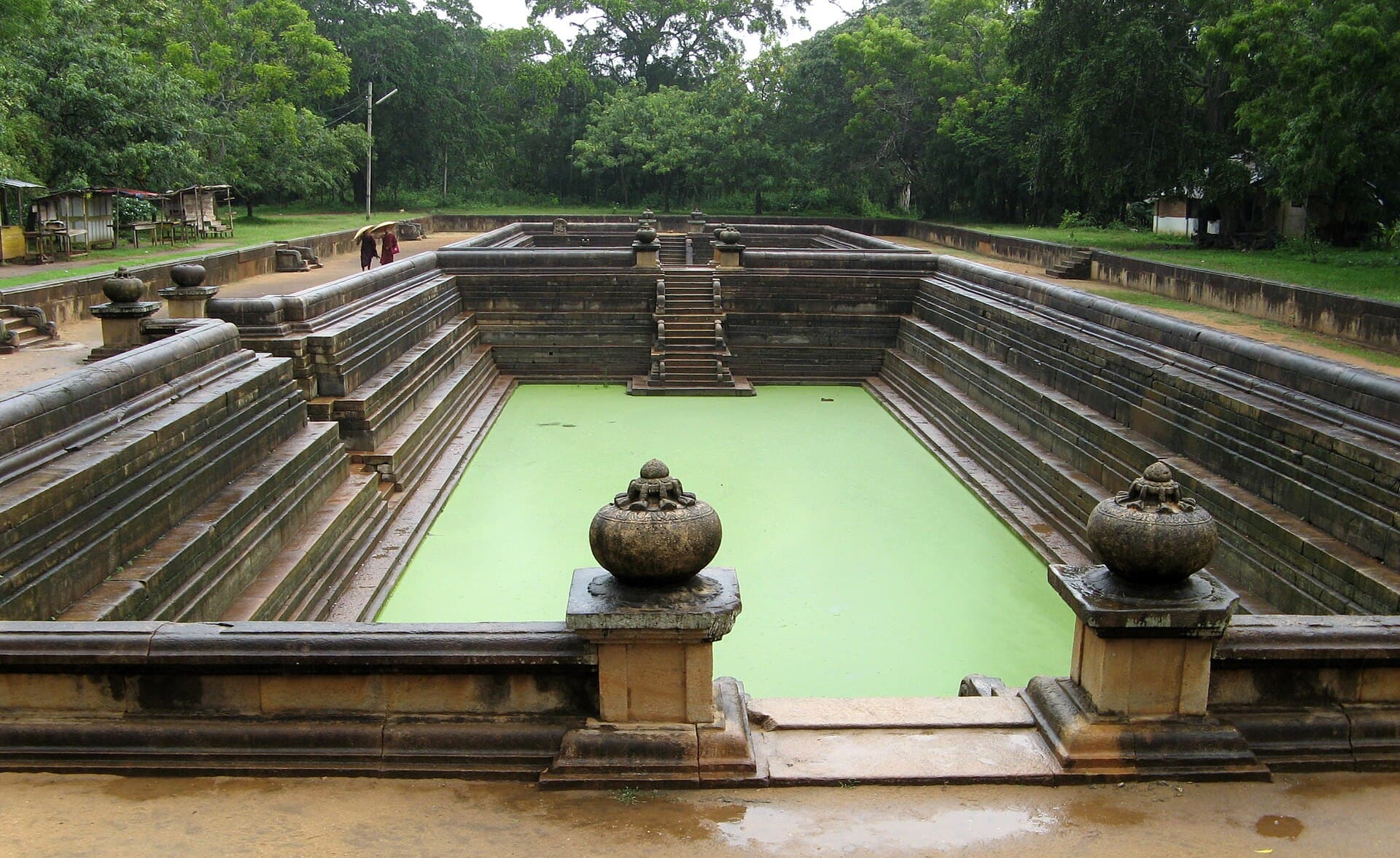
Abhayagiri Vihara was the great northern monastery of Anuradhapura, Sri Lanka's first capital, and the largest of its five major monasteries. Its ruins spread through the north of the Sacred City, a UNESCO World Heritage Site, around a brick stupa about 75 metres high whose long restoration ended in 2015. Chronicles credit King Valagamba (Vattagamani Abhaya) with founding it in the 1st century BCE; tradition says the name joins his own with that of Giri, a Jain ascetic who lived here. Open to Mahayana and Theravada teaching, it rivalled the older Mahavihara and hosted the yearly festival of the Tooth Relic, which arrived in the 4th century. Faxian, the Chinese pilgrim who studied here in the early 5th century, recorded five thousand monks. Parakramabahu I's 12th-century reform ended its order, and jungle hid the ruins until the 1880s. The moonstone at the so-called Mahasena's Palace is often called the island's finest: rings of flames, animals, a creeper and geese circle a lotus, read by the archaeologist Senarath Paranavitana as the cycle of rebirth. Look too for the Ratnaprasada guardstone with its Naga king, the Eth Pokuna reservoir, about 160 metres long, the seated Samadhi Statue and the Abhayagiri Museum. Kuttam Pokuna (Twin Ponds) has its own page. Ruwanwelisaya and Jetavanaramaya lie about 2.3 km south of the stupa and Mihintale some 13 km east, as the crow flies. Get around by bicycle or tuk-tuk and allow two to three hours. Cover shoulders and knees, remove shoes and hats at shrines, and never pose with your back to a statue of the Buddha.
Often called the island's finest.
A Naga king carved in stone.
A monks' reservoir about 160 m long.
Abhayagiri complex, northern Sacred City, Anuradhapura
At the Central Cultural Fund's counters around the ancient city, including one at the Abhayagiri Museum, or online through the fund's eTicket system.
Opened in 1992 with Chinese funding in honour of Faxian and the monastery's first head, it shows finds from the site: gold and silver jewellery, statues, Chinese porcelain, coins, beads and inscriptions.