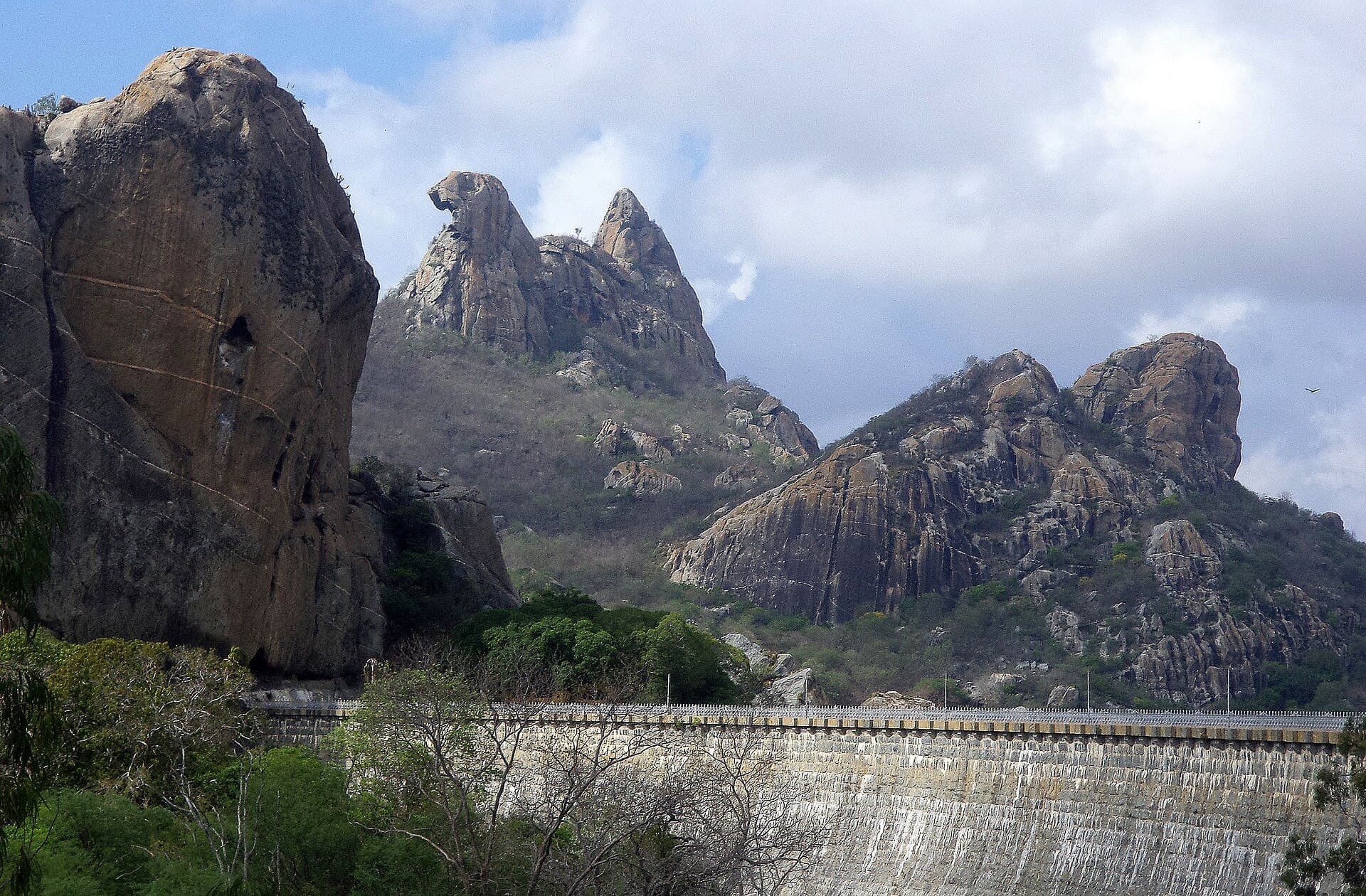
Dam wall
Stone arch.
GLandovsky — CC BY-SA 4.0 · GLandovsky — CC BY-SA 4.0 · GLandovsky — CC BY-SA 4.0 · MACÍLIO GOMES — CC BY 3.0 · GLandovsky — CC BY-SA 4.0 · Anderps — CC BY-SA 3.0 · Otávio Nogueira from Fortaleza, BR — CC BY 2.0
The Cedro Dam is a reservoir in Quixadá, in the dry backlands of Ceará, regarded as Brazil's first large dam, a landmark in the fight against drought in the semi-arid Northeast and one of the first great hydraulic works of its kind in South America. The idea followed the severe drought of 1877 to 1879, when Emperor Pedro II set up a commission to tackle it and a dam on the Sitiá River was proposed. The British engineer Jules Jean Revy was hired in 1882; work stopped after the republic was proclaimed in 1889, resumed officially on 15 November 1890 under Ulrico Mursa, and was finished in 1906 under Bernardo Piquet Carneiro. The reservoir holds 125 million cubic metres behind a masonry arch wall, and the iron parapet on its crest was made by a Scottish firm in 1906. It sits at the foot of the Brooding Hen Rock and was placed on the World Heritage tentative list in 2015.
Stone arch.
Scottish, 1906.
Above the dam.
Quixadá, Ceará backlands
It was Brazil's first large dam and began planned drought relief in the Northeast.