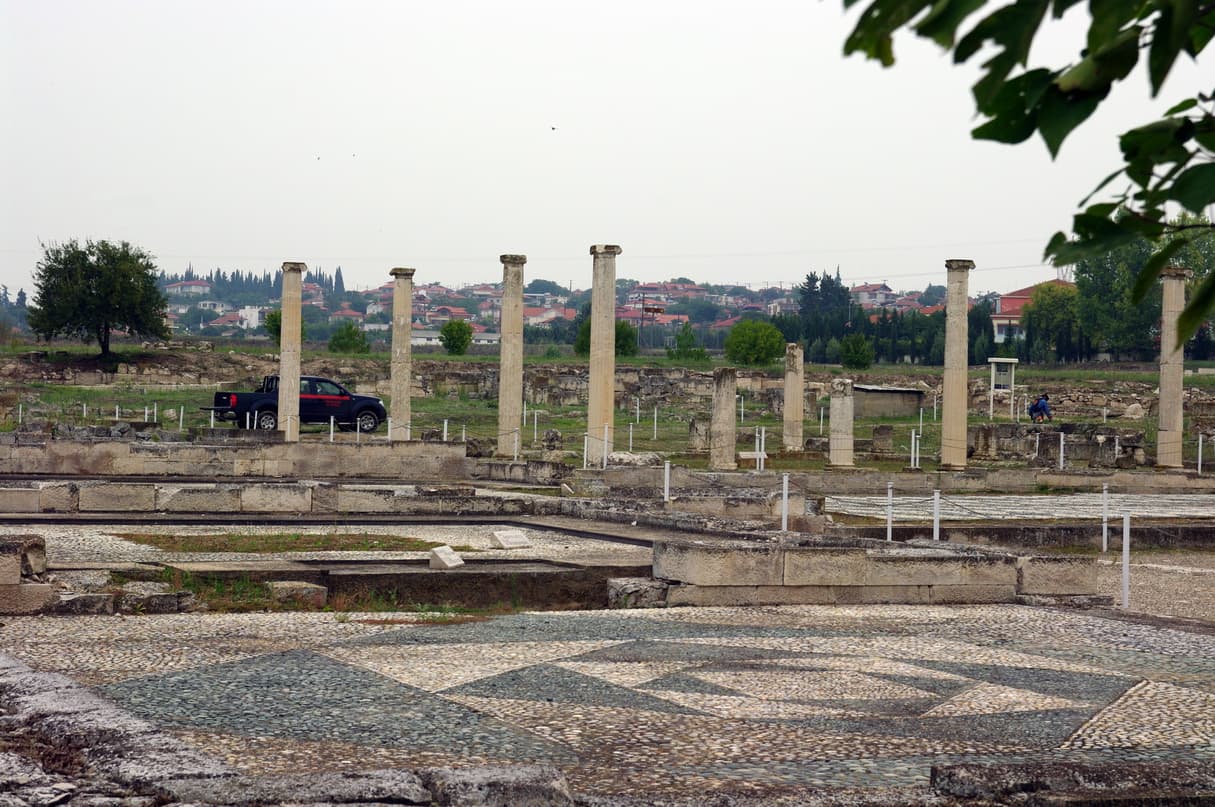
Pebble mosaic
Naturally coloured river pebbles rather than cut cubes — a harder technique.
Joyofmuseums — CC BY-SA 4.0 · Holger Uwe Schmitt — CC BY-SA 4.0 · Holger Uwe Schmitt — CC BY-SA 4.0 · Holger Uwe Schmitt — CC BY-SA 4.0
A modern museum beside the archaeological site of Pella, the capital of the kingdom of Macedon and the birthplace of Alexander the Great. Pella was the capital of Philip II and then of his son Alexander, and from it set out the campaign that changed the eastern Mediterranean and Asia. The city was wealthy and laid out on a regular grid, with palaces and large houses of the rich. The museum's most famous holdings are the mosaic floors lifted from those houses, among the masterpieces of Greek art: scenes of a deer hunt, a lion hunt and the abduction of Helen, executed in naturally coloured river pebbles rather than cut cubes — an older and harder technique, rendering muscle and movement with astonishing three-dimensionality. Beside them are displays of daily life, graves, weapons and sculpture, in a modern arrangement with good English labelling. The ticket covers the adjacent archaeological site, which is extensive and involves walking in the sun. A day trip from Thessaloniki, usually combined with Vergina.
Naturally coloured river pebbles rather than cut cubes — a harder technique.
The best-known scene, its muscle and movement astonishing for its age.
Pella was laid out on regular streets as a model Hellenistic city.
Pella, about forty kilometres west of Thessaloniki
Both lie west of Thessaloniki about forty kilometres apart, and a car is far easier than buses because the connection between them is indirect. The usual order is Pella in the morning while the site is cooler, then Vergina in the afternoon since its museum is underground and air-conditioned. Allow a full eight hours including travel. Organised tours covering both leave Thessaloniki daily in season.
Vergina is the site of Aigai, the older Macedonian capital and the burial place of its kings. Unlooted royal tombs were found there in 1977, one of them probably the tomb of Philip II, Alexander's father. What was found — a gold oak-leaf wreath, a gold burial casket bearing the Macedonian star, armour and furniture — is displayed in a museum built beneath the mound itself, among the most powerful museum experiences in Greece. It is on the World Heritage list.