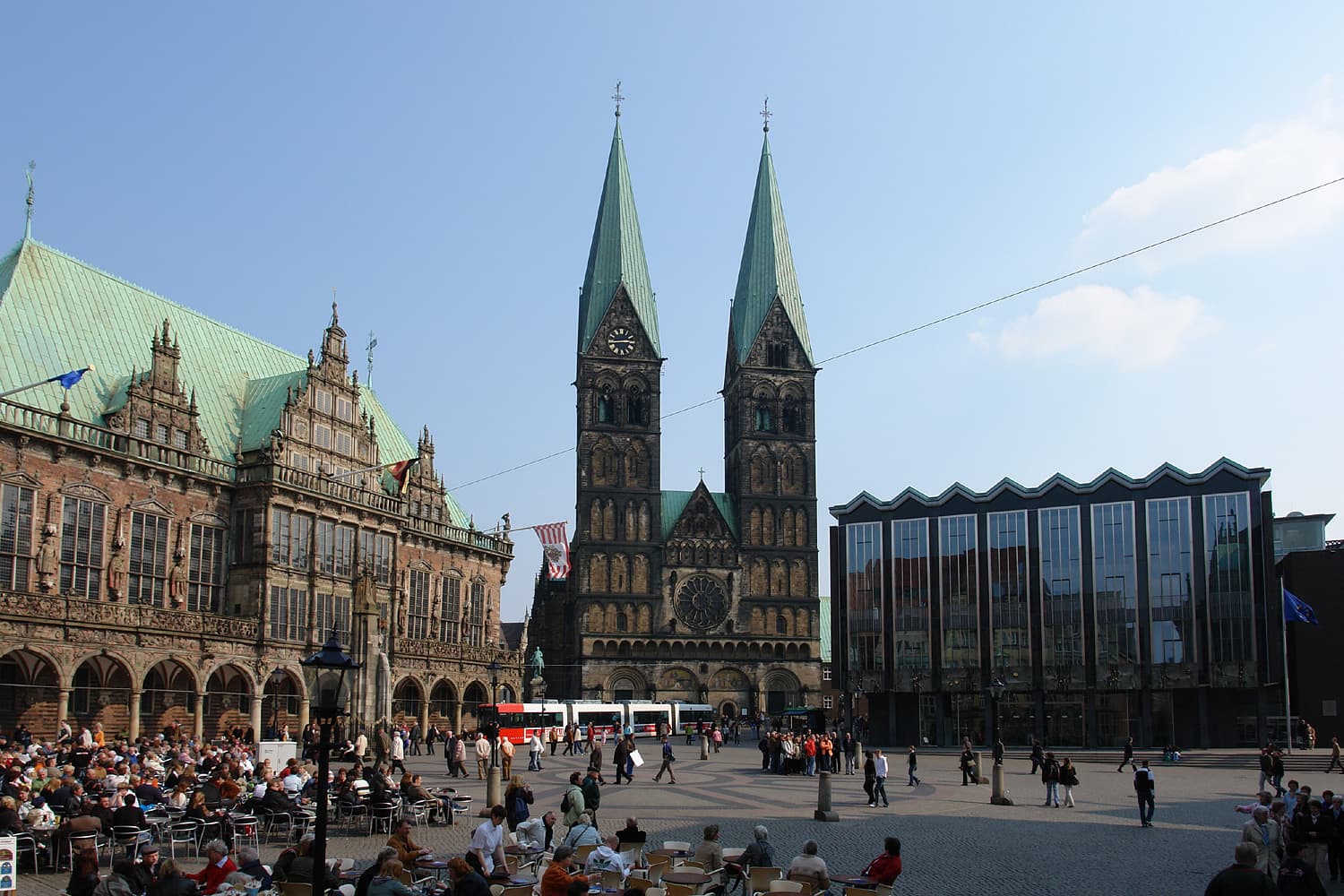
Facing the cathedral
The orientation is said to be deliberate: the city confronting church authority.
Jürgen Howaldt — CC BY-SA 2.0 de · Rami Tarawneh — CC BY-SA 2.5 · CEphoto, Uwe Aranas — CC BY-SA 3.0 · Tim Rademacher — CC BY-SA 4.0
A stone figure about ten metres high in Bremen's market square, raised in 1404, and inscribed on the UNESCO World Heritage list together with the town hall. It represents Roland, one of Charlemagne's knights in the French epic, standing with his shield and a raised sword. But its meaning is political rather than literary: Roland statues were set up in northern German towns as a physical declaration of town rights — freedom of trade, independent justice, and no subjection to the local bishop or prince. The detail always told: the statue faces the cathedral directly, and this is said to be deliberate — the city confronting the authority of the church. This stone figure replaced an earlier wooden one burned by the archbishop's men, which explains why stone was chosen. A local belief attaches to it: as long as Roland stands, Bremen stays free. A spare copy of his head was kept in reserve. It is free to see in the square at any time.
The orientation is said to be deliberate: the city confronting church authority.
Roland statues symbolised trading freedom and independent justice in northern towns.
A copy of his head was kept in reserve — the belief being that his standing keeps the city free.
The Market Square, central Bremen
Legal privileges granted by emperors or rulers to towns in the Middle Ages: the right to hold a market, mint coin, hold their own courts, fortify themselves, and govern through a council of merchants. The free cities of northern Germany acquired these rights over centuries of negotiation, purchase and conflict with bishops and princes, and Roland statues were a permanent reminder of them in the middle of the square.
Yes, but not by chance. Bremen was heavily bombed in the Second World War and most of its centre destroyed, but protective casings of brick and sand were built around the statue and the town hall before the raids, a measure taken in several German cities to protect the most important monuments. That is what saved them while what surrounded them was lost.