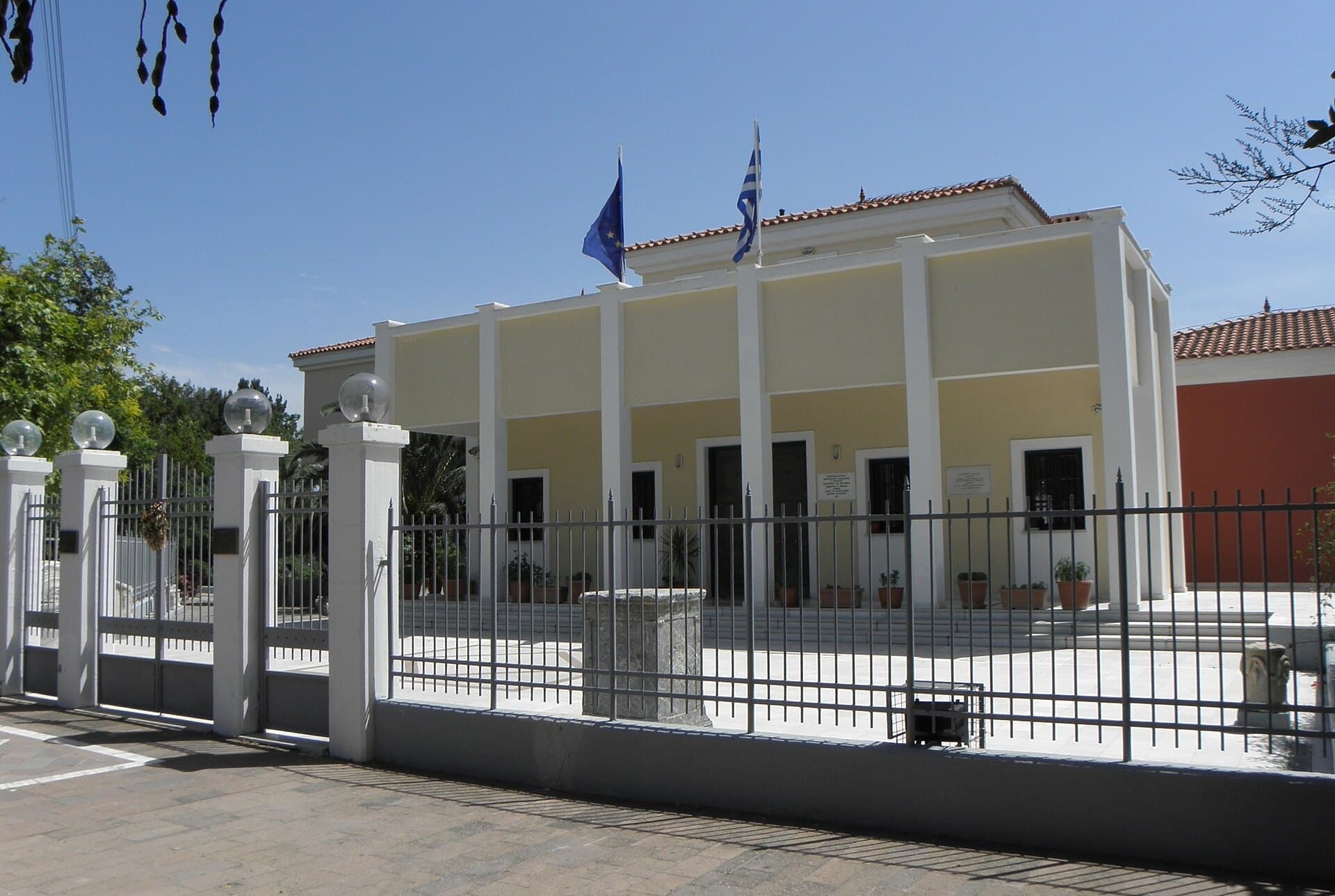
The Ottoman school
An Ottoman teaching building standing inside the walls.
Katsiaryna Naliuka — CC BY-SA 3.0 · ProtecTOR — CC BY-SA 4.0 · ProtecTOR — CC BY-SA 4.0 · ProtecTOR — CC BY-SA 4.0
**One of the largest castles in the Mediterranean, on a wooded hill above the capital of Lesbos** — covering over sixty thousand square metres. It was built on a **Byzantine** core in the 6th century, **then rebuilt by the Genoese** **Gattilusi** family in the 14th century when they ruled the island, **then greatly extended by the Ottomans** after 1462, who added to it. ⚠ **So it is three castles in one**: interleaved walls from three periods, and inside them an **Ottoman school**, a **bath**, a **powder magazine**, the **remains of a mosque**, and the foundations of an ancient temple whose stone was reused. ✅ The hill is **covered in pines** — so the visit is shaded, which is rare. ⚠ But the site is **vast, poorly explained** and neglected in parts.
An Ottoman teaching building standing inside the walls.
Genoese coats of arms cut into 14th-century stone.
Mytilene, its port and the Turkish coast from the upper walls.
Mytilene, 81100 Lesbos, Greece
**A Genoese family who ruled Lesbos for a century — having received it as a dowry.** ✅ **The story**: in **1355**, **Francesco Gattilusio**, a Genoese noble and naval adventurer, helped the Byzantine emperor **John V Palaiologos** regain his throne. **The emperor rewarded him with his sister in marriage and the island of Lesbos as a fief** — among the stranger transactions in Aegean history. ✅ **The rule**: the Gattilusi held Lesbos **from 1355 to 1462** — over a century — **governing it as a semi-independent entity** between Byzantium, Genoa and the Ottomans, with their reach extending to **Thasos, Samothrace and Ainos**. ✅ **What they left**: **they rebuilt this castle** almost entirely, and their arms — a double eagle and the family device — **are still carved into its stone**. ✅ **They minted their own coinage** and ran the alum and mastic trades. ⚠ **The end**: the island fell to the Ottomans in **1462** after a siege, **and the family ended**. ✅ **They are essential** to understanding why Lesbos looks Latin, Byzantine and Ottoman all at once.