Colourful facade
Folk-art majolica.
Mister No — CC BY 3.0 · Surayana1989 — CC BY-SA 3.0 · Mister No — CC BY 3.0 · Szilas — CC BY 4.0 · Bocskai László — CC BY 3.0
The Cifrapalota, the Ornamented Palace, is an Art Nouveau building in the centre of Kecskemét in south-central Hungary, on the corner of Rákóczi út and Szabadság tér, the main square. Since 1983 it has been the main exhibition venue of the city's Katona József Museum. The architect Géza Márkus designed it in 1902, and it was built in 1903 as a town-owned apartment building with shops, flats and a casino club. Márkus followed the approach of Ödön Lechner in shaping a national Hungarian style drawn from folk art. Its most striking features are the coloured majolica ornaments on the facades, dominated by folk-art motifs, the wavy line that finishes the two-storey frontage, and a tall roof covered in coloured tiles. The glazed facade decorations and roof tiles were made by the Zsolnay factory in Pécs. Inside, a ceremonial hall has walls and ceiling decorated in plaster with peacocks and flowing ornament. Visitors admire the colourful facades from the square, then go inside for exhibitions of 19th- and 20th-century Hungarian art, temporary shows and the ceremonial hall. It stands in the heart of the city near the town hall, so the two are easy to see together.
Folk-art majolica.
Plaster peacocks.
Coloured tiles.
Corner of Rákóczi út and Szabadság tér, Kecskemét, Hungary
Exhibitions of the Katona József Museum.
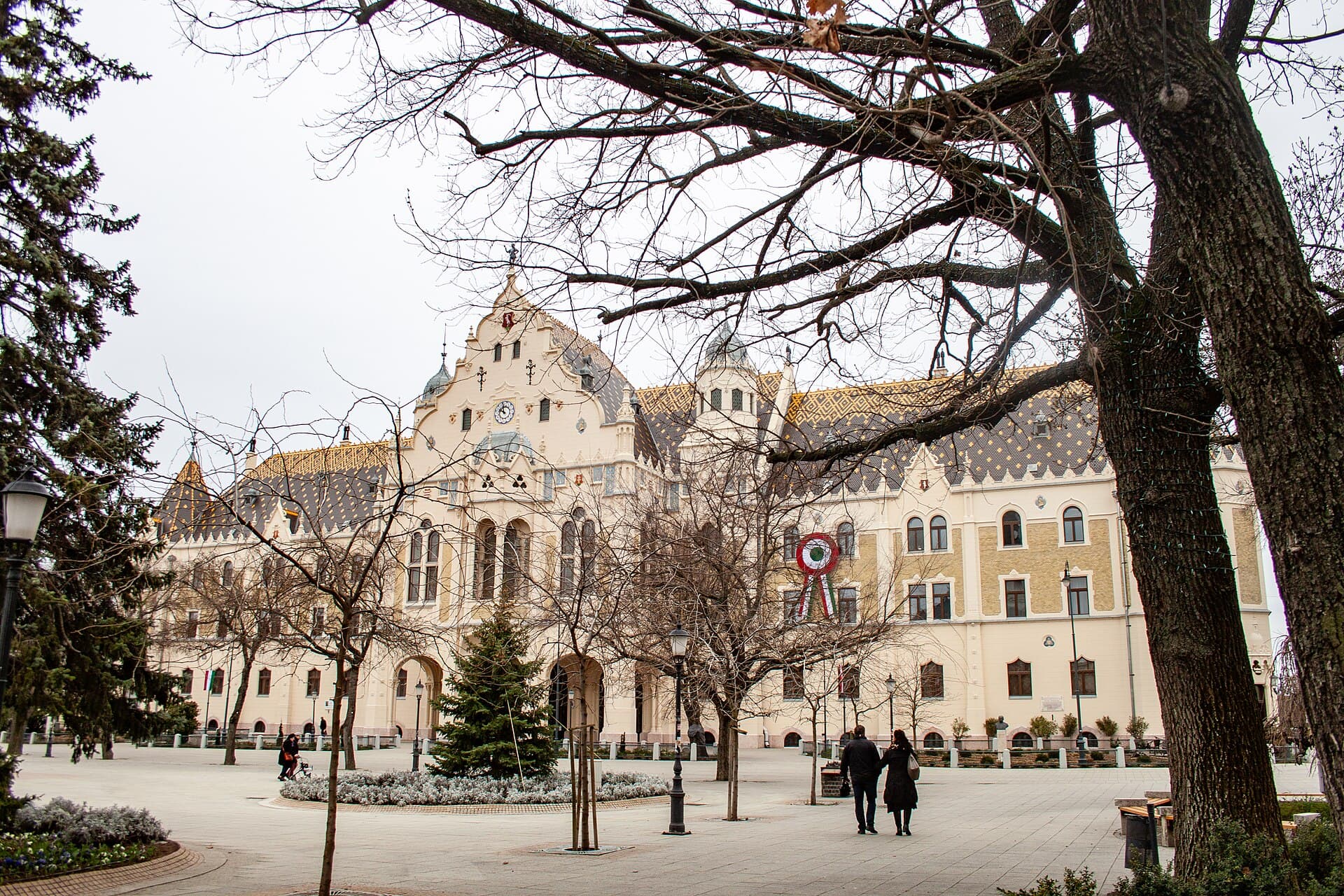
The town hall on the same square.