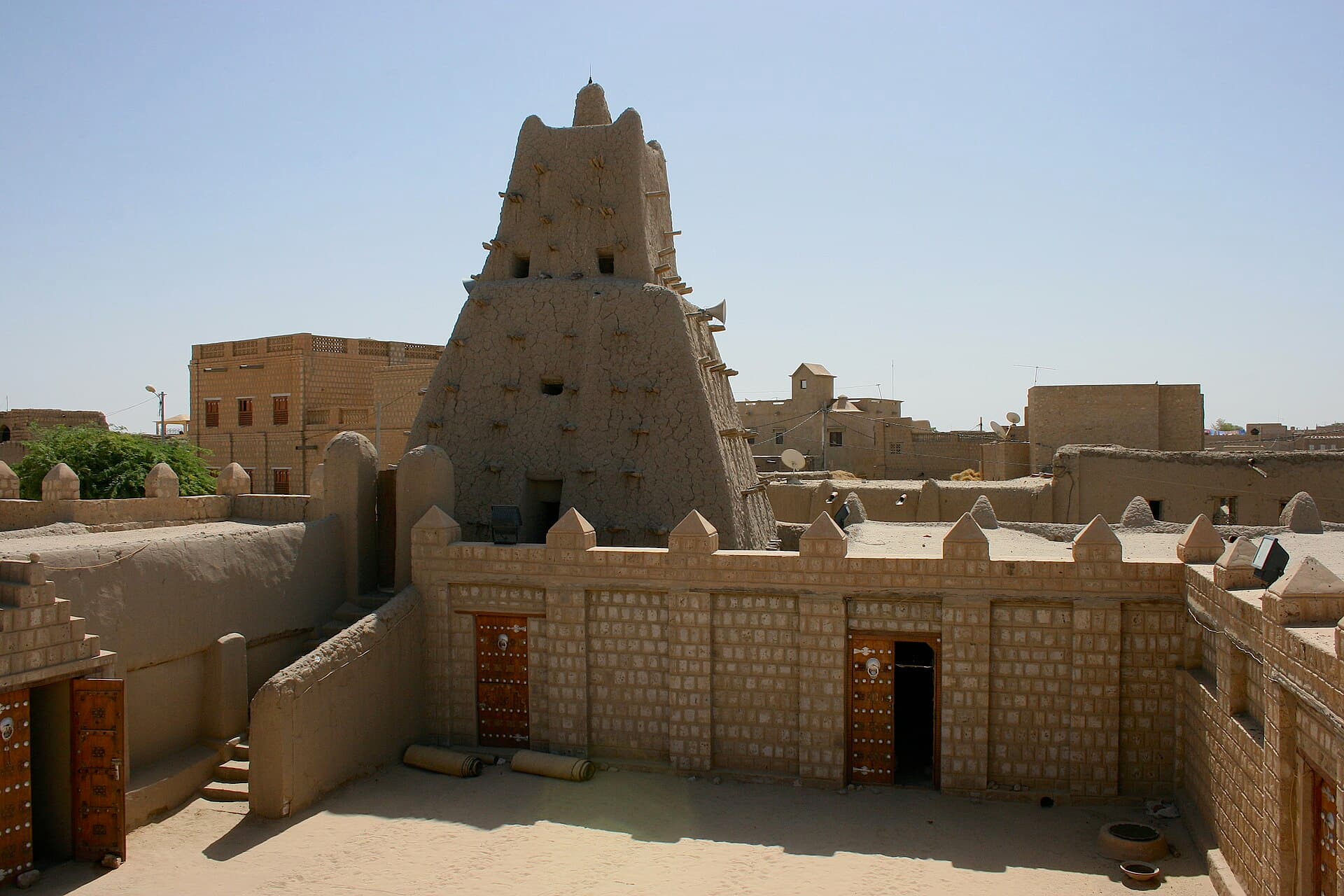
The minaret
Jutting beams.
Ousmane Garba Kounta — CC BY-SA 4.0 · Angeline A. van Achterberg — CC BY-SA 4.0 · Angeline A. van Achterberg — CC BY-SA 4.0 · upyernoz — CC BY 2.0 · Angeline A. van Achterberg — CC BY-SA 4.0
The Djinguereber Mosque is a famous earthen mosque in Timbuktu and a historic centre of learning. Its name means «great mosque» in Koyra Chiini. It is one of three mosques linked to the community of scholars and students known today as the University of Timbuktu. UNESCO listed it as a World Heritage Site in 1988. It was built in 1327, and tradition credits its design to the Andalusi scholar Abu Ishaq al-Sahili, who Ibn Khaldun says received 12,000 mithqals of gold. Recent studies argue its style comes mainly from Saharan mosques and traditional African architecture. It is still used for prayer today. You see a long sand-coloured earthen wall topped with serrated decoration, with sloping buttresses and wooden beams jutting out. At one end rises a conical minaret bristling with beams. Wide sandy streets and low mud houses surround it. From afar the mosque looks like a single stepped mass. The Sankore Mosque is about 700 metres away in a straight line. Non-Muslims usually view it from outside. The UK Foreign Office currently advises against all travel to the whole of Mali, so read the current advice before any planning.
Jutting beams.
Serrated tops.
Around the mosque.
Timbuktu, Mali
Tradition credits al-Sahili, while scholars see a Saharan African style.
Yes, the UK Foreign Office advises against all travel to the whole of Mali.