Virgin mosaic
12th-century gold.
Martijn Munneke from Netherlands — CC BY 2.0 · Herbert Frank from Wien (Vienna), AT — CC BY 2.0 · Jaba1977 — CC BY-SA 4.0 · Dmitry Torbins — CC BY 2.0 · Roberto Strauss from Frankfurt am Main, Deutschland — CC BY-SA 2.0 · Herbert Frank from Wien (Vienna), AT — CC BY 2.0 · Giakosh — CC BY-SA 4.0 · Unknown; photographed by the National Archives of Georgia expedition team in 2015. — Public domain
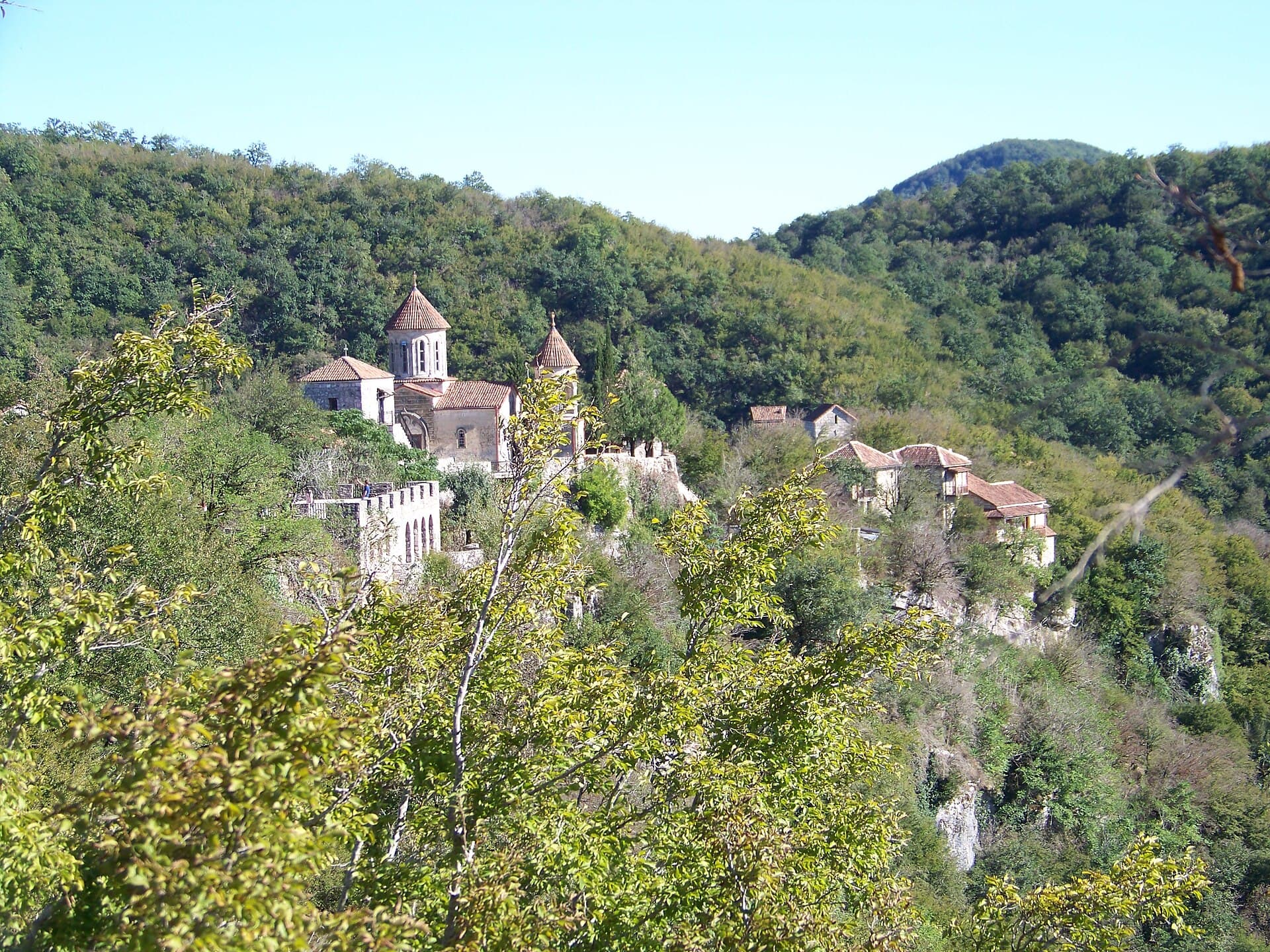
A medieval monastic complex on a hill above the Tskaltsitela gorge, a few kilometres north-east of Kutaisi, founded by King David IV the Builder in 1106 as a monastery and centre of learning, when Kutaisi was Georgia's capital. A symbol of the Georgian Golden Age, it has been a UNESCO World Heritage Site since 1994. The monastery was an academy of science and philosophy, where the king gathered scholars, philosophers and theologians; contemporaries called it «a new Hellas» and «a second Athos». Its main church, the Church of the Virgin, was completed in 1130 under Demetrius I, alongside two smaller thirteenth-century churches and a bell tower. The greatest treasure inside is a twelfth-century mosaic in the apse showing the Virgin holding the Child against a shining gold background, along with colourful frescoes of Georgia's kings and saints. King David the Builder lies buried at the monastery's entrance, and near his grave hangs an ancient iron gate that his son brought back as a trophy from Ganja in 1138. Entry is free, so just dress modestly. The monastery is about twenty minutes by car from Kutaisi and usually visited together with nearby Motsameta; restoration work may cover parts of it at times.
12th-century gold.
Georgia's kings.
At the entrance.
Hilltop above the Tskaltsitela gorge, a few kilometres north-east of Kutaisi
Take a taxi from Kutaisi, about twenty minutes to Gelati, then on to nearby Motsameta; the whole trip takes about half a day.