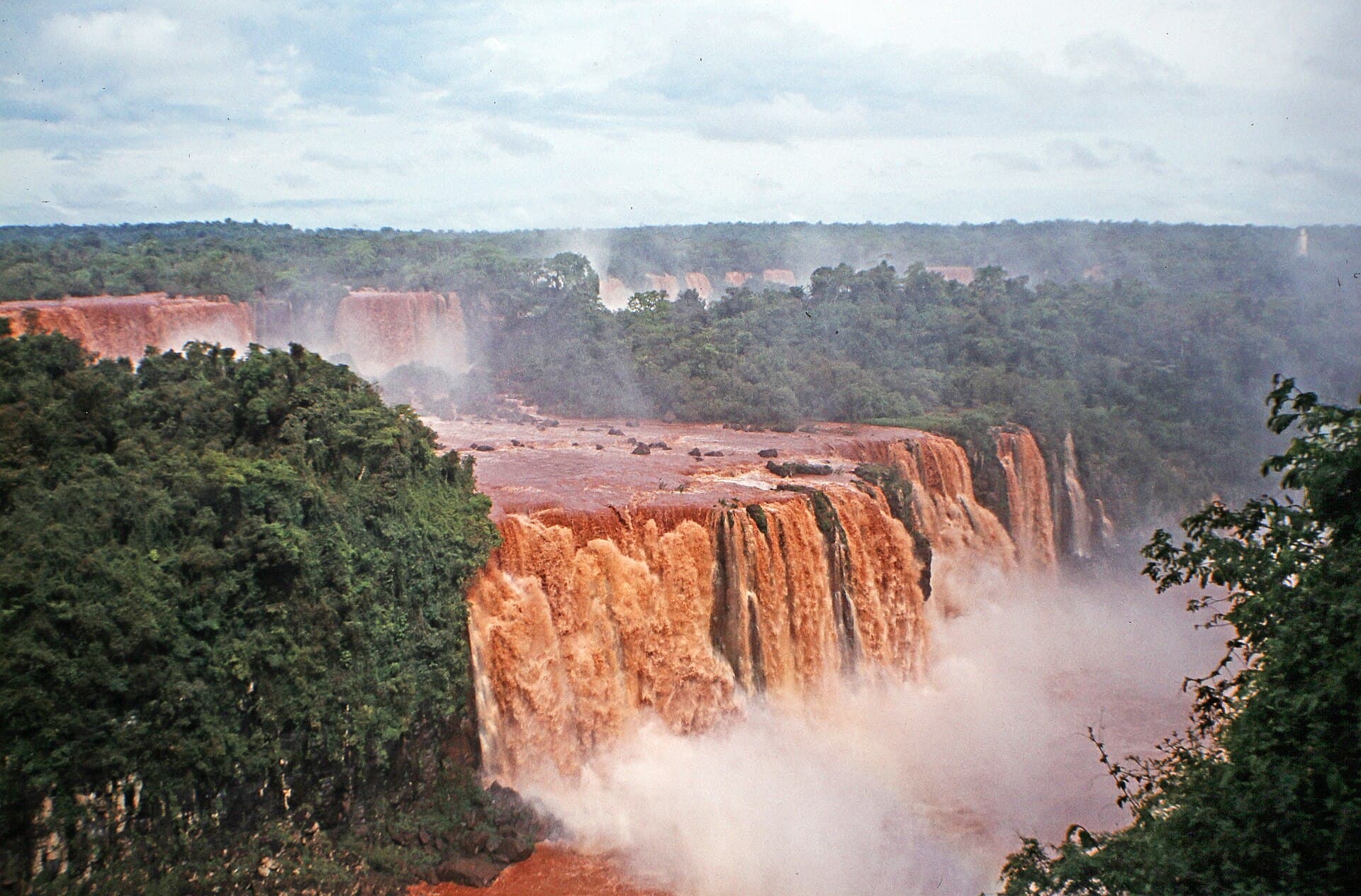
The Devil's Throat
The walkway to the chasm's edge.
Mariordo (Mario Roberto Durán Ortiz) — CC BY-SA 4.0 · Leandro Kibisz — CC BY-SA 3.0 · Marinelson Almeida - Traveling through Brazil from Niteroi, Brasil — CC BY 2.0 · Marinelson Almeida - Traveling through Brazil from Niteroi, Brasil — CC BY 2.0
Most of the Iguazú Falls lie on the Argentine side, so where the Brazilian side gives the panorama, the Argentine side takes you into the heart of the falls. Iguazú National Park was created in 1934 to protect the falls and the subtropical forest around them, and UNESCO listed it as a World Heritage Site in 1984; the name is Guarani for big water. Three main walkway circuits run through the park: the upper circuit follows the brink, with the water dropping away beneath your feet, and the lower circuit winds down through the forest to the foot of the falls and into the spray. The best known is the Devil's Throat walkway: the Rainforest Ecological Train carries visitors to its station, then a walkway runs about a kilometre over the calm upper river to the edge of the chasm where roughly half the river falls, in a roar of noise and thick mist. Give the Argentine side a full day, and take the Devil's Throat train first thing in the morning, before the crowds. Bring a rain jacket and a phone cover, and do not feed the coatis. Boat trips to the foot of the falls cost extra.
The walkway to the chasm's edge.
Along the brink.
To the Devil's Throat.
Iguazú National Park, about 18 km from Puerto Iguazú
A full day for the Argentine side and its three circuits, and half a day for the Brazilian side; the border between them can be crossed the same day with a passport.