The round towers
A sand-coloured front.
Petar Milošević — CC BY-SA 4.0 · Adam Harangozó — CC BY-SA 4.0 · Adam Harangozó — CC BY-SA 4.0 · VASHGIRD — CC BY 4.0 · Petar Milošević — CC BY-SA 4.0
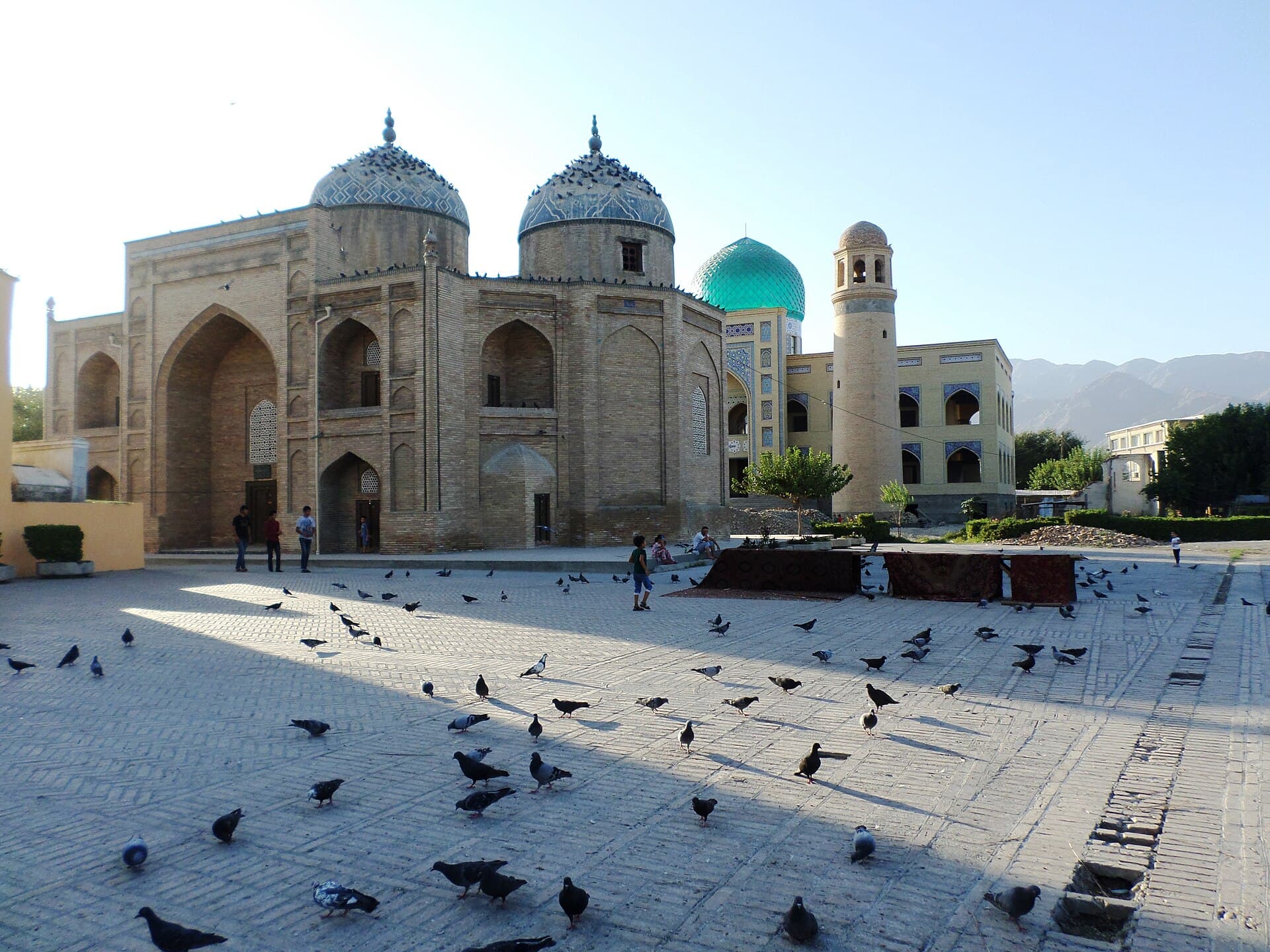
Khujand Fortress is an ancient site in the heart of Khujand, Tajikistan's second city and the capital of Sughd Region. Sources say it was built over 2,500 years ago and went through cycles of destruction and renovation. Today it holds the Historical Museum of Sughd in a building with round towers, along with remains of old earthen walls behind it, near the Syr Darya. Khujand is among the oldest cities in Central Asia, going back about 2,500 years, and it was a major Silk Road city at the mouth of the Fergana Valley. Alexander the Great captured it in 329 BC and founded Alexandria Eschate nearby. In the early 8th century it was taken by Umayyad forces under Qutayba ibn Muslim, and Islam then spread here. You see a broad sand-coloured front with round towers and battlements, the national flag above and brown mountains behind. Behind the museum runs a sloping earth wall with timber beams jutting from it, along with worn old masses of mud brick. In the yard stands a pavilion whose carved wooden ceiling is finely patterned, near buildings with painted ceilings and old wooden carts on show. The Sheikh Muslihiddin Mausoleum is about 1.5 km away in a straight line, with Panjshanbe Bazaar beside it. Museum opening days vary, so check before you come, and ask about photos inside. The yard is exposed and hot at midday in summer. After a visit you can walk along the nearby bank of the Syr Darya.
A sand-coloured front.
Worn earth and beams.
Finely carved wood.
Central Khujand, near the Syr Darya, Tajikistan
The museum is a modern build on an ancient site, and the earth walls behind it are the oldest remains.
He captured it in 329 BC and founded Alexandria Eschate nearby.