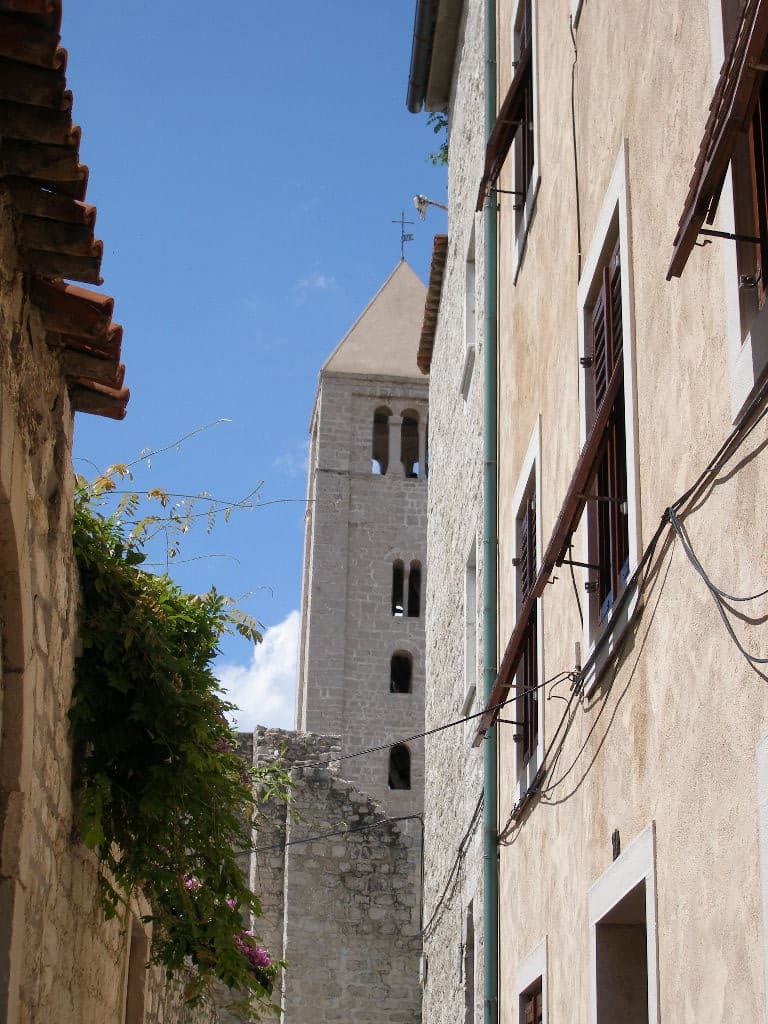
The tower angle
The best view of the town''s four towers from the north.
A forest park falling from the edge of the old town to the sea, and **the work of one man** on ground that had been entirely bare. At the start of the twentieth century this slope was **naked rock**, stripped by the bora like the rest of the island''s north-eastern side. **Pravdoje Belia**, the municipality''s forestry manager, began a planting programme in **1900** that ran for decades: **Aleppo pine** first, to hold the soil, then cypress, oak and other Mediterranean species beneath them. The result is about **ten hectares** of dense woodland with paths, steps and benches, dropping to the rocky shore. That project is also what made Rab town viable as a resort: the forest breaks the wind, moderates the heat and gives shade that had not existed. Note: **the park is free and always open**, and gives the best angles on the town''s four towers from the north. Note: the paths slope and are stepped in places.
The best view of the town''s four towers from the north.
Falling from the old town''s edge to the rocky shore.
Non-existent before 1900 — the whole wood is planted.
North of the old town, Rab town
**The bora** is the answer. The island is split by a sharp line: the **north-eastern** side faces the Velebit channel directly, and the bora falls on it violently off the mountains opposite, drying everything and sweeping the soil into the sea — so nothing grows there but scattered grass on naked rock. The **south-western** side is sheltered from that wind by the island''s own bulk, so soil accumulated and dense pine and oak woods grew, among them the protected **Dundo** forest. ⚠ The difference is **visible from the air** and perfectly clear from the ferry. ⚠ Komrčar Park is an example of **fighting that with planting**: it was bare rock and became forest, and that is what made the town viable for tourism at all.