The climbing lanes
Narrow white alleys with blue doors, too tight for a car.
Gerd A.T. Müller — CC BY-SA 3.0 · Deror_avi — CC BY-SA 3.0 · Deror_avi — CC BY-SA 3.0 · Deror_avi — CC BY-SA 3.0
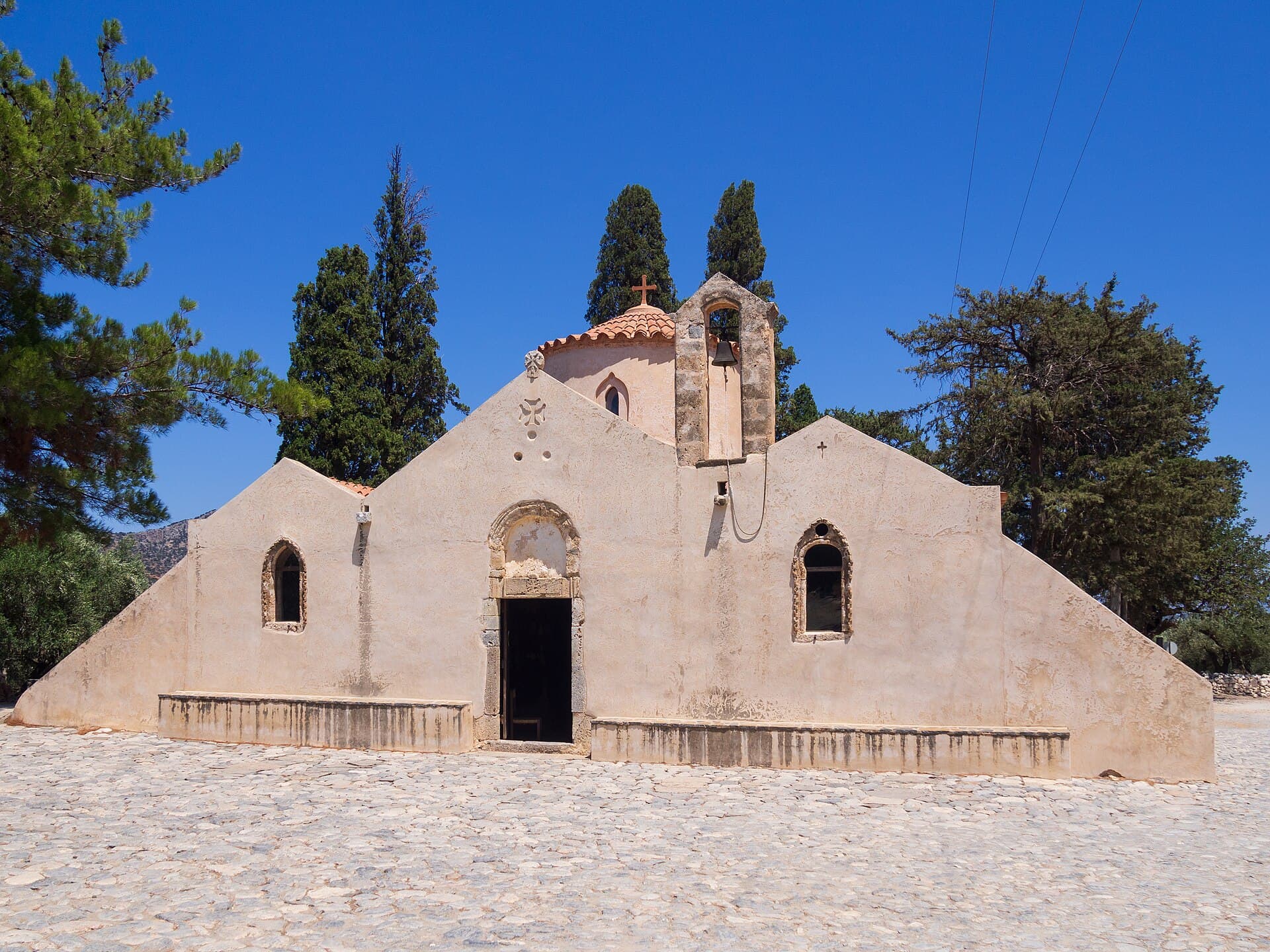
**A white hill village hung on a slope, ten kilometres from Agios Nikolaos** — and one of the largest traditional villages in Crete. It is built on a steep flank above the olive plain, its lanes **very narrow and climbing**, winding between white houses with blue doors, too tight for a car — which is what preserved its shape. It is a known centre of **hand-weaving**: village women sit outside their houses with cloths, blankets and embroidered pieces, and you buy directly from the maker. ⚠ But be aware — **not everything on show is local**; some is imported. From the village a road climbs to **Lato**, an ancient Dorian city on a saddle between two peaks, with foundations, stepped streets and a view reaching the Gulf of Mirabello — and **almost no visitors**. ✅ The best-known thing nearby is the frescoed church of **Panagia Kera**, one kilometre away. ✅ And the cafés on the square charge village prices, not coast prices.
Narrow white alleys with blue doors, too tight for a car.
Women showing cloths and blankets outside their houses.
Dorian foundations and stepped streets on a saddle between peaks.
Kritsa, 72100 Lasithi, Crete
**Yes if you like empty sites; no if you want explained ruins.** ⚠ **What you will find**: **stone foundations**, stepped streets, remains of a wall, an agora and a temple — no standing buildings, no columns, no museum, and **very few interpretive panels**. Anyone arriving expecting Knossos, or even Gournia, will wonder what they are looking at. ✅ **What earns it**: **the site itself**. Lato is a **Dorian** city — from the era after the Minoan collapse — deliberately built on a **saddle between two peaks** for defence, and the view from up there runs across the whole olive plain to the **Gulf of Mirabello** and the sea. ✅ **And above all**: **you may be completely alone**. Walking a street of a 2,500-year-old city without seeing another person does not happen at any well-known Cretan site. ⚠ **On condition**: in the morning, with water, and in a small car.
**Three checks, and the first is asking directly.** ✅ **Ask**: "did you make this yourself?" — a real maker answers with pride and explains the stitch, and many will point to the work in their hands. ✅ **Look for production**: someone sitting with **a loom, a needle or a piece in progress** is a reliable source; someone with twenty identical folded pieces on a table and no sign of work may be a reseller rather than a maker. ✅ **Look at the variation**: a handmade piece is **not perfectly uniform** — the stitches differ slightly, the edges are not perfect, and colours vary between pieces. **Perfect uniformity means machine production.** ⚠ **Do not assume bad faith**: many sellers stock local and imported side by side and **will say so plainly if asked** — the problem arises when nobody asks. ✅ **On price**: genuine work costs a little more, which is both expected and reasonable.