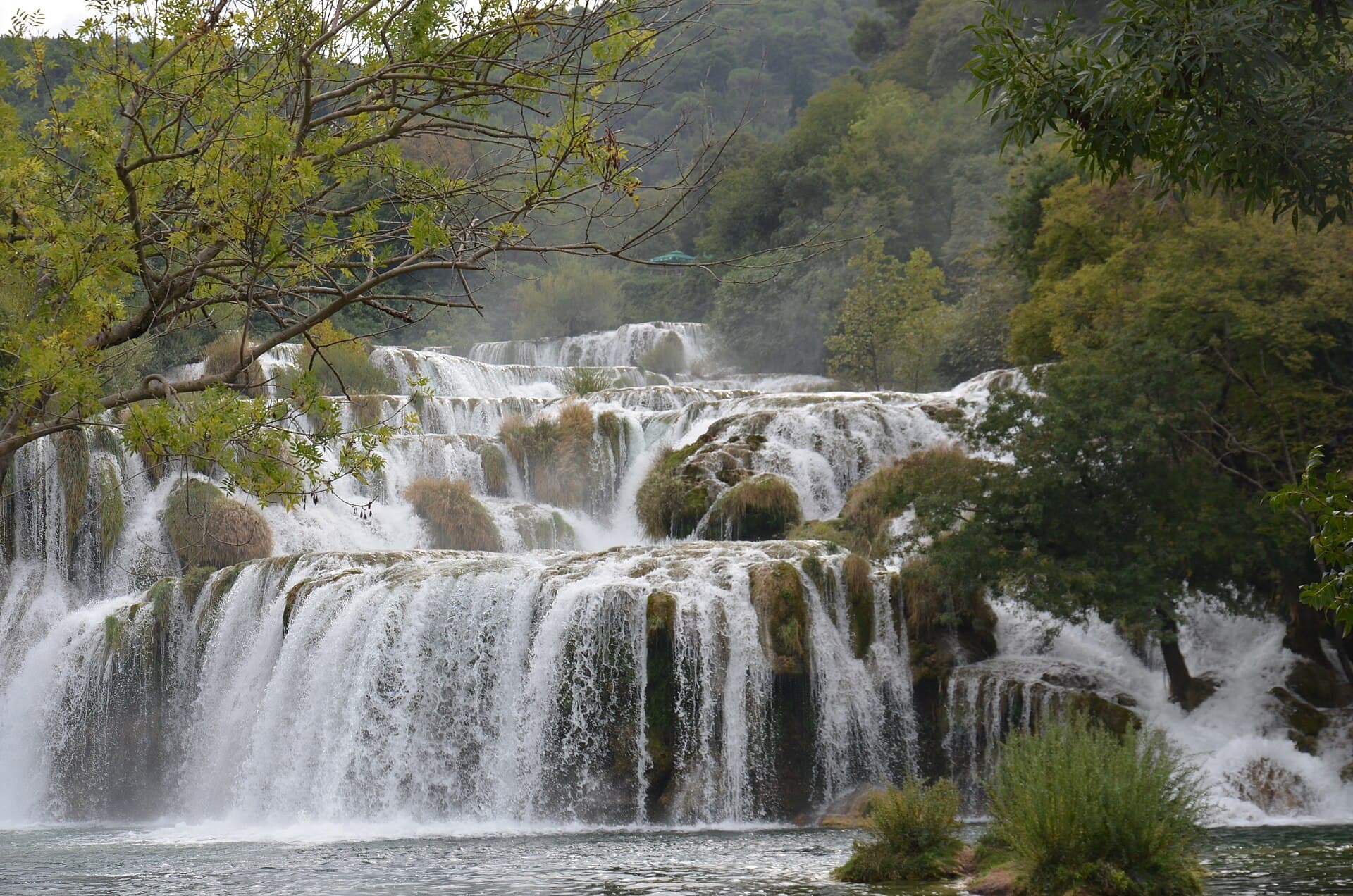
Skradinski Buk
The milk-green amphitheatre across eight hundred metres.
Matea Bolčević — CC BY-SA 4.0 · Fiver, der Hellseher — CC BY-SA 4.0 · Fiver, der Hellseher — CC BY-SA 4.0 · Mladen Bozickovic — CC BY-SA 4.0
Krka is Dalmatia's water symphony: the river descending its limestone canyon in seven waterfall stairs — the crown Skradinski Buk: an amphitheatre of seventeen travertine terraces through which the lake pours milk-green across eight hundred metres — Croatia's most famous water picture after Plitvice, and a far warmer visit. The tour is timber walkways looping the great fall entire, over streams and the old watermills (working craft museums in summer) — boats extending to Visovac island: the Franciscan monastery ringing its round islet mid-river like a wreath — and Roški Slap, the upper fall, for the hungry. Practically, an hour from Split (Lozovac the main gate with parking and a free shuttle in the ticket — or Skradin town and the river boat, the lovelier arrival). Swimming at Buk was banned (2021) to save the living travertine — take it as scene, not pool, with Skradin town the ideal lunch close.
The milk-green amphitheatre across eight hundred metres.
The monastery as wreath mid-river.
Working museums on the streams in summer.
Lozovac, 22000 (day trip)
Croatia's eternal comparison: Plitvice grander in scene (sixteen terraced lakes), farther, busier, colder — Krka warmer, nearer Split, kinder in crowds and children. Based on the coast: Krka by verdict — crossing the country north: Plitvice unmissable. Taking both loses nothing: they are two experiences, not copies.