The promenade
A level tree-lined path the city walks every evening.
CC BY-SA 2.0 de · Jean Housen — CC BY-SA 3.0 · Jean Housen — CC BY-SA 3.0 · Jean Housen — CC BY-SA 3.0
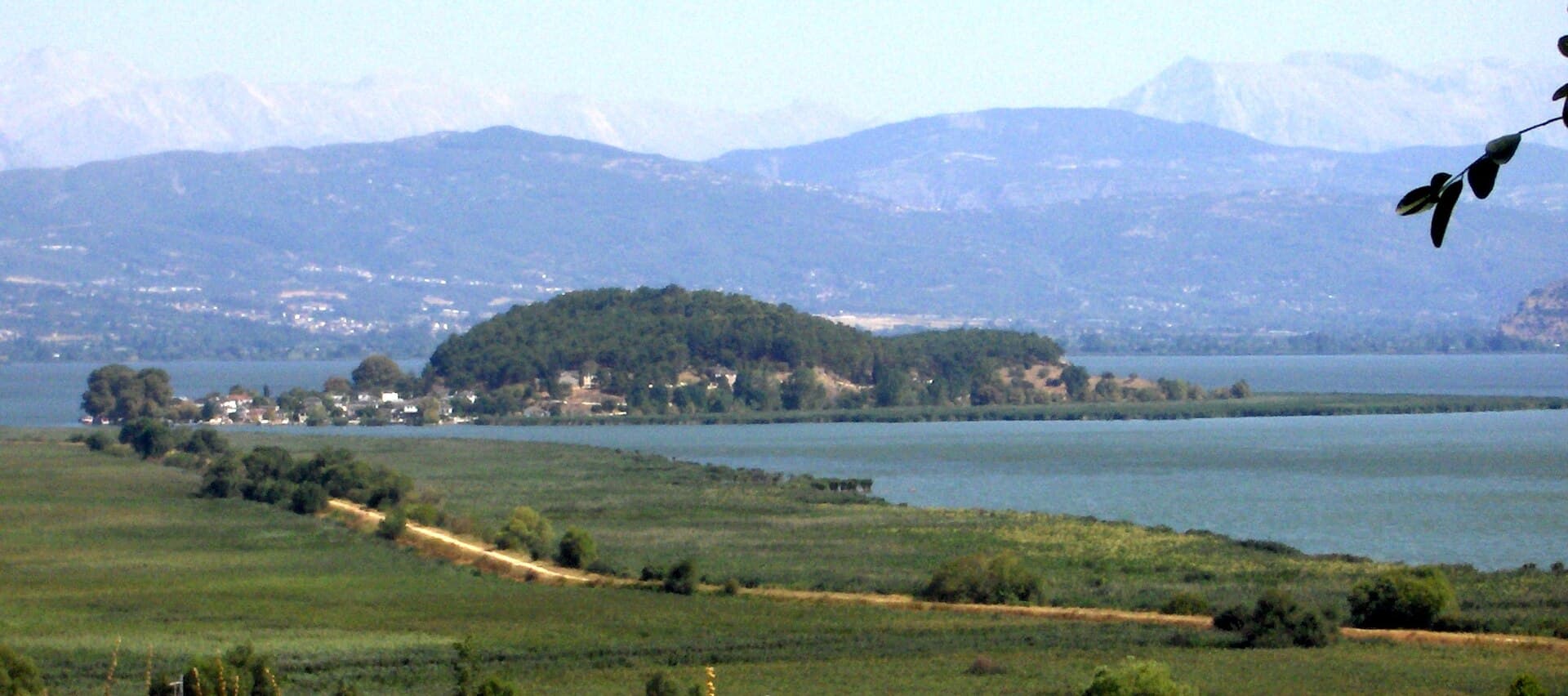
**The lake that explains Ioannina** — the whole city is built on its shore, the citadel stands out into the water, and mountains ring it on three sides. It is **among the oldest lakes in Greece** geologically, relatively shallow and wide, bounded to the east by **Mount Mitsikeli**, which reflects in it on a still morning. Along its edge runs a **long tree-lined promenade** from the citadel northwards, walked every evening by the city's people between cafés and plane trees — and it is **Ioannina's principal social space**, not merely a view. ⚠ Be honest about expectations: **this is not a swimming lake**. It is shallow and suffers from environmental problems and summer algal growth, **and swimming is not advisable**. ✅ Its value is in **the walk, the reflection and the sunset** — and in being the way to the island.
A level tree-lined path the city walks every evening.
The mountain on still water in the early morning.
Ioannina's walls from the island boat — its best angle.
Lake Pamvotida, 45500 Ioannina, Greece
**For known environmental reasons that have been worked on for years — this is not excessive caution.** ✅ **The situation**: Pamvotida is a **shallow** and relatively closed lake, which makes it very sensitive: the water does not renew quickly, and nutrients from **sewage and agriculture** around it accumulate. The result is seasonal **algal growth**, especially in summer when temperatures rise and the level drops. ✅ **Efforts have been made** to improve its condition over the years, but it is **not classified as bathing water**, there are no designated beaches and no water-quality monitoring for swimmers. ⚠ **So the practical advice**: **do not swim and do not let children paddle**, and certainly do not drink from it. ✅ **What to do instead**: **walk the shore**, **take the boat to the island**, and **photograph the reflection in the morning** — those are the ways to enjoy it, and they are entirely sufficient.
**At least three nights — four if you want Zagori done properly.** ✅ **A day for the city**: the citadel and its quarter, the municipal museum, the promenade, and the island with its monasteries — a comfortable full day. ✅ **A day for the city's surroundings**: **Perama Cave** in the morning (ten minutes away), then the archaeological site of **Dodona** in the afternoon (about 20 km) — two entirely different places in one day. ✅ **And two days for Zagori**: which for many people is **the real reason to come** — **Monodendri and the Oxya viewpoint** and the **Vikos** gorge, then **Papingo**, the stone bridges and the villages. ⚠ **Zagori cannot be done in half a day**: the mountain roads are slow and the distances between villages are longer than they look on a map. ✅ **An optional addition**: **Metsovo** (about an hour east) on your way if you are heading to **Meteora** — a very natural link between the two destinations.