The shattered bells
On the south tower floor, where they fell in 1942.
Carsten Steger — CC BY-SA 4.0 · Soluvo — CC BY-SA 4.0 · Farmbruster2012 — CC BY-SA 4.0 · Soluvo — CC BY-SA 4.0
**The model church for the entire brick Gothic style** of northern Europe — built between 1250 and 1350, and copied by some **seventy churches** around the Baltic. It was built by **Lübeck''s merchants**, not by the bishop, and its position between the town hall and the market was deliberate: this was the city''s church rather than the Church''s. They wanted it taller than the bishop''s cathedral, and it is. Its central vault stands at **38.5 metres** — **the highest brick vault in the world**. Its towers reach 125 metres. Note: what stays with you is something else. On **Palm Sunday night in 1942** a British air raid burned the church, and its **bells** melted, fell, and shattered on the floor of the south tower. **They were left where they fell.** They were never restored or lifted — the broken bells and the cracked stone beneath them lie exactly where they landed that night, with a small plaque above. It is **a memorial against war**, and its effect is stronger than any built monument. The church also holds a reconstructed **astronomical clock**, and an **organ** tradition so celebrated that Bach walked 400 km to hear Buxtehude play here.
On the south tower floor, where they fell in 1942.
38.5 metres, the highest of its kind anywhere.
Bach walked 400 km to hear Buxtehude play here.
Marienkirchhof 1, Lübeck
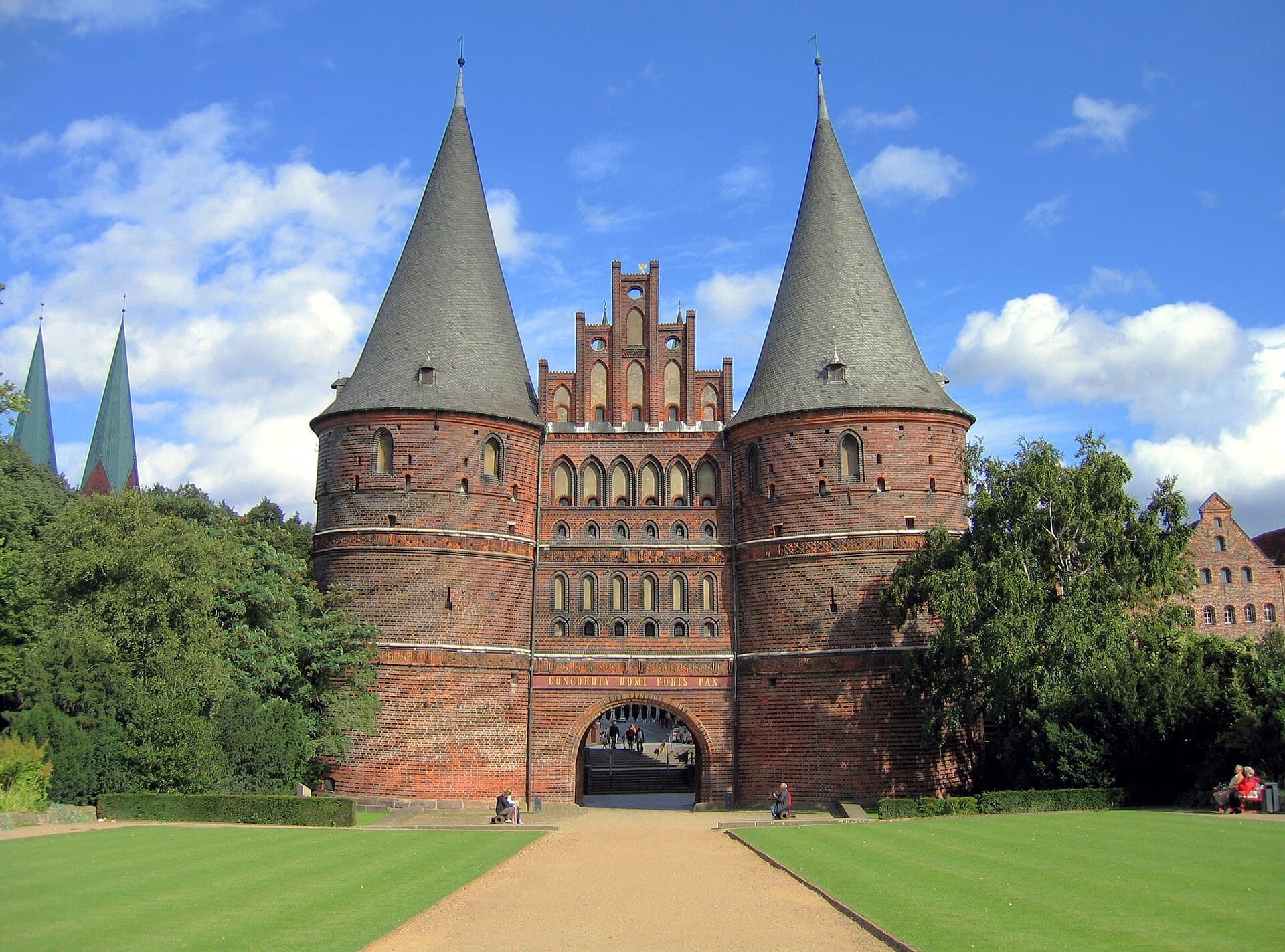
**A necessity that became a style.** Classic Gothic in France and England depends on **carved stone**: slender piers, fine tracery, delicate ornament. But the north German plain and the Baltic **have no building stone** — they are glacial deposits of clay and sand. So what was available was used: **fired brick**. Brick cannot be carved, so the style itself changed: fine ornament disappeared and was replaced by **simple massive volumes**, geometric patterns made from the arrangement and colour contrast of the bricks themselves, and stepped gables. The result is architecture that is **less delicate and more forceful**. ⚠ The style spread with the Hanseatic League from Lübeck to Gdańsk, Riga, Tallinn and Stockholm — which is why the centres of Baltic cities resemble each other so strikingly.