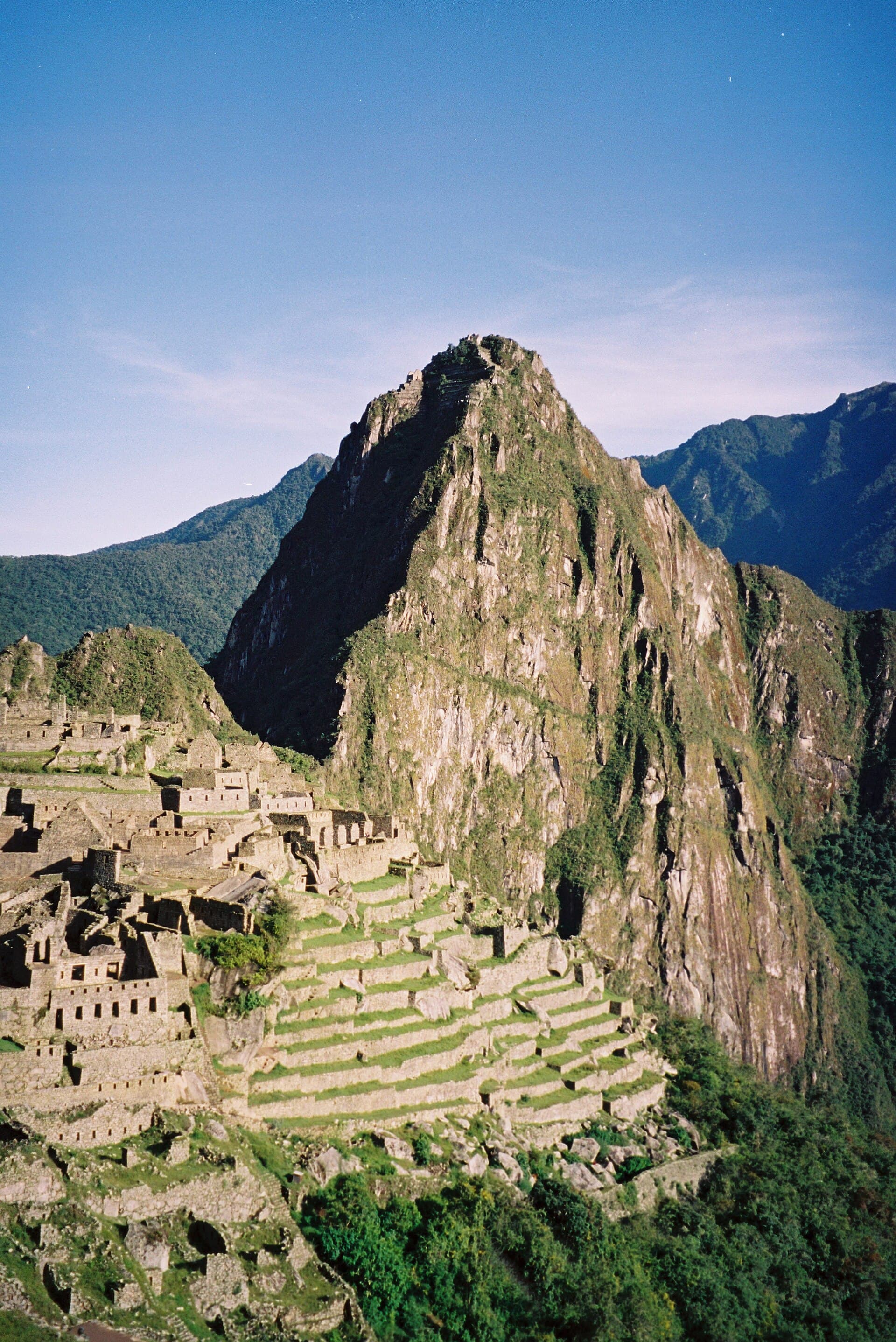
The classic view
City and Huayna Picchu.
Martin St-Amant (S23678) — CC BY-SA 3.0 · Draceane — CC BY-SA 4.0 · Draceane — CC BY-SA 4.0 · Draceane — CC BY-SA 4.0
The most famous site of Inca civilisation and one of the world's great archaeological sites: a 15th-century stone city on a mountain ridge about 2,430 metres up, above a deep gorge cut by the Urubamba River, ringed by towering green peaks wrapped in cloud. It is on UNESCO's list and was voted one of the New Seven Wonders of the World. It was probably built around 1450 as an estate for the emperor Pachacuti, then abandoned about a century later, so the Spanish never reached it, and it stayed hidden from the outside world until the early 20th century, earning the name «Lost City of the Incas». Its most famous feature is its mortar-free stone walls, the cut blocks fitting so tightly a blade cannot pass between them. The site has plazas, temples, houses and farming terraces down the slopes, among them the Temple of the Sun, the Temple of the Three Windows and the Intihuatana stone. The famous view of the city with Huayna Picchu behind it is seen from the terraces near the Guardhouse. Entry is by timed ticket with a daily cap, on three circuits with fixed one-way routes, so book weeks ahead, especially June to August. You get there by train from Cusco or Ollantaytambo to Aguas Calientes and then a bus up, or on foot along the Inca Trail with a permit.
City and Huayna Picchu.
Fitted without mortar.
A highlight of the site.
Above the town of Aguas Calientes, about 80 km north-west of Cusco; by train, then the bus up
Through the official website or an authorised agency, for a set time and circuit, with a daily cap. Book weeks ahead, then book the train and bus to the site.