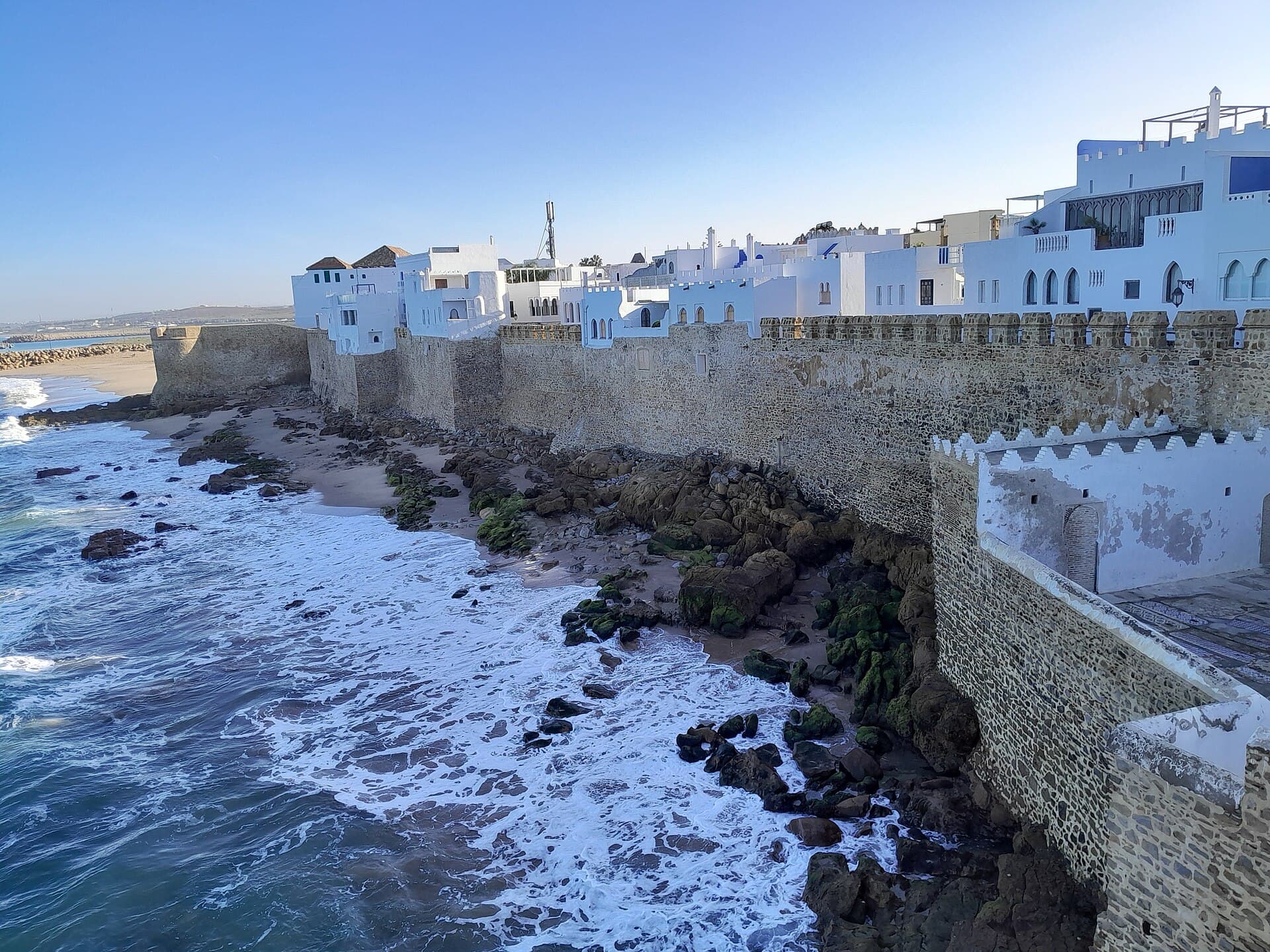
White lanes
Blue and green doors.
Rais67 — CC BY-SA 3.0 · Rodrigo Silva — CC BY 2.0 · Rodrigo Silva — CC BY 2.0 · Rodrigo Silva — CC BY 2.0 · Robert Prazeres — CC BY-SA 4.0 · August Dominus — CC0 · Khalid Souqbi — CC BY-SA 3.0 · Dans — CC BY-SA 3.0
A walled old town on the Atlantic coast, about thirty kilometres south of Tangier, with whitewashed houses trimmed with blue and green doors and shutters, and clean, quiet lanes that end at the sea. It is one of Morocco's loveliest small medinas and a holiday favourite for people from the big cities. The town dates back to the Idrisids and was rebuilt by the Umayyad caliph al-Hakam II in 966. The Portuguese took it in 1471 and rebuilt its walls; it then passed between the Portuguese, the Spanish and the Saadians until Morocco recovered it under Moulay Ismail in 1692, and from 1912 to 1956 it was part of the Spanish protectorate. Its face changed from 1978 with the Asilah International Cultural Moussem, launched by Mohamed Benaissa and the painter Mohamed Melehi: the old quarters were restored, and artists now paint new murals on its walls every year. At its heart stand the Raissouni Palace, built in 1909 by Ahmed er-Raisuni, the local strongman notorious for kidnapping foreigners, which now hosts exhibitions and cultural events, and the Grand Mosque with its octagonal minaret, open to Muslims only. Wandering the medina is free. It is at its best early in the morning before the summer crowds, or just before sunset when people head to the sea walls. Its restaurants are known for fish and seafood with a clear Spanish touch.
Blue and green doors.
Art on the walls.
Now a cultural venue.
Central Asilah on the Atlantic coast, about thirty kilometres south of Tangier
It has been held every summer since 1978, with exhibitions, concerts and mural workshops; its dates change from year to year, so check before you travel.