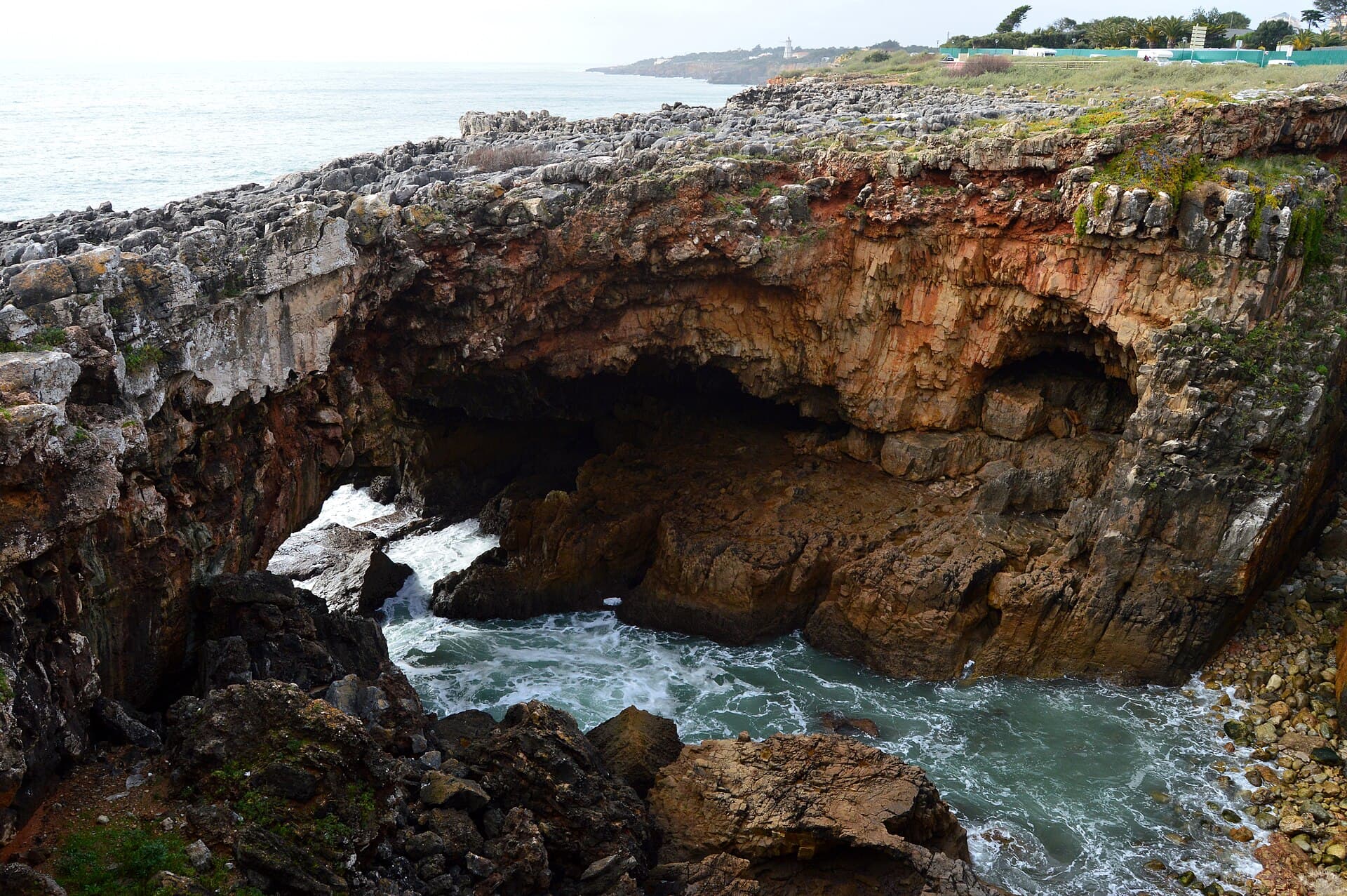
Sea beneath the bridge
An arm of the ocean enters the grounds and runs under a small bridge.
Diego Delso — CC BY-SA 4.0 · prilfish from Vienna, Austria — CC BY 2.0 · prilfish from Vienna, Austria — CC BY 2.0 · Jorge Franganillo — CC BY 2.0
An early twentieth-century palace on the rocky shore at Cascais, built as a summer house and turned into a museum after its owner left it to the town. The building is the first reason to come: a style mixing romantic, oriental and Gothic elements, with a tower, balconies looking straight onto the Atlantic, and an arm of the sea running beneath a small bridge in the grounds. It was designed to look like a fantasy castle and it succeeds. Inside it keeps its furniture and library: books, manuscripts, paintings, carpets and objects the owner gathered, including rare volumes going back to the sixteenth century. It matters to know this is in Cascais rather than Sintra: a coastal town about thirty kilometres west of Lisbon, reached by direct train from the city in around forty minutes along the shore, a fine journey in itself. Around the museum are a free public park, the rocky front and the ocean, so the area makes a comfortable half day.
An arm of the ocean enters the grounds and runs under a small bridge.
Romantic, oriental and Gothic mixed, with a tower and Atlantic balconies.
Books and manuscripts going back to the sixteenth century among the holdings.
Cascais, on the coast west of Lisbon
They are entirely different. Sintra is palaces on a mountain inside forest — Pena and Quinta da Regaleira — very crowded and needing booking and planning. Cascais is a relatively quiet coastal town with beaches and fish restaurants. With two days take both; with one, Sintra is the more spectacular and Cascais the more restful.
Boca do Inferno, a rock chasm where the surf breaks, a short walk west of town; the marina and the old streets; and the beaches inside the bay. The coast road west towards Guincho is fine by bicycle or car.