The Marienbrücke
A footbridge slung over a narrow gorge behind the castle, and the spot from which the famous full view against the mountains is taken. It can close in winter or bad weather.
Thomas Wolf, www.foto-tw.de — CC BY-SA 3.0 de · DestinationFearFan — CC BY-SA 4.0 · U.S. Army 12CAB by Sgt. Terrell Mason — Public domain · U.S. Army 12CAB by Sgt. Terrell Mason — Public domain
Neuschwanstein is the most famous castle in Germany and the most photographed thing in Bavaria: white towers rising out of pine forest at the foot of the Alps, above two lakes. King Ludwig II of Bavaria began it in 1869 — not as a fortress or a seat of government, but as a private stage set for his imaginings of medieval chivalry and for the operas of his friend Richard Wagner. It looks ancient and Gothic, yet it is a thoroughly modern nineteenth-century building, with central heating, running water and a food lift. Ludwig lived in it for only a few weeks, and it was never finished. He was removed from power in 1886 on grounds of incapacity and found dead in Lake Starnberg days later, in circumstances still unexplained. Six weeks after his death the castle opened to the public — a place built as a private refuge became one of the most crowded sights in Europe, and the model from which Walt Disney drew his own famous castle. Visiting takes organising. Tickets are not sold at the castle but at the ticket centre in the village of Hohenschwangau below, and entry is by a short guided tour at a time printed on the ticket. From the centre it is roughly a forty-minute walk uphill, or a shuttle bus or horse-drawn carriage. Book online weeks ahead in summer; arriving without a booking in July or August may well mean no slot that day.
A footbridge slung over a narrow gorge behind the castle, and the spot from which the famous full view against the mountains is taken. It can close in winter or bad weather.
A Byzantine-styled hall of gold, mosaic and marble stairs — and no throne, since the king died before one was made.
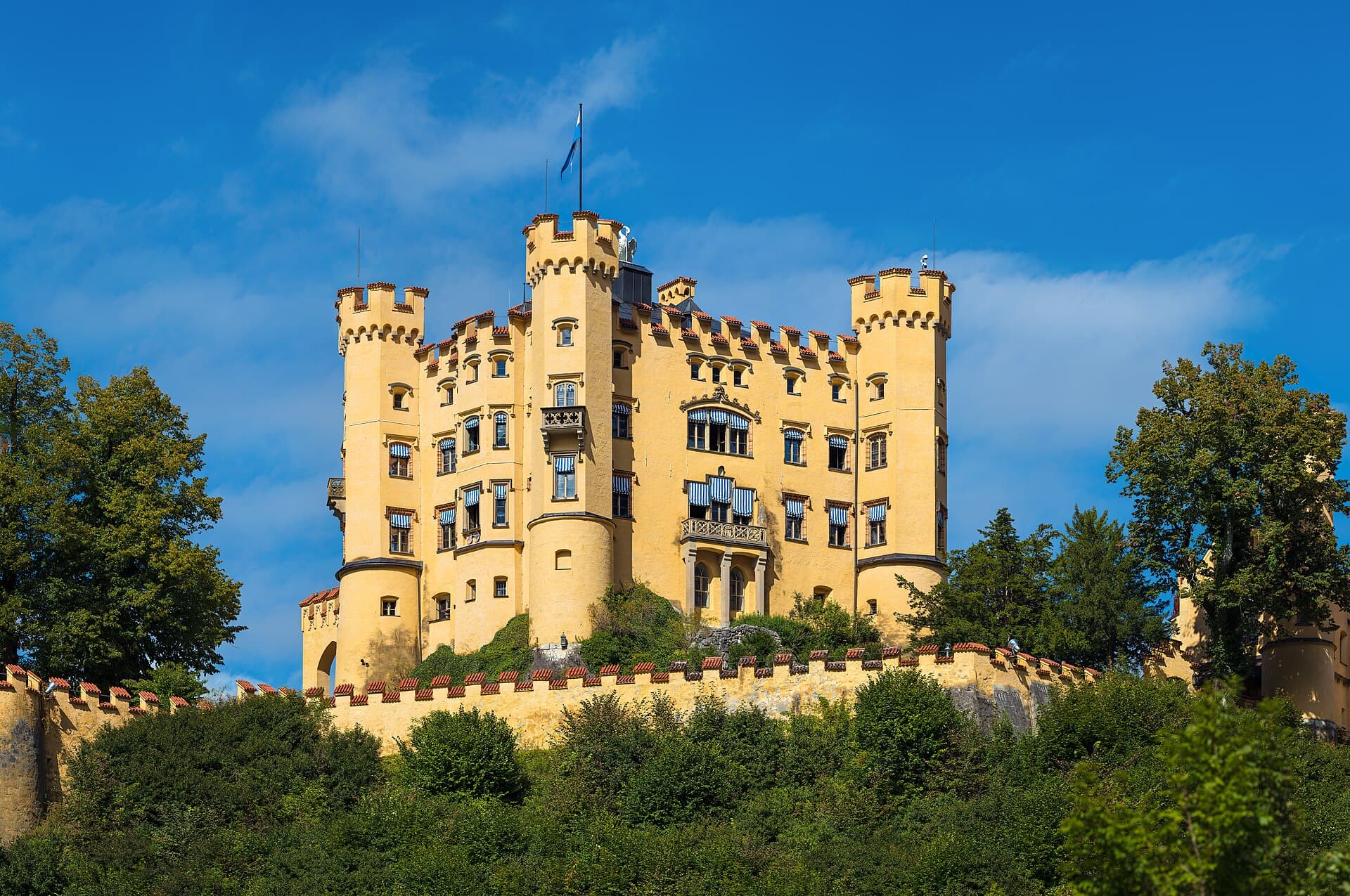
The yellow childhood castle in the village below, where Ludwig grew up — far quieter, and visited on a combined ticket the same day.
A clear mountain lake minutes on foot from the village, its water a transparent green — the best place to end the day away from the crowds.
Neuschwansteinstraße 20, 87645 Schwangau
Yes, and emphatically so in summer. The number of daily tours is limited and July and August slots sell out weeks in advance. Book on the official site and collect the ticket at the Hohenschwangau centre in good time before your slot.
A train from Munich Hauptbahnhof to Füssen (about two hours), then a short bus to Hohenschwangau. It is a full day return, and worth starting early. The Bayern-Ticket day pass covers both train and bus and saves a good deal for a group.
The road rises steadily for about forty minutes — tiring but not rough. A shuttle bus and a horse-drawn carriage run for an extra fee, though both stop short of the castle and leave a brief walk. Anyone who struggles on foot should weigh this before booking.
The tour is short — about half an hour — and covers few rooms, because the castle was never finished, and photography inside is forbidden. Anyone who came for the view can be content with the exterior and the Marienbrücke. But the Throne Hall and the Singers' Hall explain Ludwig in a way no photograph does.