The white arcades
Cafés above the arches.
Manuel Reyes Mantilla — CC BY-SA 4.0 · Pavel Špindler — CC BY 3.0 · PsamatheM — CC BY-SA 4.0 · Jklamo — CC BY-SA 4.0
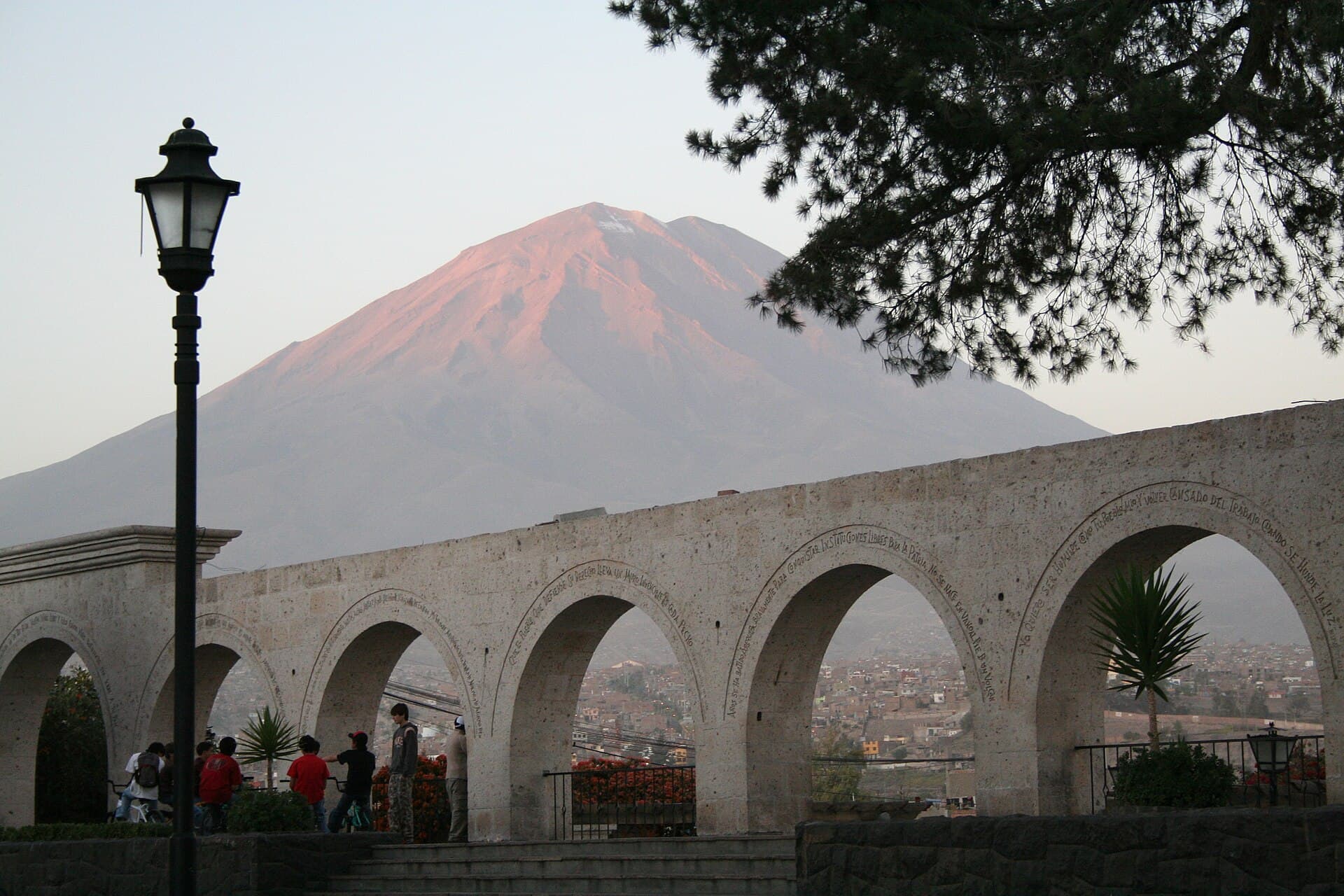
The heart of Arequipa, Peru's second city, called the «White City» because its colonial buildings are made of sillar, a pale white volcanic stone that glows in the sun. Its historic centre is on UNESCO's list, overlooked by three huge volcanoes, the best known being El Misti with its perfect cone. The square is one of the finest in South America: a garden of palm trees with a bronze fountain in the middle, framed on three sides by long two-storey arcades of white arches holding cafés and restaurants on the upper balconies, while the whole fourth side is taken up by the white-stone cathedral. From the café balconies above the arcades you see the whole square with the volcano behind the buildings, especially at sunset when the snow on its summit turns pink. Around the square branch streets of colonial houses with courtyards and carved doorways. Arequipa is about 2,300 metres up, lower than Cusco, so it is a good place to acclimatise before the Colca Canyon and Puno. It is sunny and dry most of the year with strong sun, so bring a hat and sunscreen.
Cafés above the arches.
Behind the city.
Pink snow on the peak.
Historic centre of Arequipa, southern Peru
Yes: at about 2,300 metres it is much lower than Cusco and Puno, so many spend two days here before heading up to the Colca Canyon and Lake Titicaca.