The harbour
Fishing boats and waterside tavernas in an ancient basin.
Tomisti — CC BY-SA 3.0 · Pavel Vlček — CC BY-SA 3.0 · Gareth Williams — CC BY 2.0
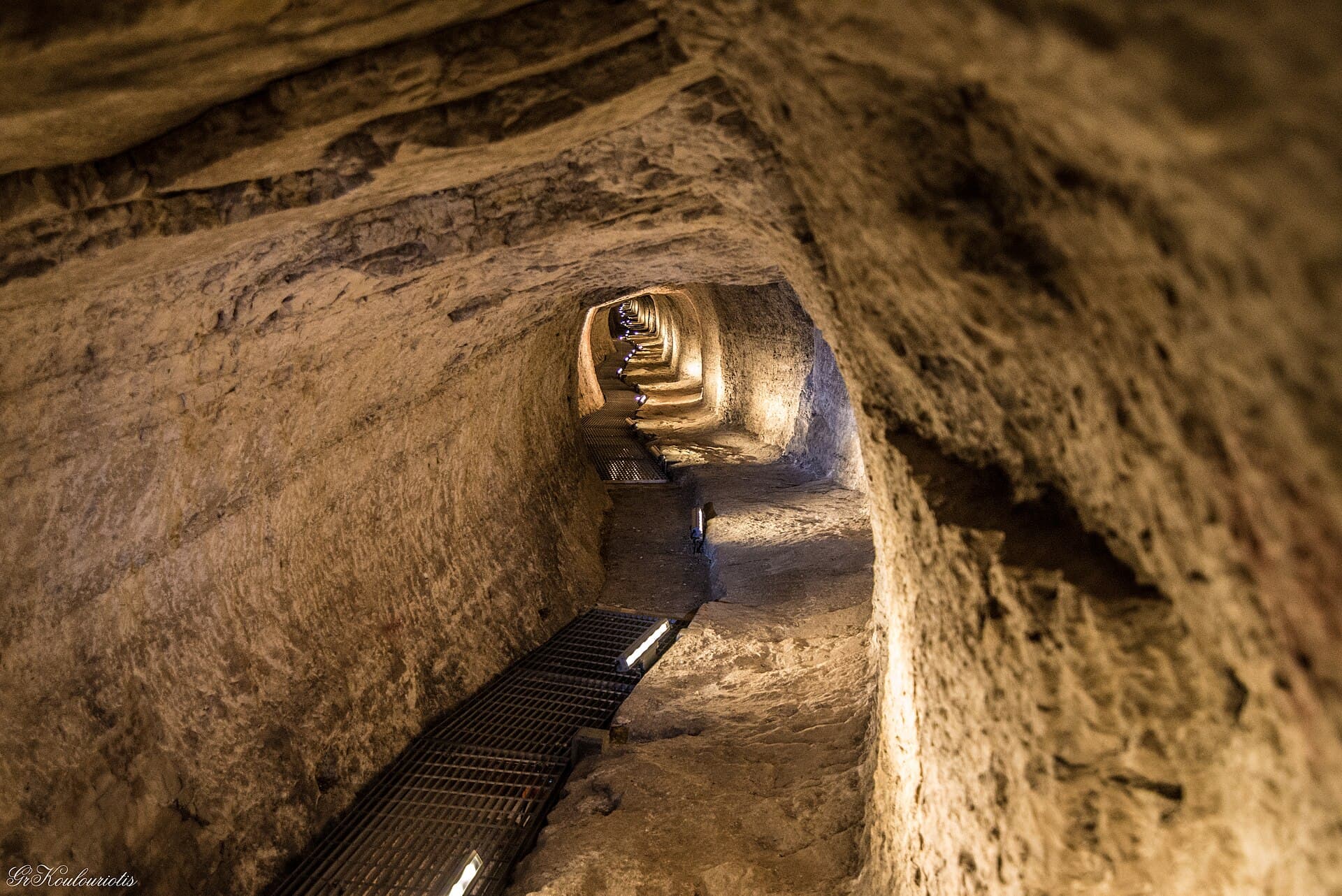
**A harbour town named after Pythagoras, built over the ancient capital of Samos** — and, with the Heraion, a **World Heritage site**. This was **Polycrates's city** in the 6th century BC and one of the richest ports in the Aegean. **Pythagoras was born here** — hence the town's modern name, given in 1955. What survives of the ancient city lies under and around the town: the **ancient mole** still sheltering the harbour today after 2,500 years, the **city walls**, the **Tunnel of Eupalinos** in the mountain behind, a **theatre** and **Roman baths**. ✅ The modern town is genuinely handsome: a small harbour of fishing boats, waterside tavernas, and the **Lykourgos Logothetis** castle from the war of independence above it. ⚠ But it is **very crowded** at peak.
Fishing boats and waterside tavernas in an ancient basin.
A fort from the war of independence above the town and sea.
The Anatolian mainland strikingly close across the strait.
Pythagoreio, 83103 Samos, Greece
**Yes — it is one of the shortest crossings between Greece and Turkey, but read the conditions before relying on it.** ✅ **The route**: passenger ferries from **Pythagoreio** (and sometimes Vathy) to **Kuşadası** in Turkey — **a short trip**, because the Anatolian coast is very close across the strait. ✅ **The usual motive**: visiting **Ephesus** as a day trip — one of the greatest Roman sites in the world, a short distance from Kuşadası. ⚠ **The conditions**: **a valid passport is required** (not an ID card), **and you may need a Turkish visa** depending on nationality — **check before travelling and do not count on buying one at the port**. ⚠ **Timing**: sailings are **seasonal** and irregular outside summer, and can be cancelled for weather — **do not plan one for the day before your flight**. ⚠ **Returning**: if you are in Greece on a **single-entry** Schengen visa, leaving for Turkey **uses it up** and you will not be able to return — **this is the critical point**; make sure your visa is multiple-entry.
**Yes — he was born on Samos, but he left it and did not work there.** ✅ **The birth**: **Pythagoras** was born on Samos around **570 BC**, which is secure in the ancient sources, **and the town was renamed after him in 1955** (it had been Tigani). ✅ **The departure**: he left as a young man — the accounts say to escape **Polycrates's** rule — **and settled at Croton** in southern Italy, **where he founded his school** and community. **So all his known work was done off Samos.** ⚠ **What we know of him is little and disputed**: he left no book, and what reached us came from **followers and opponents** centuries later; **even the «Pythagorean theorem» was known in practice in Babylon and Egypt centuries earlier** — attributing it to him probably means the **proof** or its diffusion, not the discovery. ✅ **More reliable**: his school tied **mathematics to music and the cosmos** — the idea that numerical ratios govern harmony, which influenced all of Greek philosophy. ✅ **In the town**: there is a statue of him by the harbour, and no more — **no house and no site**.