The front
Three carved levels between two towers.
El Ágora — Public domain · Alberto Talavera Ortiz — CC BY-SA 3.0 · Öskr Rck — CC BY-SA 3.0 · LBM1948 — CC BY-SA 4.0 · Eddann123 — CC BY-SA 3.0 · Eu.francov — CC BY-SA 3.0
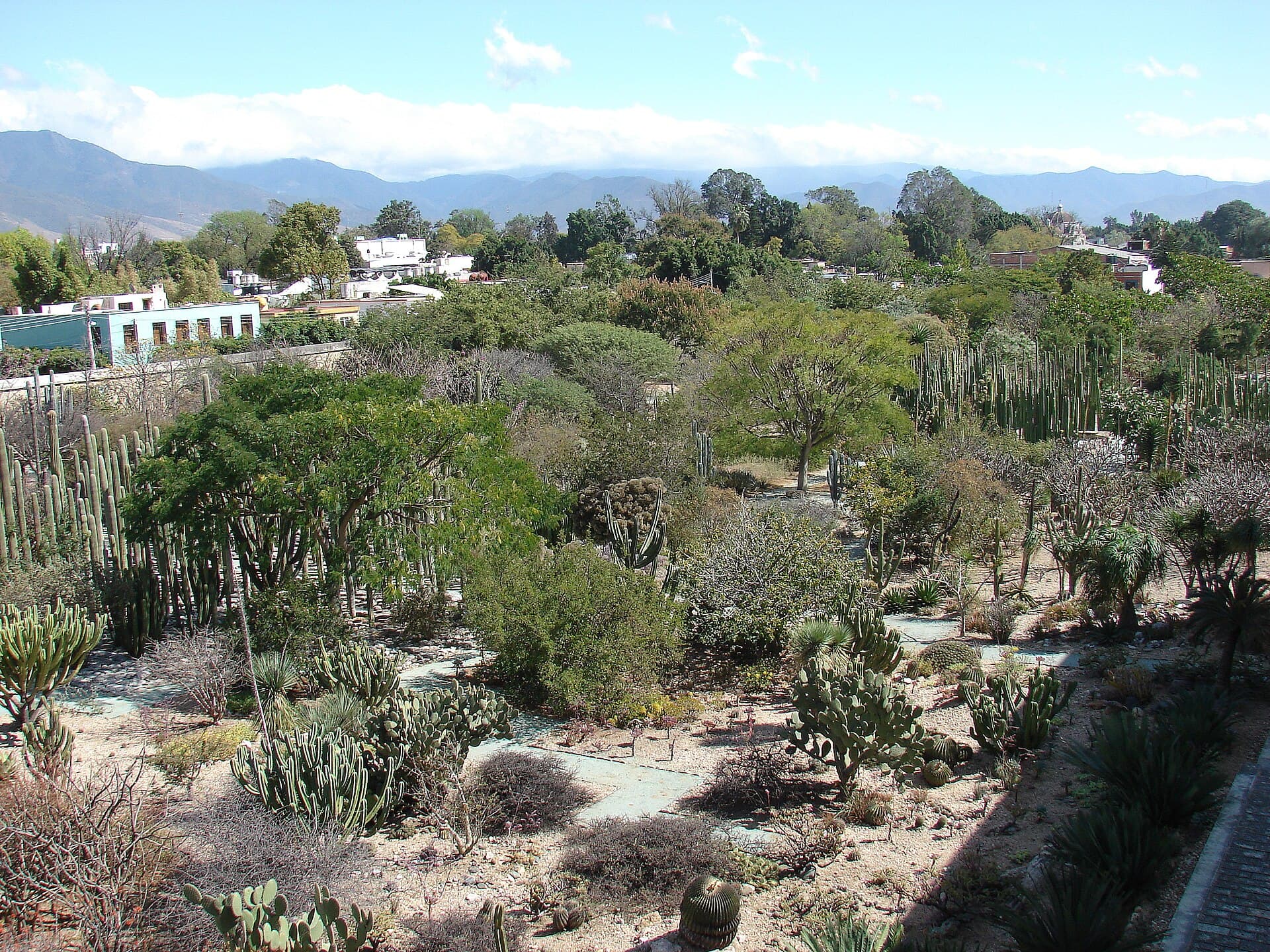
The Church of Santo Domingo de Guzmán and its Dominican convent are among the finest examples of New Spanish Baroque, set in the historic centre of Oaxaca, a UNESCO World Heritage Site. It is still a working church, and the convent houses the Regional Museum of Oaxaca. The city gave the Dominicans the land in 1551, but work stalled for lack of money. Two earthquakes in 1603 and 1604 destroyed another convent and spurred it on, and the complex opened in 1608 while still unfinished. The decoration was done by 1666, and the Rosary Chapel was begun in 1724. In 1859 the building passed to the army, returning to the church in 1902. Pope John Paul II visited in 1979. The front has three levels between two towers, each with arched openings, fluted columns and a small dome, and the domes are covered with glazed tiles. You arrive across a small square used for popular festivals, set with neat rows of agave and cactus. The museum shows the treasures of Tomb 7 at Monte Albán, among its most important collections, and the Ethnobotanical Garden lies behind the convent. The complex stands in the walking zone of the old town, 0.6 km in a straight line north of the main square. The church is a place of worship, so dress modestly and avoid walking about during Mass. The best light on the front comes late in the afternoon, and it is lit in the evening.
Three carved levels between two towers.
The treasures of Tomb 7 at Monte Albán.
Neat cactus beds and popular festivals.
Plaza de Santo Domingo, historic centre of Oaxaca
Yes, services are held here, while the convent beside it is now a museum and garden.
The treasures of Tomb 7 at Monte Albán, found by Alfonso Caso.