The portal
Faience mosaic under a carved wooden canopy.
Patrick — CC BY 2.0 · Terki hassaine samir — CC BY 4.0 · Riad Salih — CC BY 4.0 · Riad Salih — CC BY 4.0 · Riad Salih — CC BY 4.0
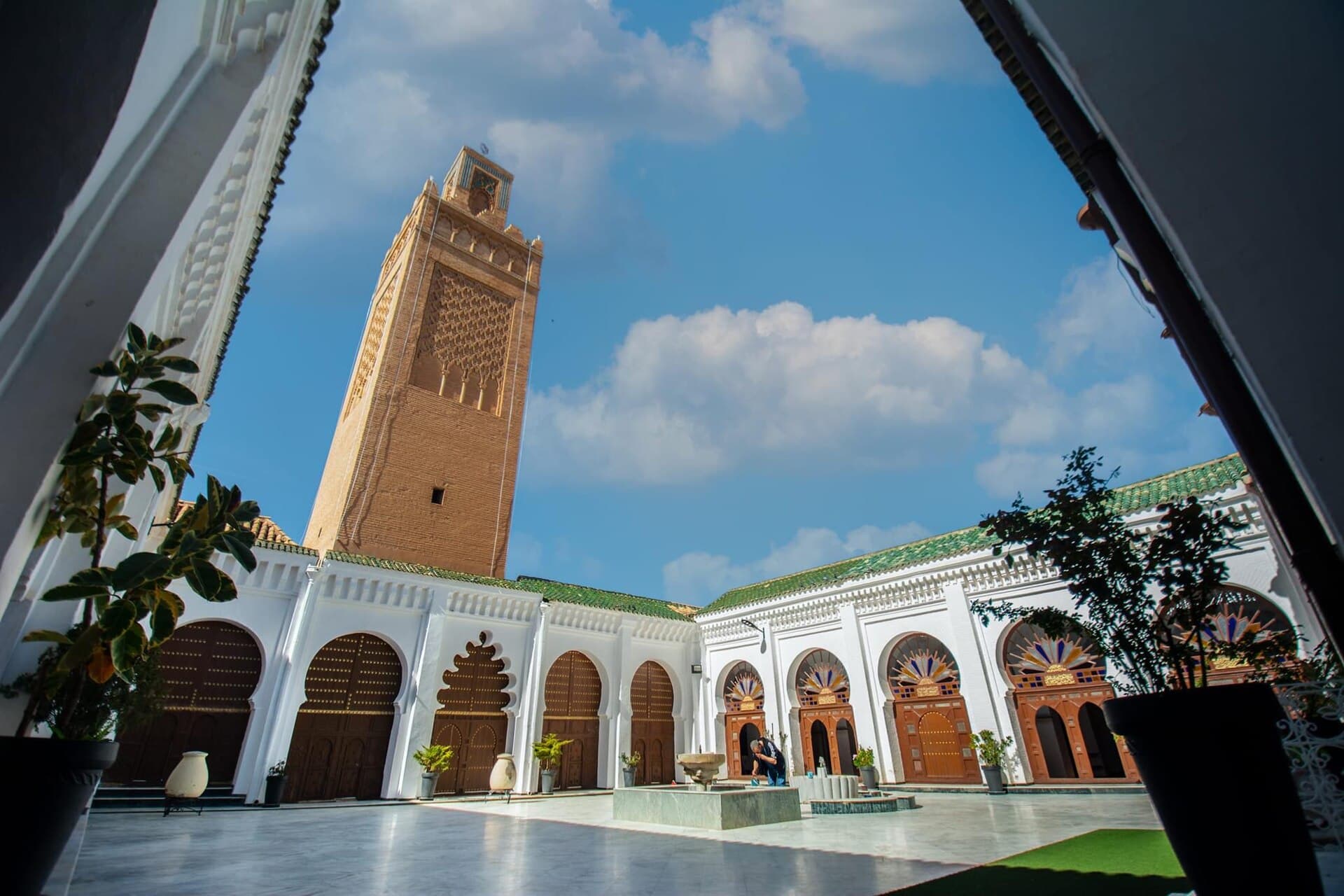
Sidi El Haloui Mosque stands on the slope below the north-east edge of Tlemcen's old town, outside the medieval walls. The Marinid sultan Abu Inan Faris built it in 754 AH (1353), while his dynasty held the city, to honour the Andalusian scholar Abu Abdallah al-Shudhi, called Sidi El Haloui, beside his reputed tomb. Its plan follows the Sidi Boumediene mosque, built by his father Abu al-Hasan some fourteen years earlier. Tradition says al-Shudhi gave up a judgeship in Seville and, in Tlemcen, handed out sweets to children, hence the name al-Halwi. A later legend adds that he tutored a ruler's children, was falsely accused of sorcery and executed, then cleared; older texts say only that he died in Tlemcen. A madrasa and a zawiya that completed the complex are long gone. The portal is framed in faience mosaic beneath a carved wooden canopy, and the inscription over the door is dated 754. In the five-aisled prayer hall, under ceilings of interlaced cedar, eight translucent, veined onyx columns carry horseshoe arches, and the capitals at the mihrab name the saint and the sultan. The 25 m minaret wears brick lattice and glazed tile; the domed ablutions hall faces it across the street. The mosque lies about 550 m north-north-east of the Great Mosque as the crow flies, reached by a steep lane down from the Bab Zir quarter. El Mechouar Palace is about 700 m south, the Sidi Boumediene Complex about 2 km south-east. It is a working mosque: come between prayers and allow 30 to 60 minutes.
Faience mosaic under a carved wooden canopy.
Translucent veined stone, carved capitals.
25 m of brick lattice and glazed tile.
Below the Bab Zir quarter, north-east edge of the old town, Tlemcen
The French scholar Charles Brosselard in 1860, and William and Georges Marçais in 1903, argued that they were taken from the Palace of Victory that Abu al-Hasan had begun at Mansourah. The Marçais brothers noted a sundial carved on one column in a spot the sun never reaches, a sign that it was moved there.
A small, plain mausoleum attributed to him stands on the slope just above the mosque, though historians have not confirmed that it is really his grave.