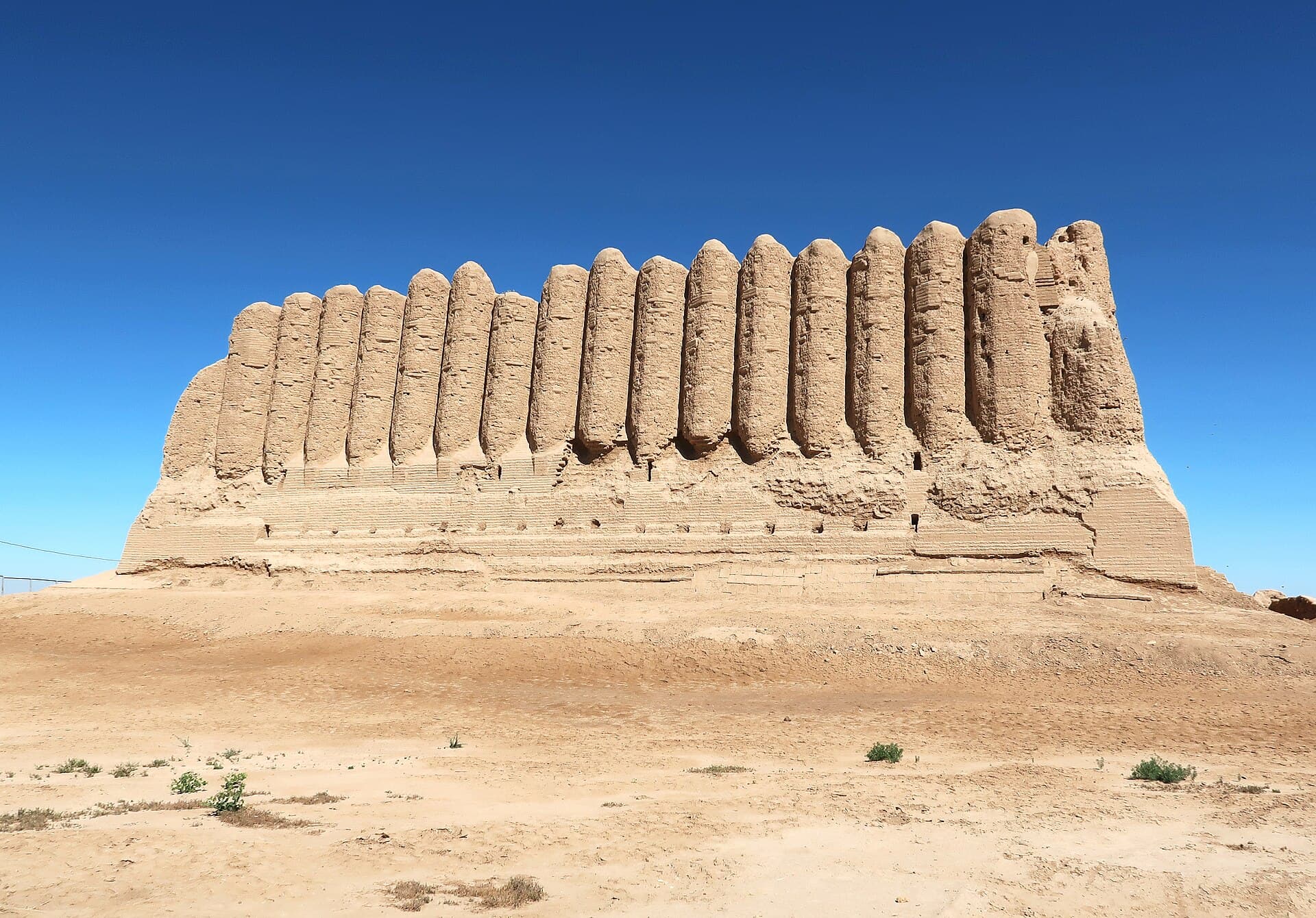
The dome
Seen from far across the plain.
Hans Birger Nilsen — CC BY-SA 2.0 · Hans Birger Nilsen — CC BY-SA 2.0 · Hans Birger Nilsen — CC BY-SA 2.0 · Hans Birger Nilsen — CC BY-SA 2.0
The Sultan Sanjar Mausoleum is a huge cube-shaped building topped by a dome, standing in the middle of Seljuk Merv and part of the Ancient Merv UNESCO site. It honours the Seljuk ruler Ahmad Sanjar, and you can see it from far across the plain. It is one of the few surviving examples of Seljuk funerary architecture. Ahmad Sanjar was born in 1085 and died in 1157, reigning for about forty years with Merv as his capital. His successor, Muhammad ibn Aziz, built the tomb in 1157 on the Silk Road. The Mongols burned it when they attacked the city in 1221. Soviet, Turkmen and Turkish architects later restored it in the 20th and 21st centuries, so the main structure still stands. The dome is 27 metres high, the walls 14 metres, and the building measures 17 by 17 metres. Near the top a row of open arches runs around the base of the dome, but the turquoise-covered outer dome, the second storey and the surrounding buildings are gone. Inside is a wide hall with pale walls and small windows, with the sultan's tomb at the centre. It is about 1.5 km from Great Kyz Kala in a straight line and about 30 km from Mary. Open ground without shade surrounds it, so morning or just before sunset suits best. Dress modestly out of respect for the tomb, keep quiet inside and ask about photos.
Seen from far across the plain.
Around the dome's base.
With the tomb at its centre.
Sultan Kala, Ancient Merv, Mary Province, Turkmenistan
The main structure dates from 1157 and has been restored, while the turquoise outer dome is gone.
A Seljuk ruler who governed from Merv for about forty years and died in 1157.