The plane tree
A trunk metres around, with cafés directly beneath it on the square.
Konstantinos Stampoulis (Geraki — CC BY-SA 3.0 gr · GrigorisKoulouriotis — CC BY-SA 4.0 · Spyros L. — CC0 · Parisral — CC BY-SA 4.0
**A village spread across four separate squares inside dense forest** — on Pelion's eastern slope, facing the Aegean. It is not one compact village but **four nuclei** around four churches — Agia Paraskevi, Agios Stefanos, Agios Taxiarchis and Agia Kyriaki — **separated by forest and gardens**, so you drive between them rather than walk. ✅ Its most famous feature is the **plane tree** in the Agia Paraskevi square: **said to be about a thousand years old**, its trunk several metres around — among the largest plane trees in Greece, with cafés directly beneath it. ✅ From here an **old stone path** descends to the beach of **Mylopotamos** — the best known on Pelion, with its arched rock dividing two coves. ⚠ The forest here is **dense and humid** — the green sometimes closes off the view.
A trunk metres around, with cafés directly beneath it on the square.
Four nuclei around four churches, separated by forest.
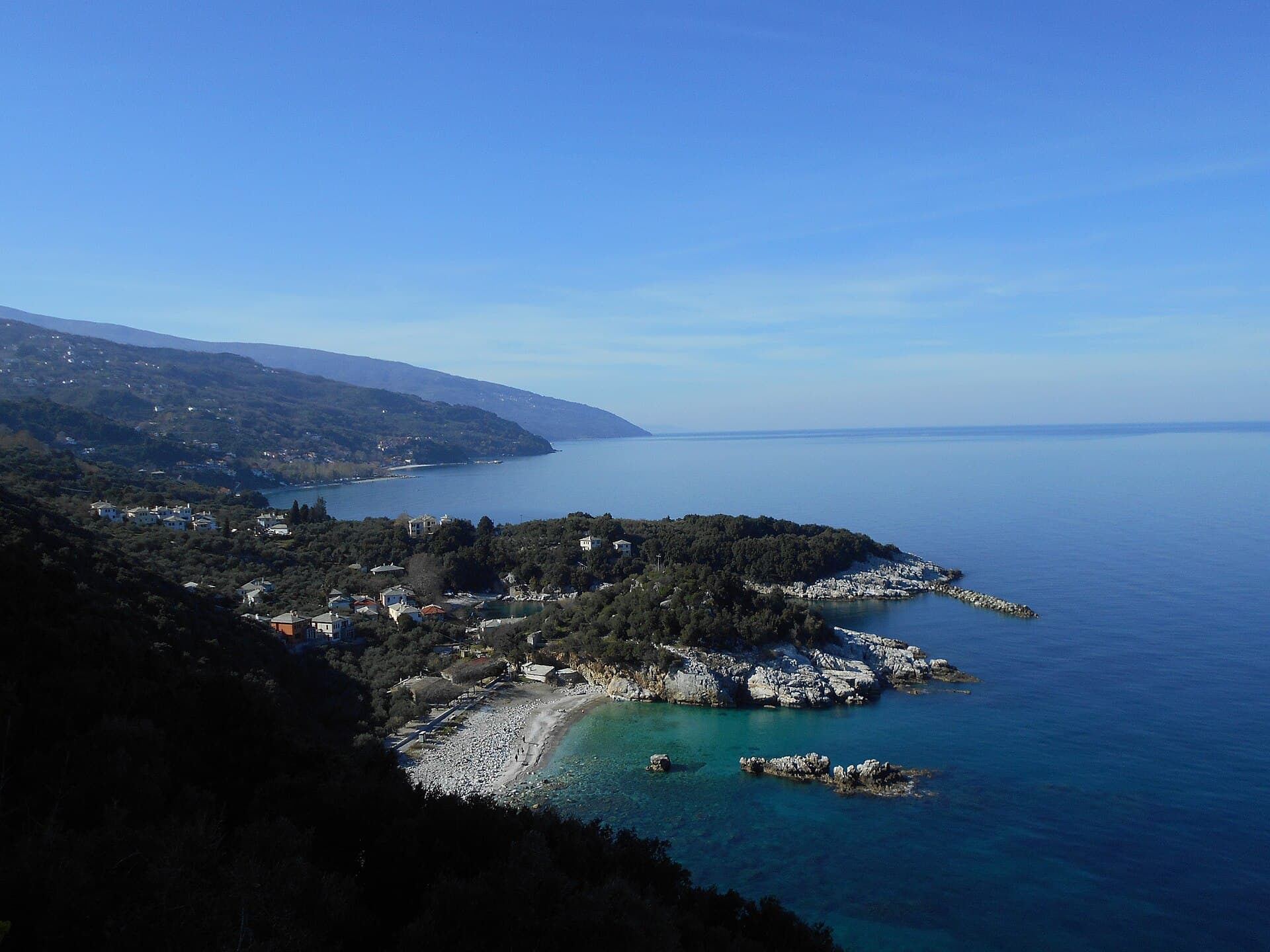
An old stone way descending from the village to the beach.
Tsagarada, 37012 Magnesia, Greece
**A network of stone-paved ways linking the mountain villages — among the best walking in Greece.** ✅ **What they are**: **kalderimia** (καλντερίμια) are **stone-paved paths** built to move people and mules between villages before roads were cut for cars. Pelion has an extensive surviving network **still in use**, because modern roads came late and the mountain is difficult. ✅ **What distinguishes them**: they are **carefully paved** with flat stones, with **retaining walls**, drainage and small stone bridges — **engineering rather than mere tracks**. They run through **chestnut and oak forest**, past streams and villages. ✅ **The best known**: **Tsagarada to Mylopotamos**, **Milies to Vyzitsa**, and **Damouchari to Tsagarada**. ⚠ **What to know**: **the stone is very slippery after rain** — and Pelion is rainy; **going down is far easier than coming up**, so **arrange your return** before you start; and **waymarking varies**, so take a trail map.
**A locally circulated figure with nothing precise behind it — but the tree genuinely is very old.** ✅ **What is certain**: **the tree is exceptionally large** — its trunk several metres around, **among the biggest oriental planes in Greece**, and it shades the whole square. **Plane trees are long-lived** — several hundred years is unremarkable. ⚠ **What is not certain**: the **«thousand years»** figure itself. Dating a living tree precisely is **difficult**: the reliable method is counting rings, which requires felling the trunk or taking a core, **and old planes are usually hollow inside** — so the central rings are lost and counting becomes impossible. **Estimating from girth alone is imprecise**, because growth rates vary with water and soil. ✅ **The honest formulation**: **a very old tree, estimated at several hundred years**, with the common figure a local tradition rather than a measurement. ⚠ **This is a general pattern**: the ages of «millennial» trees around the Mediterranean **are usually exaggerated** — and the tree remains astonishing at any number.