The belvedere
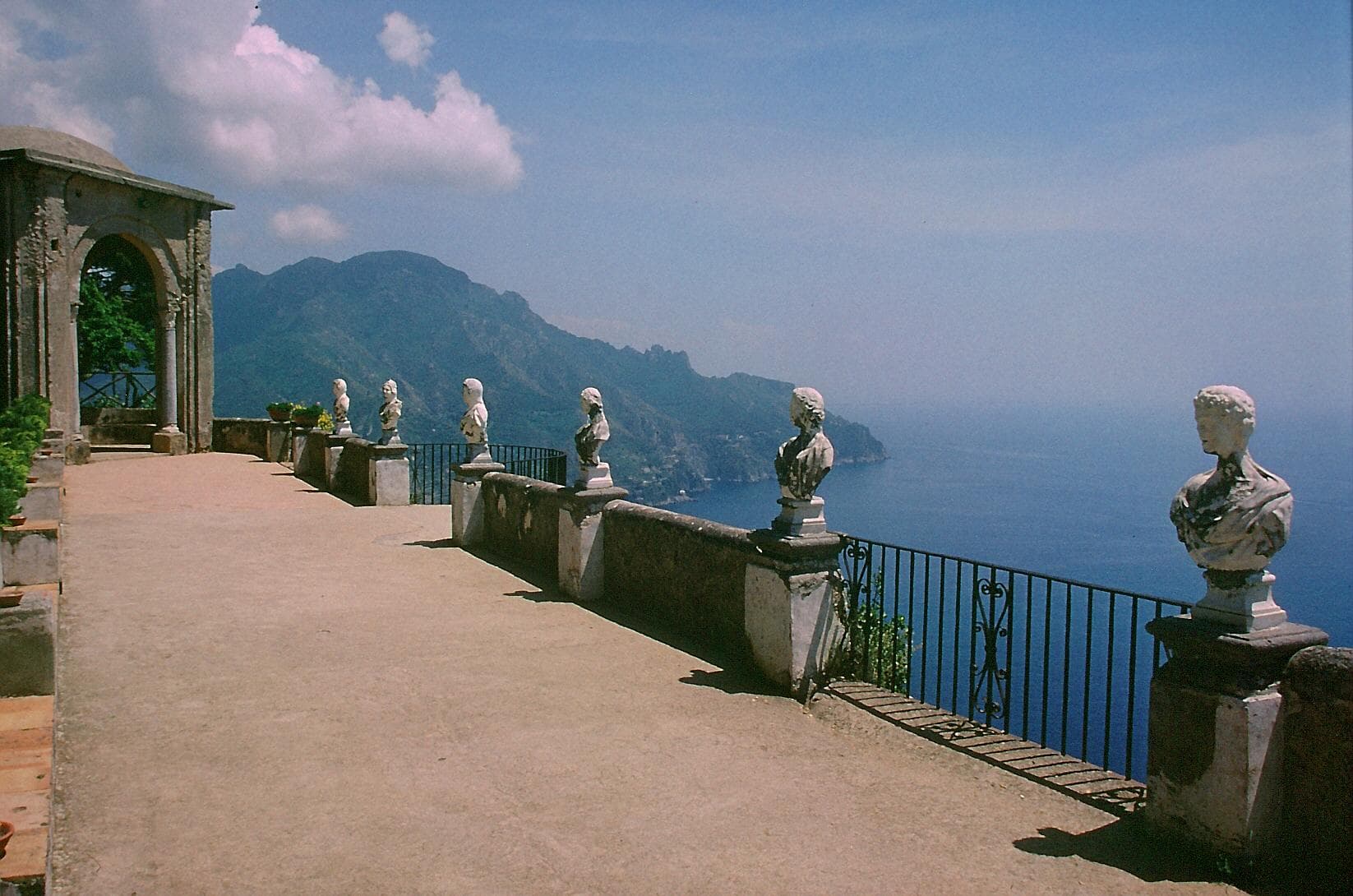
Terraces stepping down to a stone balustrade hung more than three hundred metres above the Gulf of Salerno — the view that became the face of the whole coast.
Istvánka — CC BY-SA 3.0 · Justinawind — CC BY-SA 4.0 · Miguel Hermoso Cuesta — CC BY-SA 3.0 · Miguel Hermoso Cuesta — CC BY-SA 3.0
In 1880 Richard Wagner climbed up to Ravello, stood on the terrace of Villa Rufolo where the ground simply stops and falls more than three hundred metres to the sea, and announced that he had found the magic garden of Klingsor he had been imagining for Parsifal. The terrace is still there, and the photograph taken from it — two umbrella pines, a stone balustrade, the Gulf of Salerno spread out beneath — is probably the single most reproduced image of the entire Amalfi Coast. Underneath the garden is a merchant's palace. The Rufolo family, rich Ravello traders whom Boccaccio put into the Decameron, built it in the 13th century, and what survives from then is the best thing in it: an arcaded courtyard laid out like a cloister, its interlacing arches and carving unmistakably Arab-Sicilian in feeling, and the great tower at the entrance. The house then decayed for centuries until a Scot, Francis Neville Reid, bought it in the mid-19th century, patched up what could be saved and replanted the terraces in the romantic taste of his own day. So what you walk through is a Victorian garden grown over medieval bones — no bad thing, but worth saying plainly. The visit itself is short and honest about itself: 45 to 90 minutes covers it. The interiors and the small museum in the tower are modest, and nobody comes for them. You come for the cloister, then for the terraces stepping down towards the edge, and for the belvedere at the bottom of them. From early July to early September a stage is built out over that edge for the Ravello Festival, whose twenty-odd events are split between it and other spots around the town; the stage is handsome in itself but it does block part of the view by day, and concert tickets are entirely separate from admission. And now the part that decides the trip: from Sorrento this is not an outing, it is a full day. Overland means the SITA bus to Amalfi — ninety minutes to an hour and forty in normal conditions, two to two and a half hours in July and August traffic — then a change onto the Ravello bus for twenty-five minutes of hairpins. Buy SITA tickets before you board, at a tabaccheria or newsstand; they are not sold on the bus. The nicer alternative is the ferry from Sorrento to Amalfi (roughly April to October, about 40 minutes on a direct fast boat and up to 75 if it calls at Positano) and the same climb by bus. Budget eight to ten hours door to door. The good news is that the bus sets you down a few minutes from Piazza Duomo and the villa gate opens straight onto the square — no long climb on foot unless you choose the famous staircase up from Atrani. The less good news is that the boats unload in Amalfi through the middle of the day, so the wave reaches Ravello in the early afternoon. Take the first morning bus, or go in after four, when everyone leaves and the light is at its best.
Terraces stepping down to a stone balustrade hung more than three hundred metres above the Gulf of Salerno — the view that became the face of the whole coast.
Interlacing 13th-century arches with an unmistakably Arab-Sicilian accent, the truest surviving fragment of the Rufolo merchants' palace.
From early July to early September the Ravello Festival builds its stage out over the drop; a concert there is an entirely different experience, on a separate ticket.
Piazza Duomo, 84010 Ravello, Italy
The villa alone does not justify eight hours of travel — you will be inside for about an hour. But the day is not only the villa: Ravello is a quiet town perched above the coast, far calmer than Positano or Amalfi, and alongside Rufolo it has the gardens of Villa Cimbrone, a small cathedral and a square you can actually sit in. If you have three days or fewer in Sorrento, choose Positano and Amalfi instead — closer and easier. With five days or more, and if you prefer gardens, quiet and views to beaches, go, and plan it as a proper full day rather than a stop.
It suits children who walk: the garden is open, safe and roomy, but the paths are stepped, stony and uneven, and a pushchair will be a genuine burden — bring a carrier instead. The tower museum admits children aged five and over only, for safety. Note too that Ravello is a very small town: there is no mosque and no halal restaurant we know of, so plan meals in Sorrento before you set off or stick to fish, vegetarian dishes and pizza, and carry a prayer mat if you need one.