The sphinx parapet
The Egyptian sphinx turns its back on you and faces the sea, and custom holds that a wish made while resting your left hand on it comes true.
Mайкл Гиммельфарб — CC BY-SA 4.0 · Berthold Werner — CC BY-SA 3.0 · Berthold Werner — CC BY-SA 3.0 · Berthold Werner — CC BY-SA 3.0
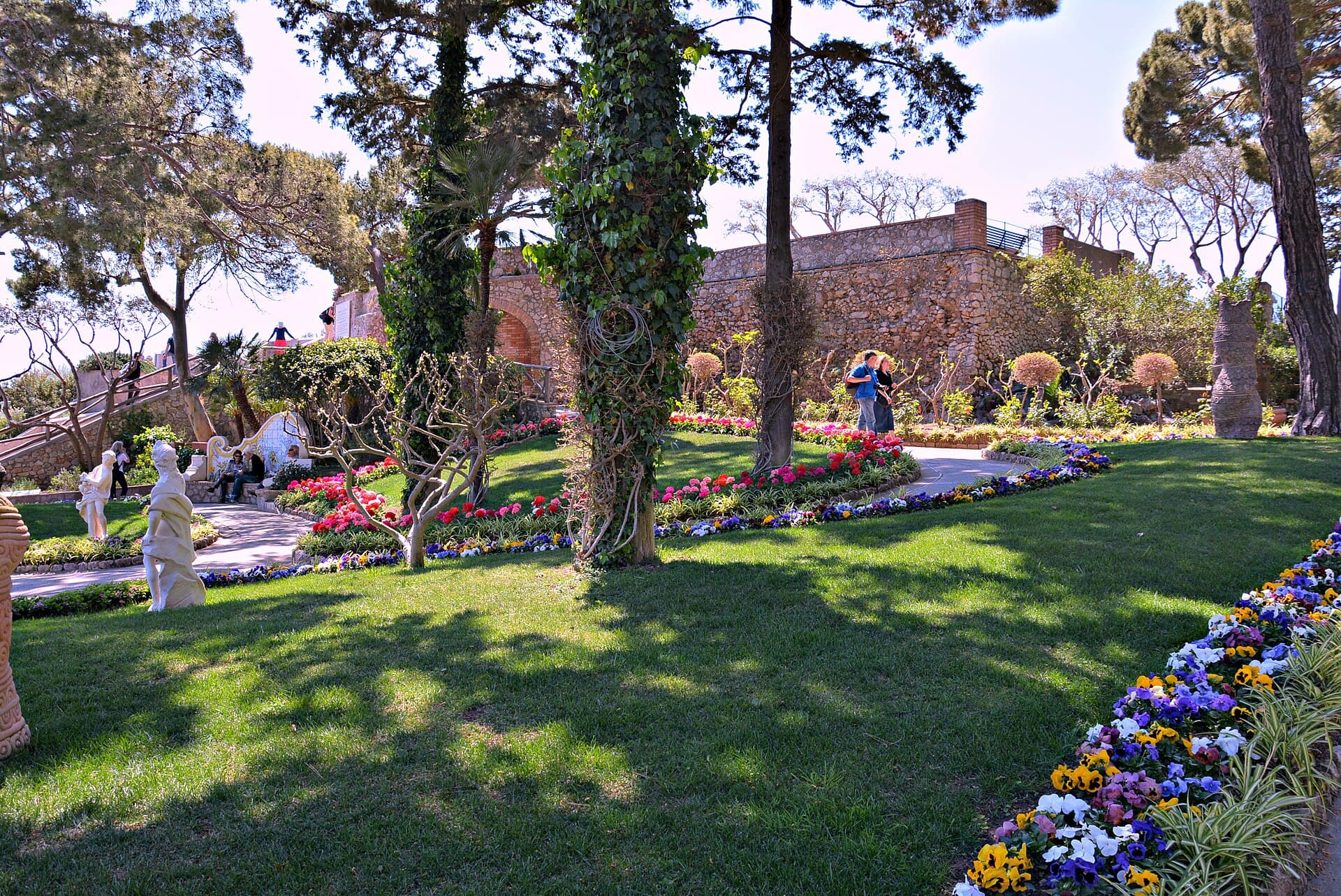
A red granite sphinx sits on the parapet with its back to you, staring out across the Bay of Naples. It is some three thousand two hundred years old, and it ended up here because a Swedish doctor named Axel Munthe decided, around 1900, to build his house on the ruins of a Roman villa in Anacapri. The house itself is small. The view from its loggia and its vine-covered walk is one of the widest in southern Italy — the whole bay beneath you, Vesuvius opposite, Sorrento a white thread on the far shore. Munthe was no ordinary collector. He was a celebrated physician who became personal doctor to Queen Victoria of Sweden, and the memoir he later wrote, The Story of San Michele, sold in the millions and made this house famous long before most of its visitors ever set eyes on it. The columns, marble heads and shards of mosaic set into the walls he gathered himself, from the island and from the antiquities trade; the little chapel, the garden and the colonnade are his own design rather than an architect's. Capri's harsh light eventually ruined his eyes and he moved to the dark Torre di Materita elsewhere on the island. A Swedish foundation runs the place today. Budget your time honestly: an hour to ninety minutes covers it, which is what the villa itself tells you. There are only a handful of rooms, and the antiquities are a gifted amateur's hoard from an age with looser rules about digging, not a catalogued archaeological museum — the effect is cumulative rather than piece by piece. What you really came for is outside: the parapet, the pergola walk, the steps down to the chapel. Above the house rises Monte Barbarossa, which Munthe bought to stop the netting of migrating birds; it is still a sanctuary, with a ringing station where migration is studied, crowned by a ruined castle you can reach only on the foundation's guided visit — Thursdays from April to October, booked in advance. The journey is half the decision. A fast ferry from Sorrento's Marina Piccola reaches Capri's Marina Grande in twenty to thirty minutes, with fares from about €21 on the cheapest operator and €24–28 on the fast boats, rising with season. Know two things: the boats from Sorrento, Naples and Amalfi mostly dock between ten and noon, so the island fills in a single wave, and the last sailings sell out — book your return before you board. From the port a bus climbs to Anacapri (€2.40 a ride, about €8 for a day pass), and from Piazza Vittoria it is a short flight of steps at the stop and then a five-minute walk along a level pedestrian avenue to the gate. Inside, though, this is a Capri house through and through — stairs, terraces and uneven stone paths — and the foundation says plainly that it is not suited to visitors with reduced mobility, so do not count on bringing a wheelchair or a stroller round it. The Phoenician Steps — 921 of them by the usual count, fewer by some — climb from above the port to Anacapri, a genuine hour-plus effort in the heat, and stretches have been closed for repair at times; if you want them, walk down rather than up. And remember that Capri is its own island, not part of the Amalfi Coast: there is no mosque on it and we could not confirm any certified halal restaurant, so plan meals and prayers accordingly.
The Egyptian sphinx turns its back on you and faces the sea, and custom holds that a wish made while resting your left hand on it comes true.
Columns, marble heads and mosaic set into the walls of a house Munthe raised on a Roman foundation, every fragment gathered by his own hand.
Munthe bought the land of Monte Barbarossa to stop the trapping of migrating birds, and it is a sanctuary still, with a station where their migration is tracked.
Viale Axel Munthe 34, 80071 Anacapri, Italy
On its own, no. Ninety minutes is the outside limit, and the day is really a Capri day rather than a villa day. Build a morning around Anacapri instead: the villa, then the chairlift from Piazza Vittoria itself up to Monte Solaro, then lunch in Anacapri's comparatively quiet lanes. If you have three days or fewer in Sorrento and the Amalfi Coast and Pompeii are also on the list, dropping Capri altogether is a perfectly defensible call.
Open the place with it. The earliest Sorrento ferries leave around 07:15 and the villa opens at 09:00, so the first or second boat gets you inside before the wave of ferries lands between ten and noon. The alternative is after three in the afternoon, when the day-trippers start heading back — but check your month's closing time and the last-admission rule half an hour earlier, because in January, November and December the gate shuts at 15:30 and you will simply find it closed. Either way, Anacapri stays calmer than Capri town at every hour of the day.