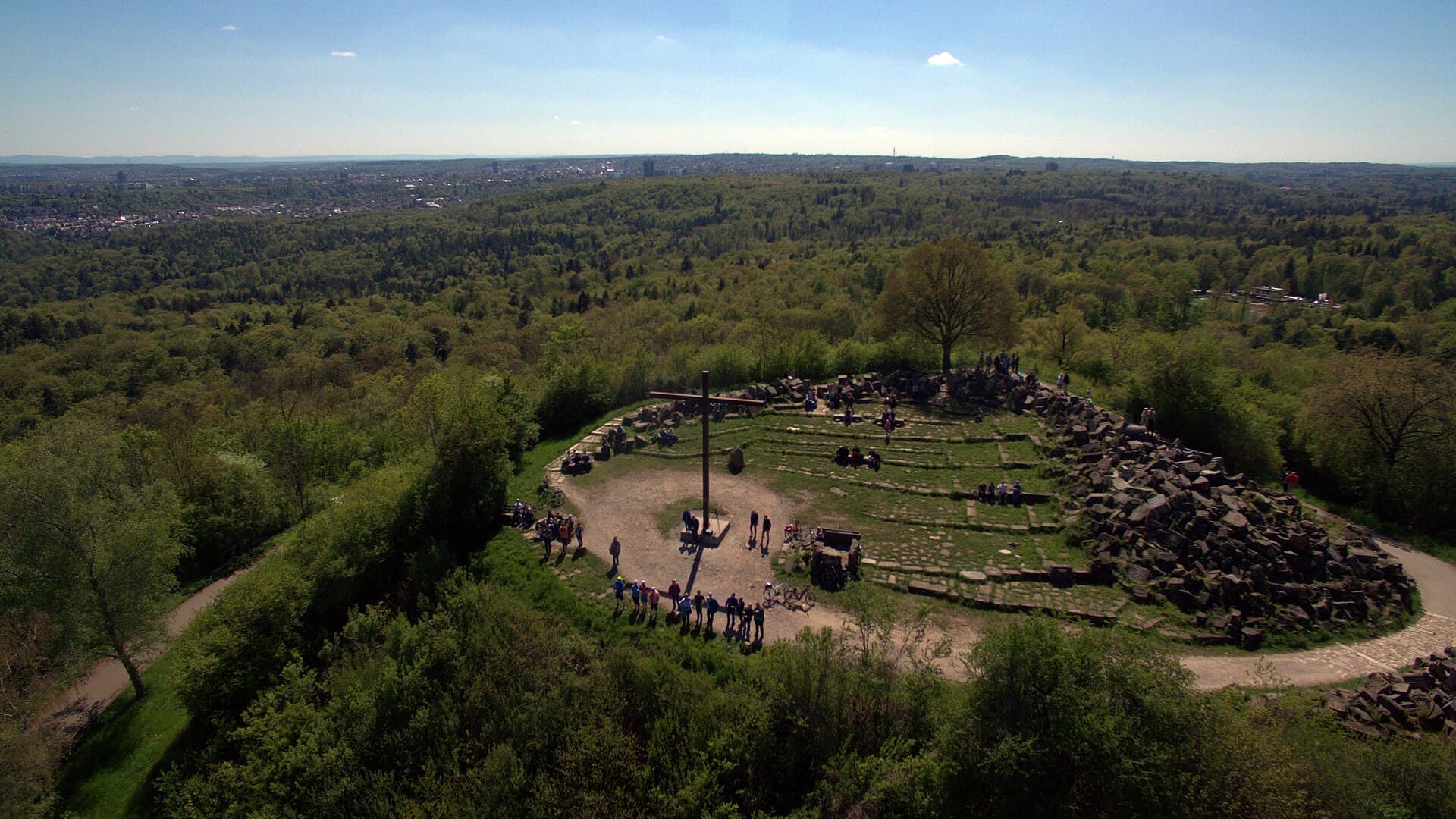
The standing forest
Mature beech and pine among the graves.
Karayaglobal — CC BY-SA 3.0 · Zinnmann — CC BY-SA 3.0 de · Garten-, Friedhofs- und Forstamt der Stadt Stuttgart — Public domain · Robert von Oliva (naruciakk) — CC0
Stuttgart's Waldfriedhof is an early and fully realised example of the forest cemetery idea that arose in Germany in the early twentieth century: instead of close-packed rows of graves in a walled enclosure, graves are placed within standing woodland with its trees intact, so the cemetery does not read as one. It opened in 1913 on a wooded slope in the city's south-west, designed so that the paths follow the land's natural contours and the trees are left where they stand. The result is a completely silent space of mature beech and pine, entirely unlike a conventional urban cemetery. It holds the graves of a number of prominent Germans, among them industrialists, politicians and artists — the best known being Robert Bosch, founder of the company that bears his name. The site is free and open and residents use it for quiet walking, but it is a working cemetery requiring the ordinary respect: quiet, modest dress, and no photography near funerals.
Mature beech and pine among the graves.
Following the slope's natural contours.
Waldfriedhof, 70597 Stuttgart
It is a design approach that appeared in Germany in the early twentieth century in reaction to crowded urban cemeteries that read as bleak and industrial. The idea was to bury the dead within existing nature rather than on a geometric grid, so the cemetery becomes a space the living can walk in too. The pattern spread through many German cities, its best-known example being Ohlsdorf in Hamburg.