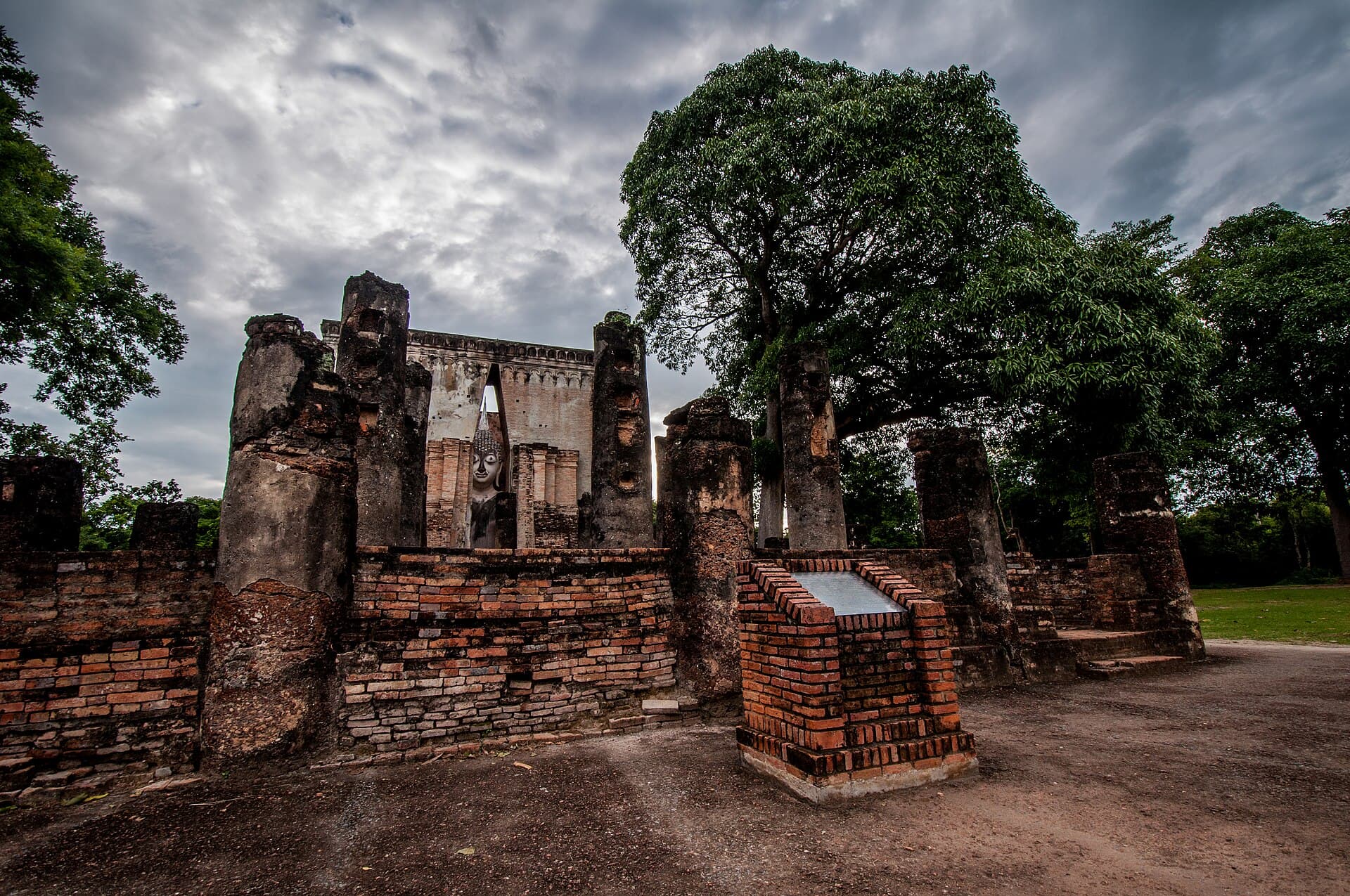
A standing Buddha
About 12.5 m on the summit.
This Photo was taken by Supanut Arunoprayote. Feel free to use any of my images, but please mention me as the author and may send me a message. (สามารถใช้ภาพได้อิสระ แต่กรุณาใส่เครดิตผู้ถ่ายและอาจส่งข — CC BY 4.0 · Christophe95 — CC BY-SA 4.0 · Christophe95 — CC BY-SA 4.0 · Christophe95 — CC BY-SA 4.0
A temple on a hilltop some two hundred metres high in the wooded western zone, reached by a path of old slate slabs, which gives it its name, «temple of the stone bridge». On the summit stands a large standing Buddha about twelve and a half metres tall, right hand raised in the gesture of reassurance, gazing out over the distant ruins of the old city. King Ramkhamhaeng's inscription records that the king rode up to this temple on an elephant on holy days to worship. The climb takes some fifteen to twenty minutes, and the path is steep in places and unshaded. Sukhothai was the capital of the first Thai kingdom in the thirteenth and fourteenth centuries, where the Thai alphabet took shape and a distinctive style of Buddha images flourished, with flowing bodies and serene smiles; its ruins are today part of a UNESCO World Heritage Site listed in 1991. The western zone has a separate ticket of about one hundred baht for foreigners, and the climb is possible in the daytime. Bring water, a hat and good shoes. The midday heat is fierce from March to May, so come early in the morning or late afternoon, with a hat and water. It is quiet with few visitors and one of Sukhothai's best viewpoints, especially in the early morning. It is about ten minutes by bicycle from the walls.
About 12.5 m on the summit.
A path of slate slabs.
The ruins from afar.
Western zone, Sukhothai Historical Park, about 3 km west of the walls
For older children yes: it is short but steep and unshaded. Avoid midday and bring enough water.