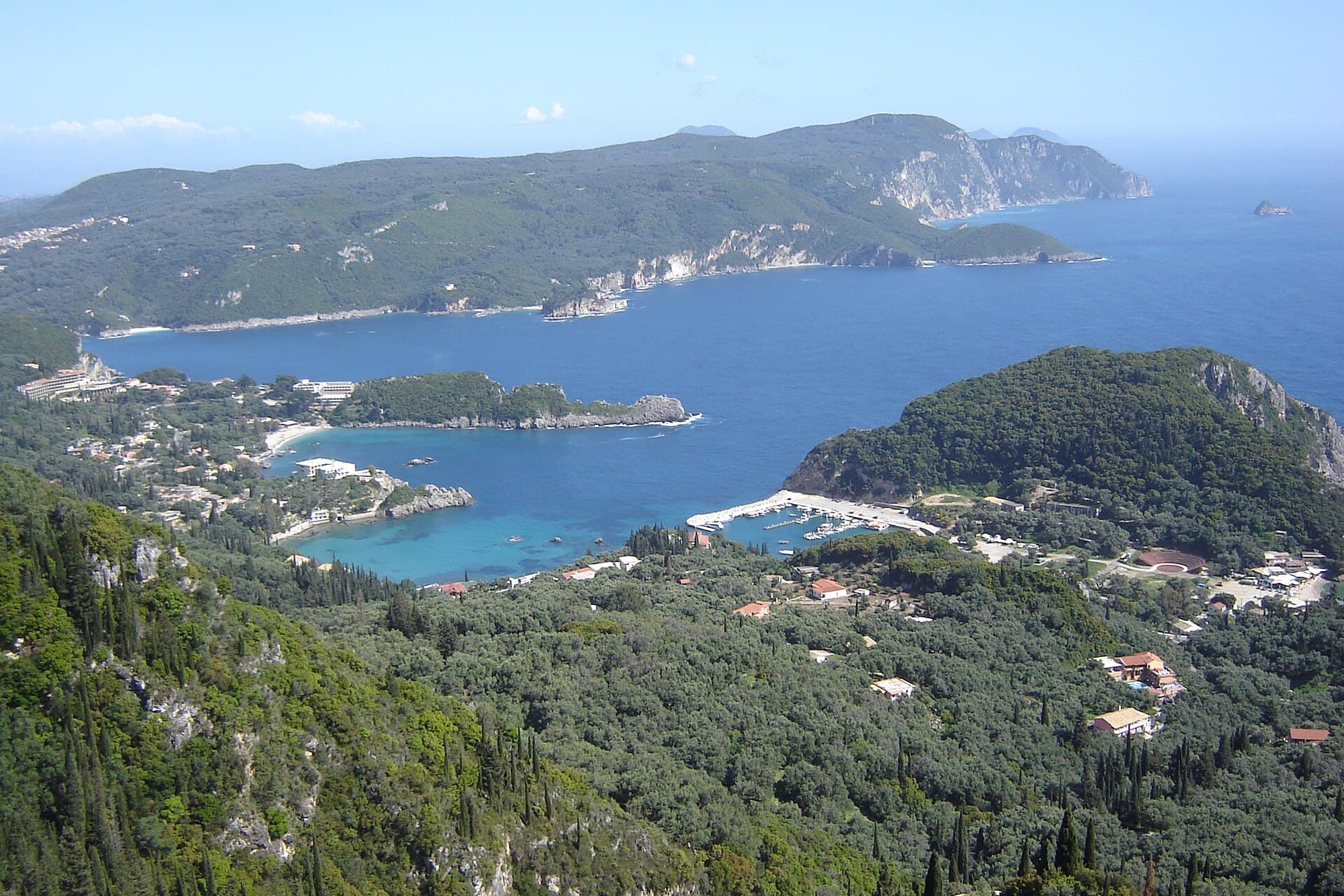
The coast view
Paleokastritsa and the bays from an angle seen nowhere else.
Dr.K. — CC BY-SA 3.0 · Z thomas — CC BY-SA 3.0 · Z thomas — CC BY-SA 3.0 · Z thomas — CC BY-SA 3.0
**A Byzantine castle on a rock summit about 300 m directly above the sea** — and it was never taken by force. It was probably built in the **13th century**, on a site that needed little fortifying: near-vertical rock on three sides, with only the fourth to be walled. It held out against **three major Ottoman sieges** — **1537**, **1571** and **1716** — and fell in none of them. In dangerous times it was **a refuge for the people of the north of the island**, not just a garrison. What remains today is **ruins**: walls and towers, cisterns cut into the rock, a **small chapel** still standing, and **grave niches** carved in the stone. ✅ But the reason to come is **the view**: from the top the whole west coast lies below you — Paleokastritsa and its bays from an angle you get nowhere else — and it is among the finest views over the Ionian. ⚠ And the climb is **hard and exposed**.
Paleokastritsa and the bays from an angle seen nowhere else.
Still standing among the ruins, with grave niches cut in the rock.
Water tanks cut in stone that kept the fort alive under siege.
Krini, 49083 Corfu, Greece
**Geography first, then water.** ✅ **The site** does most of the work: the rock is **near-vertical on three sides** and about 300 m high, so it can only be attacked along one narrow approach — which cancels the numerical advantage large armies rely on, because attackers can only come up in a narrow file under fire. ✅ **Water** is the second and more decisive factor in any siege: the castle has **cisterns cut into the rock** that collect and store rainfall — so those inside could wait, and a siege is ultimately a race between the defenders' supplies and the besiegers' patience. ⚠ **Add a human dimension**: it was not only a garrison but **a refuge for the villagers** and their families — meaning the people inside were defending their households, not a position.
**Yes — but for the view and the site, not the building.** ⚠ **Be honest about the expectation**: at the top are **broken walls and towers, cisterns and a small chapel**, with few explanatory panels — no rooms, no displays and no guided route, and you will have "seen" the ruins in ten minutes. ✅ **What genuinely earns it**: **the view** — the entire west coast and the bays of Paleokastritsa directly below, unquestionably among the finest views over the Ionian; and **the sense of the site**, standing at the edge and understanding at once why this castle never fell. ✅ **For anyone not climbing**: the village of **Krini** below has tavernas looking up at the castle itself, which is a perfectly good reward for whoever waits.