The courtyard
White arcades under dense crimson bougainvillea, and an old well.
Dietmar Rabich — CC BY-SA 4.0 · Marc Ryckaert (MJJR) — CC BY 3.0 · Dietmar Rabich — CC BY-SA 4.0 · Dietmar Rabich — CC BY-SA 4.0
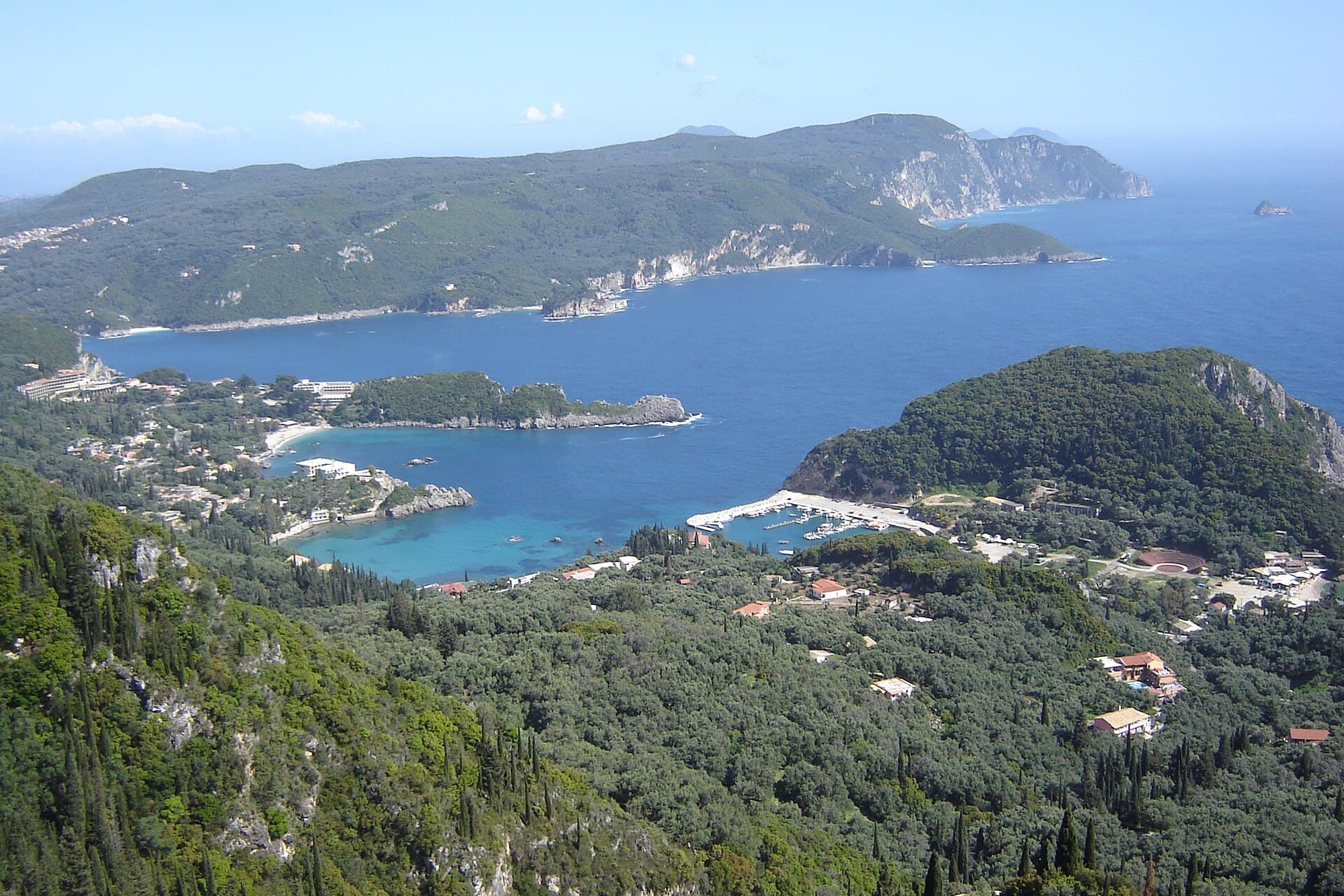
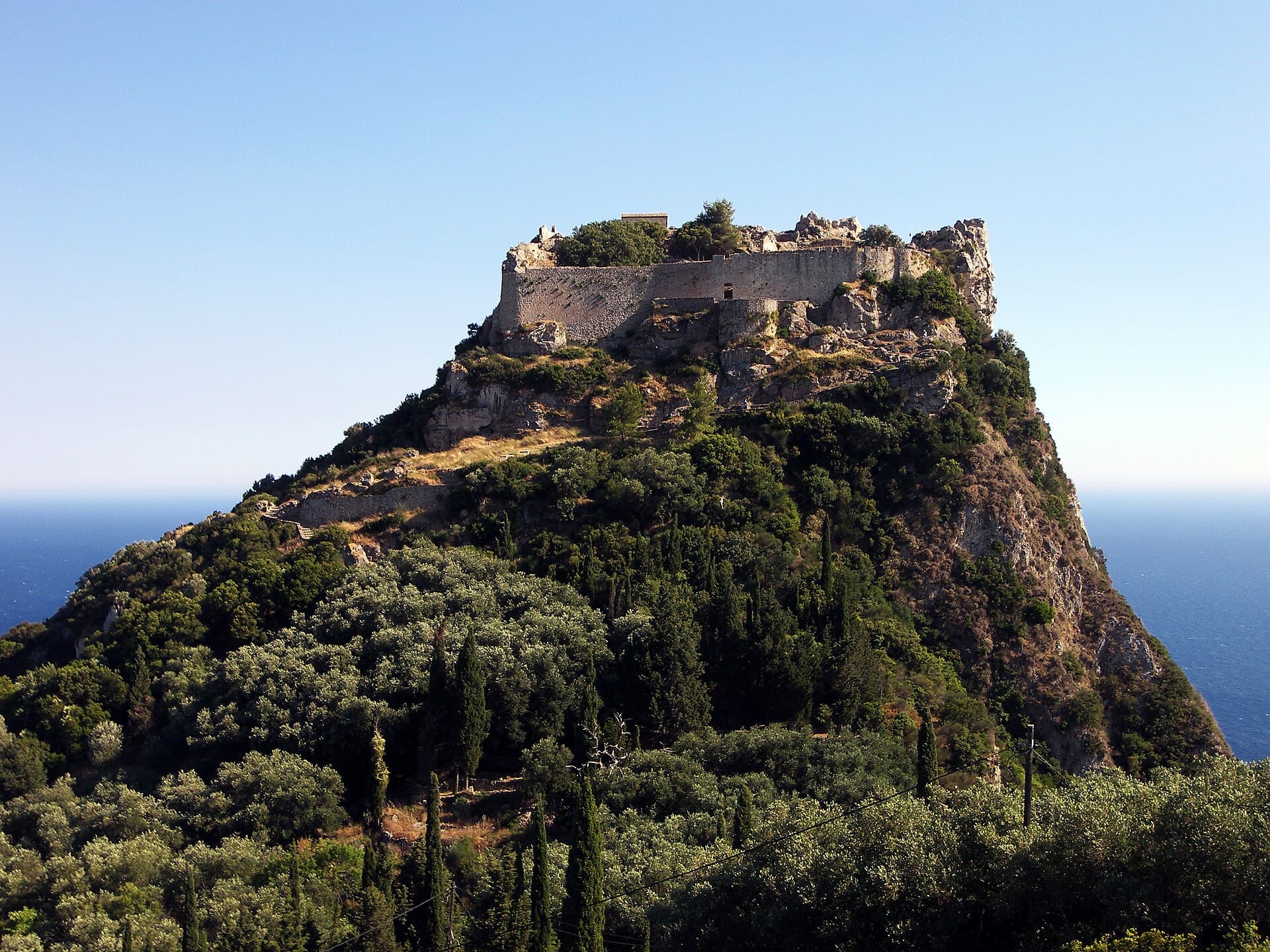
**A monastery on a rocky headland looking out over all the bays** — the best viewpoint in northwestern Corfu, and **free**. The site was founded in the **13th century**, but most of the standing buildings are **18th-century**. It is a small working monastery rather than a large complex. Its best feature is not the church but the **courtyard**: low white arcades buried in crimson **bougainvillea**, pots and trees and an old well in the middle, and cats asleep in the shade. A small place kept with visible care. There is a **small museum** of icons and manuscripts, and displayed in it are **large marine bones** that local tradition calls a sea monster's — in fact **whale bones**. ✅ And from the back terrace the view opens onto the bays and the sea directly below you — which is the real reason to come. ⚠ The visit is short: **half an hour**.
White arcades under dense crimson bougainvillea, and an old well.
The bays and sea directly below — the area's best viewpoint.
A large marine skeleton local tradition calls the sea monster.
Palaiokastritsa, 49083 Corfu, Greece
**Drive if you can, and walk only if you are ready for a real climb.** ✅ **By car**: the road is **surfaced but narrow and steep**, with tight bends — drive slowly and use the horn at blind corners. ⚠ **The only problem is parking**: very small at the top, filling quickly at peak, with nowhere to turn if you find it full — so **go up before 10 or after 4**. ⚠ **On foot**: about **15–20 minutes of continuous climb** on asphalt with no pavement and almost no shade, with cars passing — fine for a regular walker, **very hard at midday in summer**, and not safe with small children. ✅ **The practical answer**: if you are already down at the bays and the car park is full, **take a short taxi** up and walk back down — the descent is easy and the view is in front of you the whole way.
**They are whale bones — and the story is better than the fact, and worth telling accurately.** ✅ **What is displayed** in the monastery museum is a large marine skeleton: vertebrae and bones of a strikingly large size. **Local tradition** connected them with a sea monster, and sometimes with the Odyssey — a natural association on an island that considers itself the land of the Phaeacians. ✅ **The simple scientific explanation**: these are **whale bones** washed ashore, which genuinely happens on Greek coasts. ⚠ **Why is it worth noticing?** Because it is a good example of how a legend forms: a small community finds enormous bones from a creature it has never seen alive, and explains them with the stories it has. ✅ That takes nothing away from the exhibit — it makes it **cleverer than an actual monster would have been**.