The Art Cars
Real racing cars painted by international artists since the 1970s — shown in rotation, and the thing that sets this apart from any other car collection.
Diego Delso — CC BY-SA 3.0 · Diego Delso — CC BY-SA 3.0 · Diego Delso — CC BY-SA 3.0 · Ank kumar — CC BY-SA 4.0
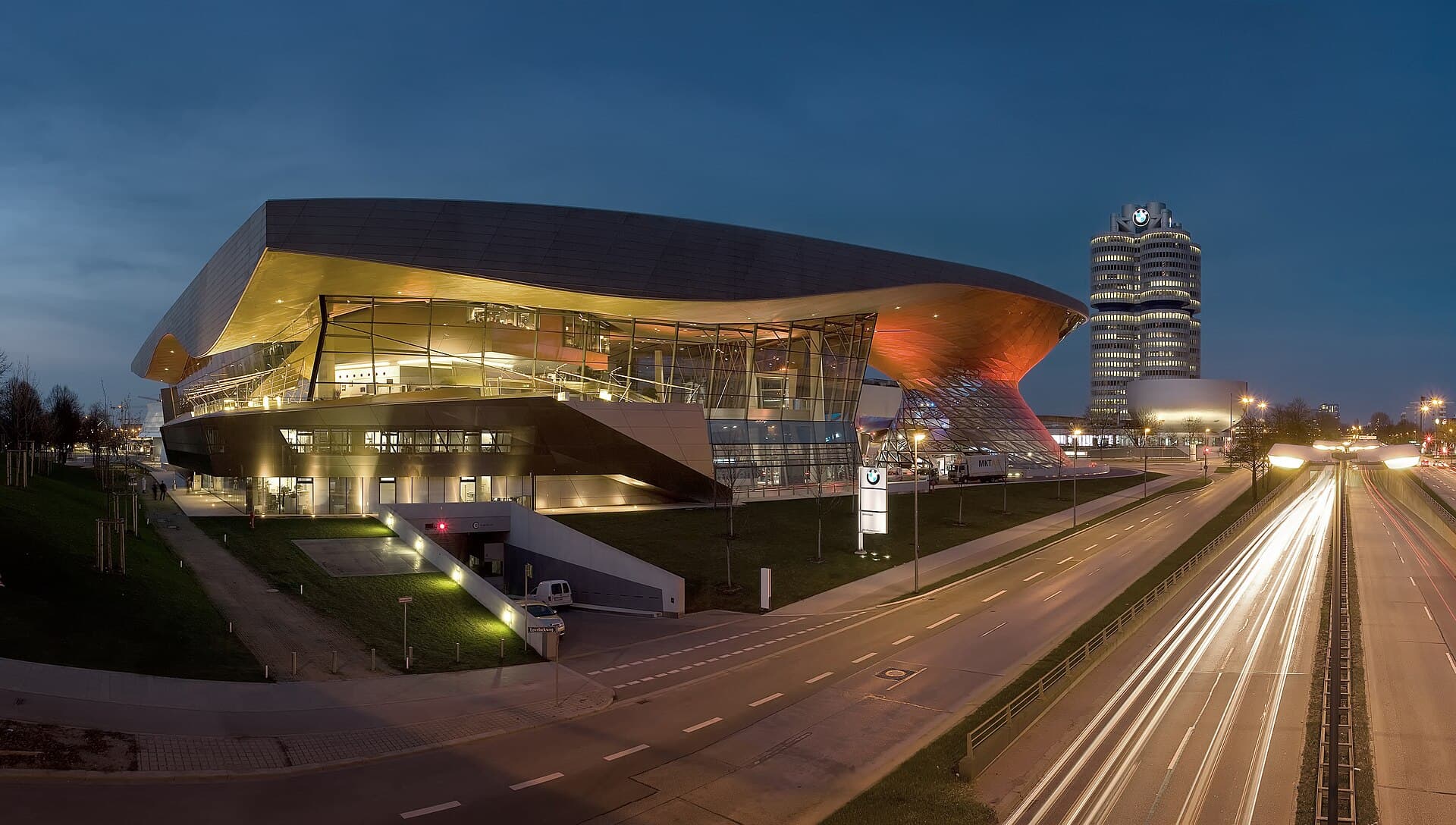
The BMW Museum is a silver drum of a building, like an upturned bowl, put up by the Austrian architect Karl Schwanzer in 1973 beside the company's four-cylinder tower — together among Munich's best-known modern landmarks. Inside, a rising spiral ramp carries you through a century of the company without ever doubling back. The story does not begin with cars. BMW started in 1917 building aircraft engines, moved from there to motorcycles, and only then to cars. The museum lays that sequence out plainly: early aero engines, motorcycles from the 1920s, the tiny front-door Isetta bubble car that rescued the company financially in the 1950s, and then the M sports cars and the Art Cars painted by international artists. And a correction to a popular myth: the blue and white roundel is not a spinning propeller but the colours of the Bavarian flag arranged in a circle. The propeller image came from a company advertisement in the 1920s and has stuck ever since. The museum itself sets the record straight in one of its sections.
Real racing cars painted by international artists since the 1970s — shown in rotation, and the thing that sets this apart from any other car collection.
A tiny car with a single front door that opens like a fridge, sold in the hundreds of thousands in 1950s Germany and credited with saving the company.
From the first aero engines to Formula 1 units, many cut lengthwise so you can see inside them.
A silver bowl from 1973 with an internal spiral ramp, beside the four-cylinder tower — Olympic-era Munich architecture at its clearest.
Am Olympiapark 2, 80809 München
The museum shows the company's history and charges admission; BMW Welt is a modern showroom for current models and a customer delivery centre, and is free. They face each other across a bridge, and a sensible visit takes in both in two to three hours.
Largely yes, because the display is built around design and industrial history rather than technical specification. The building, the Art Cars and the company's story through two wars hold a general visitor. Even so, someone with no interest in cars at all will find an hour enough.
Yes, but the plant tour is booked online weeks ahead and sold separately from the museum ticket, with a minimum age and strict rules on photography. Do not count on buying it on arrival.
The Olympic park adjoins it: the Olympiaturm with its view over the city and, on clear days, the Alps, and the 1972 stadium under its famous tented roof. Half a day covers the museum and the park together.