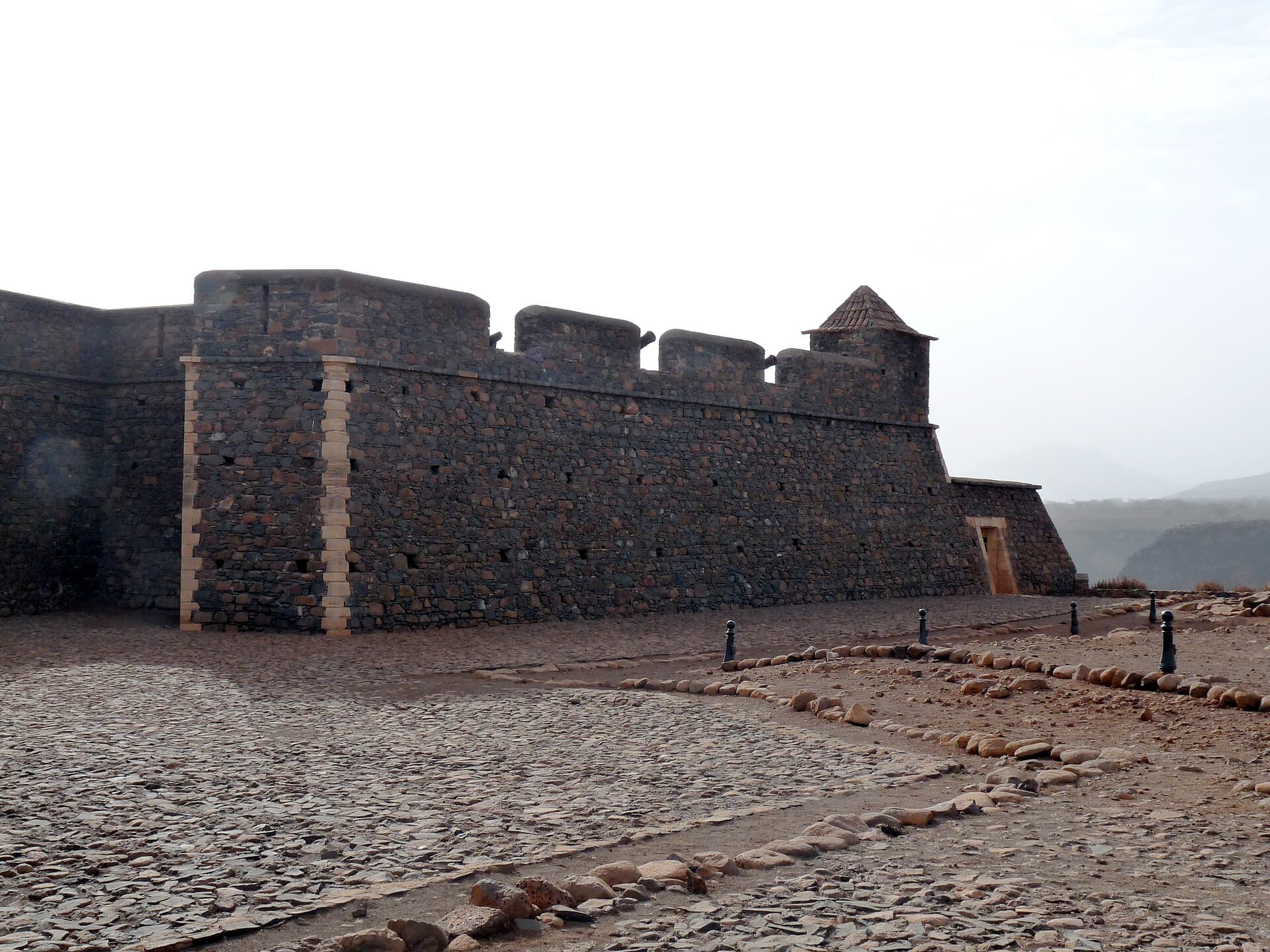
The cathedral ruins
Stone walls 60 metres long.
Franzfoto — CC BY-SA 3.0 · Reino Baptista — CC BY-SA 4.0 · Franzfoto — CC BY-SA 3.0 · Balou46 — CC BY 4.0 · Ji-Elle — CC BY-SA 3.0 · Ji-Elle — CC BY-SA 3.0
The historic centre of Cidade Velha is the oldest settlement in Cape Verde and its former capital, on the south coast of Santiago. Its name means old city. It was the first European colonial settlement in the tropics, and UNESCO listed it as World Heritage in 2009. Portuguese traders founded it in 1462 as Ribeira Grande, drawn by its plentiful water. In the sixteenth and seventeenth centuries it became a centre of sea trade between Africa, Brazil and the Caribbean and a key platform in the trade in enslaved Africans. Vasco da Gama stopped here in 1497 and Columbus in 1498. After attacks including Francis Drake's raid of 1585, the capital moved to Praia in 1770. You walk down to a small bay with coloured boats on a dark pebble beach, past low houses on Rua Banana. The main square holds the marble pillory of the early sixteenth century, where rebellious enslaved people were publicly punished. You also see the Church of Nossa Senhora do Rosário of 1495, the stone ruins of the 60-metre cathedral and the São Francisco convent on the slope. The town is 9.9 km in a straight line west of Praia, an easy half-day trip. The church is a place of worship, so dress modestly. It is hot and exposed, so bring a hat and water. Do not climb the ruins, and respect the graves within them. Keep valuables out of sight, as UK advice suggests, and take care with waves if you go down to the water.
Stone walls 60 metres long.
A church of 1495.
Coloured boats on pebbles.
Cidade Velha, southern Santiago island
Yes from Praia, and it pairs with the fort above town.
It means old city, and it was once called Ribeira Grande.