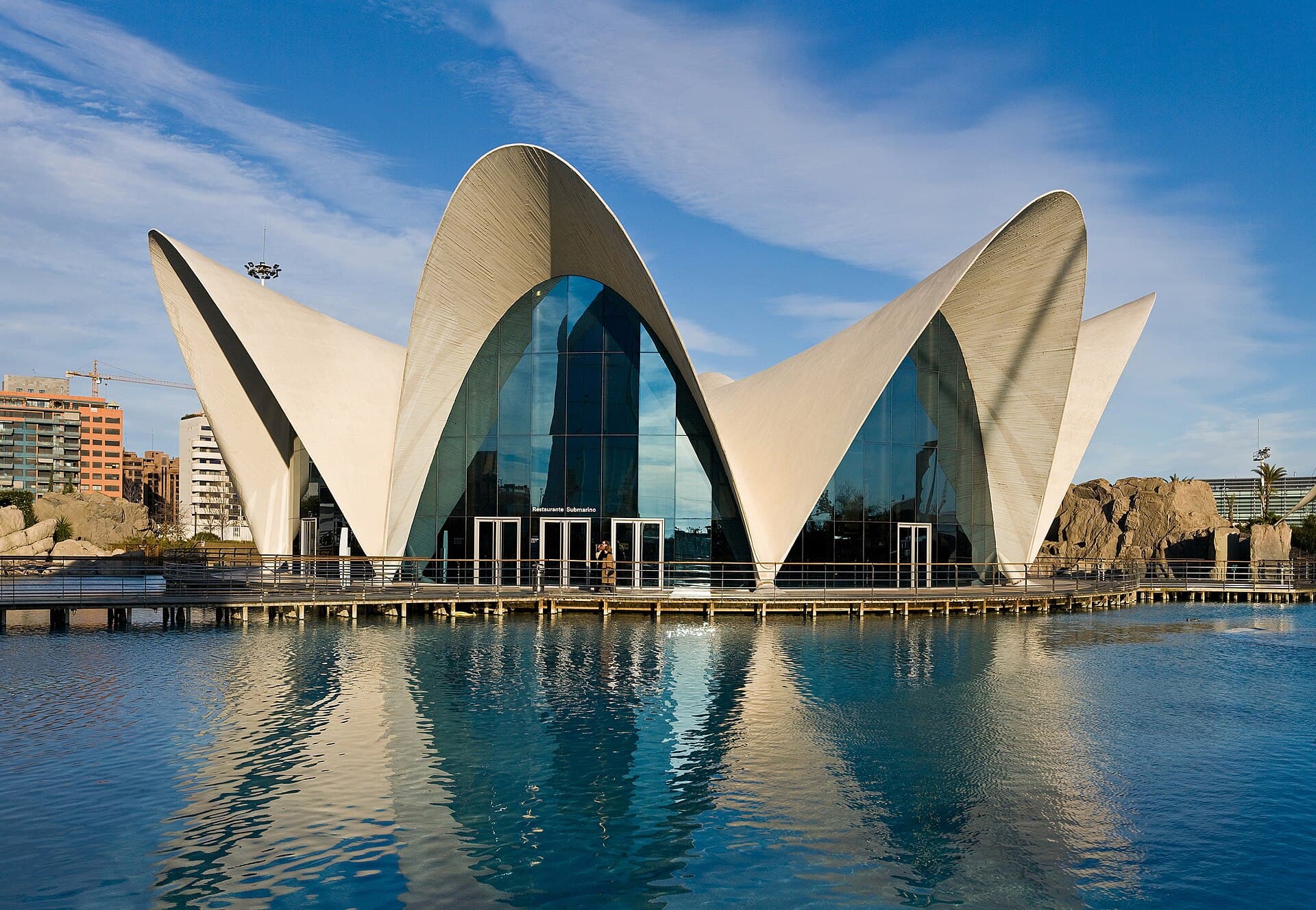
The Hemisfèric eye
The glass eyelid blinking on its pool — Calatrava's icon.
Bybbisch94, Christian Gebhardt — CC BY-SA 4.0 · Jcca76 — CC BY-SA 4.0 · Dorieo — CC BY-SA 3.0 · Dorieo — CC BY-SA 3.0
The City of Arts and Sciences is a future you walk through: Santiago Calatrava's white complex in the dry Turia riverbed — the giant blinking eye of the Hemisfèric on its pool, the whale-skeleton Science Museum, the Opera like a spacefarer's helm, the arched Umbracle garden — Spain's most famous architecture of the past half-century, backdrop to countless films and series. Walking among the pools is entirely free and is half the experience: reflections in the turquoise water make modern Spain's most famous images, and sunset here is an obligation. Interiors go by interest: a science museum where "not touching is forbidden", an IMAX dome, and Europe's greatest aquarium next door (its own page). Give the complex a free half-day, or a full one with entries — and use the combined tickets if you plan more than one building.
The glass eyelid blinking on its pool — Calatrava's icon.
White whale bones a quarter-kilometre long.
Modern Spain's most famous photos are taken from their edges.
A free arched palm walk overlooking the whole ensemble.
Av. del Professor López Piñero 7, 46013 Valencia
In honest priority: the Oceanogràfic first (world-class), the Science Museum with children (purely hands-on), the Hemisfèric for one fine dome show. The Opera is for performances, not visits. The exterior alone — at sunset — already justifies the trip.
From the centre: a lovely Turia-bed walk (a green half-hour) or direct buses. Half a day for grounds and photos, a full day with two buildings, two days for a family wanting Oceanogràfic and Science unhurried.