
The empty volume
Bare brick with no ornament — the scale alone is the effect.
W. Bulach — CC BY-SA 4.0 · Berthold Werner — Public domain · Heinz L.Boerder — CC BY-SA 3.0 · Carole Raddato from FRANKFURT, Germany — CC BY-SA 2.0
The throne hall of the emperor **Constantine**, built around **AD 310** — and **the largest surviving column-free interior from the ancient world**. The figures are the story: the hall is **67 metres** long, 27.5 wide and **33 metres** high, and its ceiling is **flat, with not one column supporting it** and no dome. No interior of this span without supports was built again in Europe **until the nineteenth century**. Inside, the effect is unexpected: the space is **entirely empty** — bare brick walls with no ornament, no furniture and no columns, and vast windows on two levels. It was originally faced in marble and mosaic and heated by an underfloor system, but all of that is gone. What remains is **the scale alone**, which is the stronger effect. Note: the design was politically deliberate: the windows in the apse are **smaller** than those in the walls, a perspective trick making the apse appear deeper and the emperor seated in it larger. After the Romans it became a bishops'' residence and then a palace, before being returned to its Roman form in the nineteenth century. It burned in the bombing of 1944 and was restored. Note: it is today a **working Protestant church**.
Bare brick with no ornament — the scale alone is the effect.
Smaller windows faking greater depth — architecture as power.
Thirty-three metres with not a single column.
Konstantinplatz 10, Trier
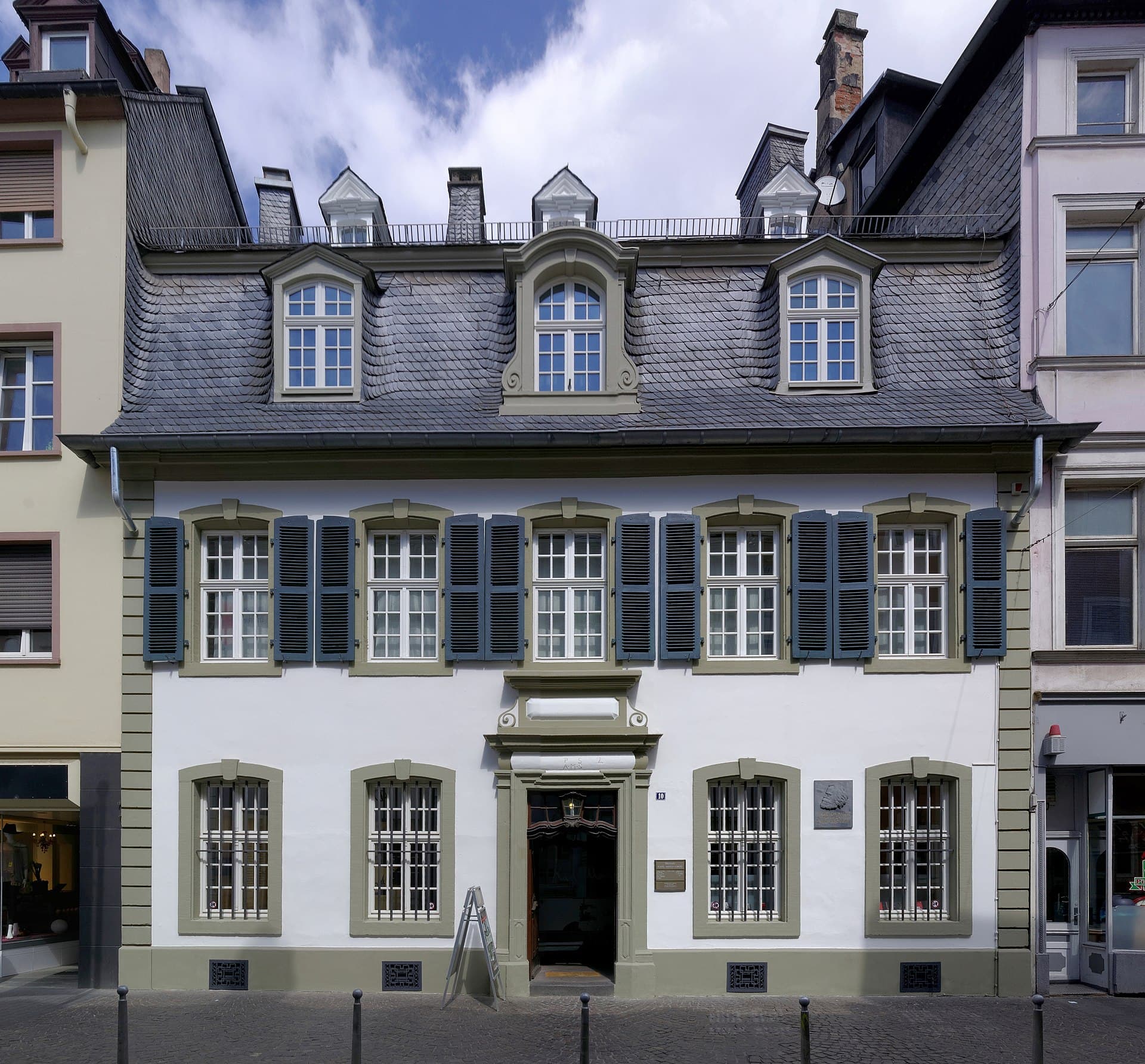 Karl Marx HouseThe house in which **Karl Marx was born** in **1818**, an eighteenth-century bar7 minutes walk4.4
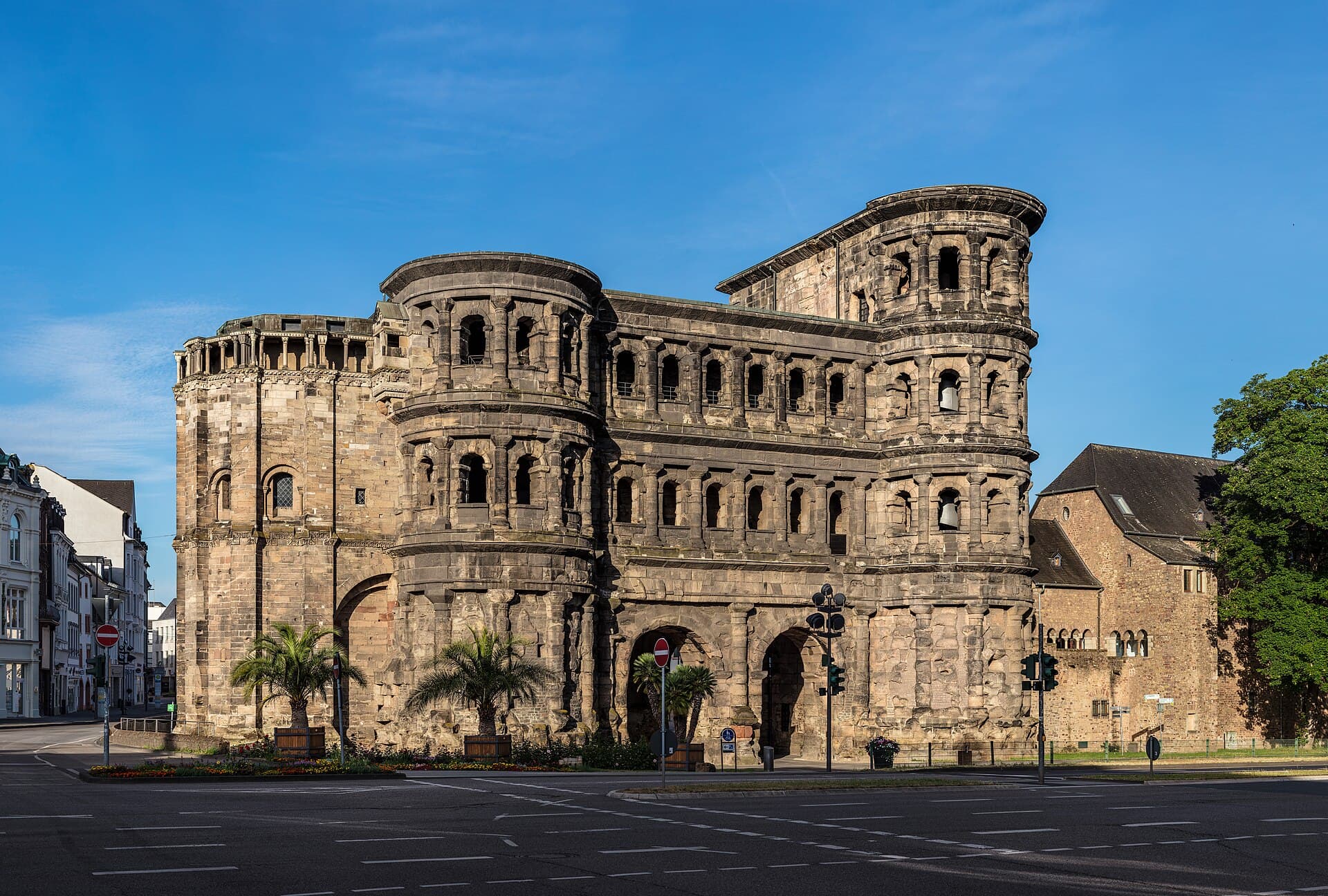 Porta Nigra**The largest surviving Roman city gate north of the Alps**, and the greatest Ro9 minutes walk4.5
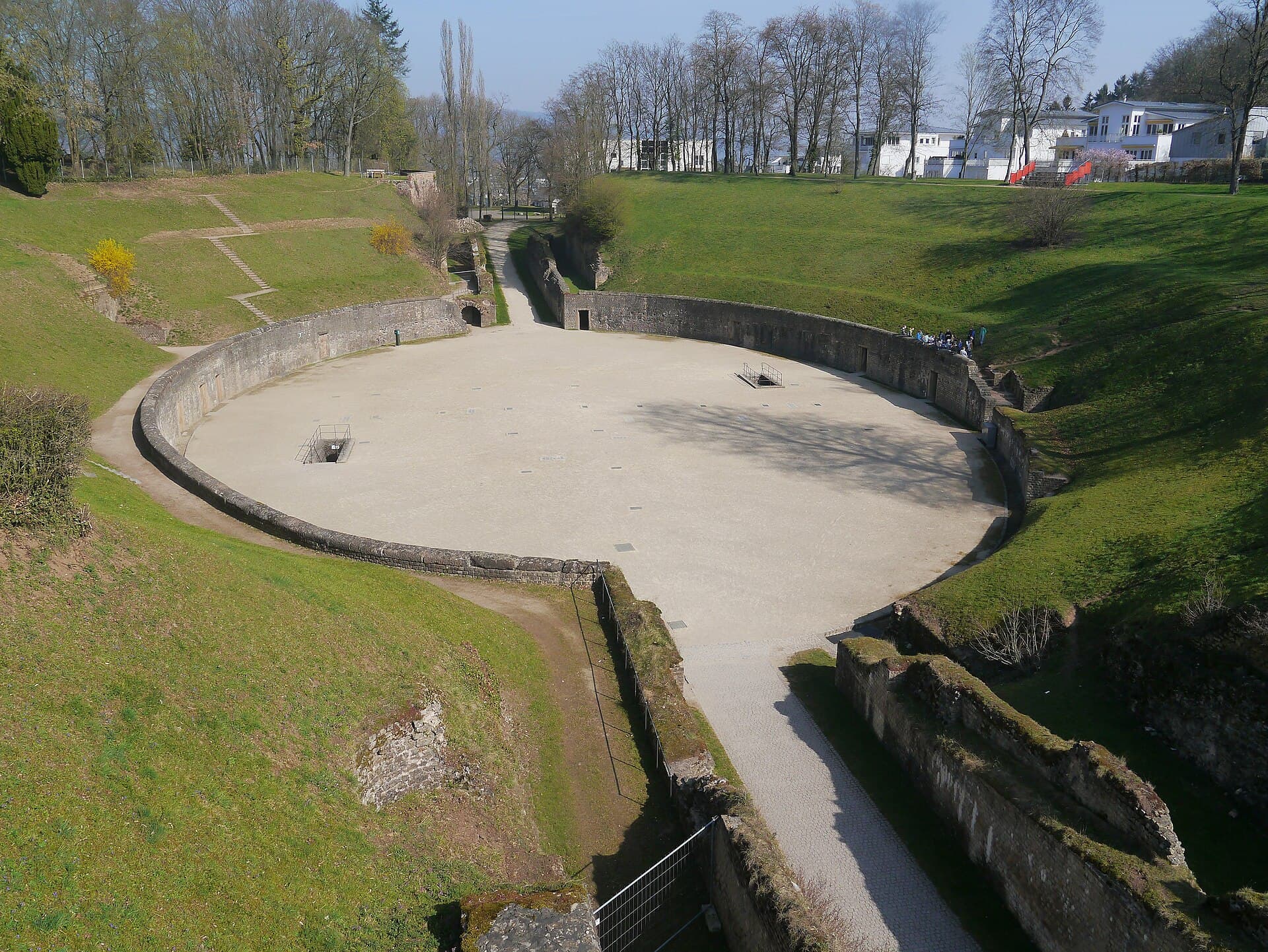 Trier AmphitheatreA Roman amphitheatre of about **AD 100** on a hillside east of the city, holding9 minutes walk4.6
Because of **the frontier**. In the late third century the empire was under threat on the Rhine from Germanic tribes, and the emperors realised that governing it from Rome — a month''s travel away — was militarily impossible. So in 293 **Diocletian** divided the empire into four parts under four rulers (**the Tetrarchy**), each with a capital near its own front. **Trier** was chosen for the west because it lies on the Moselle just behind the Rhine frontier — close enough to command, far enough to be safe. **Constantius Chlorus** ruled from it, then his son **Constantine**, then **Valentinian**. Its population reached eighty thousand, and the baths, basilica and palaces were built. ⚠ It ended in the early fifth century when the administration moved to Arles and Trier fell to the Franks.