The sculpture garden
Henry Moore and Arp on grass facing the sea.
Ppntori — CC BY-SA 4.0 · Bengt Oberger — CC BY-SA 4.0 · Bengt Oberger — CC BY-SA 4.0 · Bengt Oberger — CC BY-SA 4.0
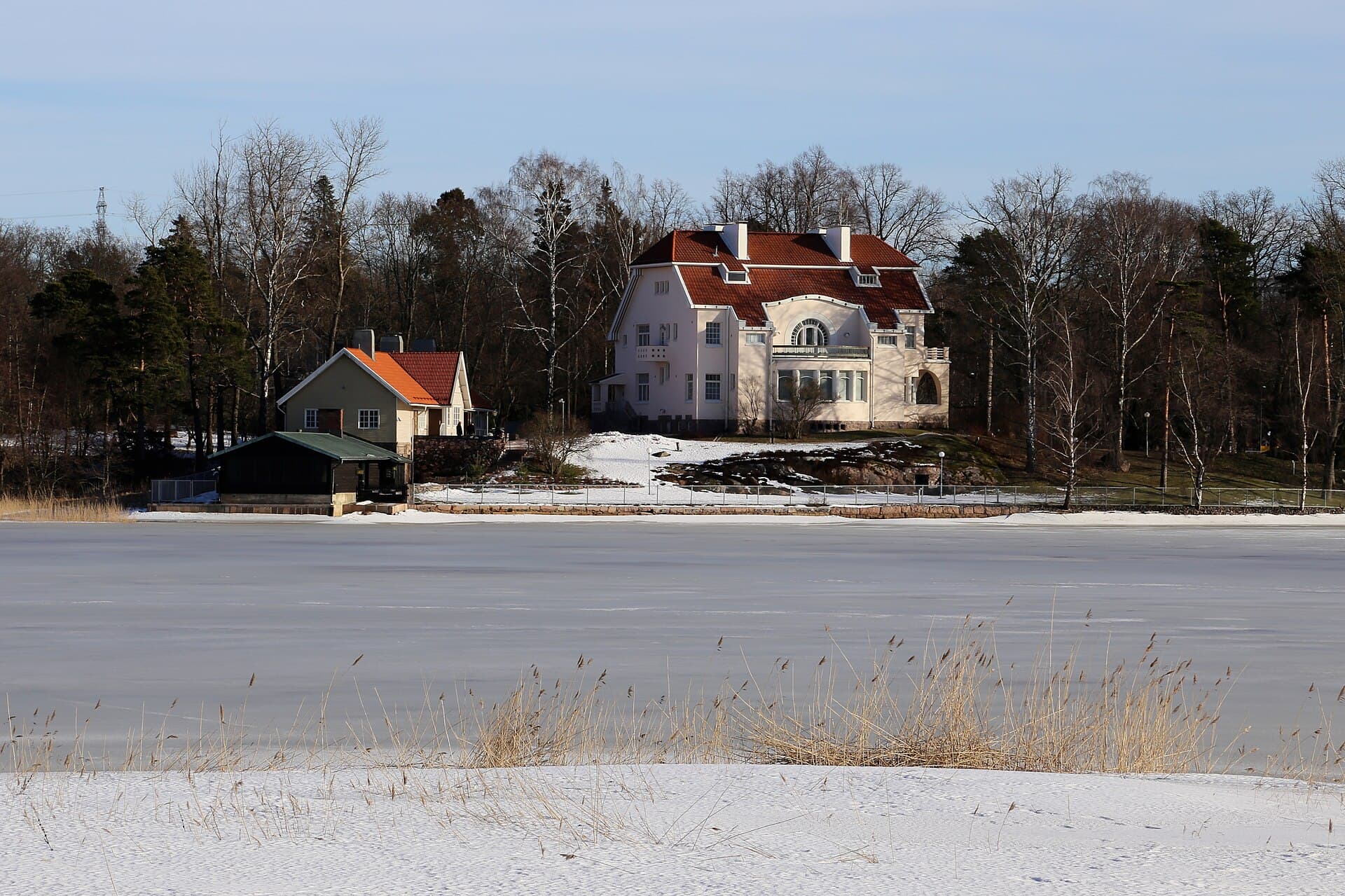
The Didrichsen Museum stands on the small island of **Kuusisaari** west of Helsinki, a private house turned museum — and among the most beautiful and least crowded places in the city. The architect **Viljo Revell** built it in 1959 for Gunnar and Marie-Louise Didrichsen, adding a gallery wing in 1965. Revell was among the leading Finnish modernists, and the house is a model example: low white masses, windows running to the floor and opening onto the sea, and a merging of interior and garden. The collection has two parts. The first is **modern Finnish art** with names like Gallen-Kallela, Schjerfbeck and Cawén. The second — the surprising one — is **Asian art**: Chinese ceramics, bronzes and sculpture from the Shang to the Tang, and Japanese pieces, collected by Didrichsen across his life. And in the garden are **outdoor sculptures** by Henry Moore, Arp and others, on grass looking straight out to sea. **West of Helsinki by bus** — a little way out, which is why it is quiet.
Henry Moore and Arp on grass facing the sea.
Shang to Tang, in a modernist house.
Kuusilahdenkuja 1, Kuusisaari, Helsinki
Three you will meet in every Finnish museum. **Akseli Gallen-Kallela** (1865-1931) is the best known, and painted scenes from the national epic Kalevala in a strong symbolist manner — his pictures are the visual image of Finnish myth. **Helene Schjerfbeck** (1862-1946) is the one critics now rate highest: self-portraits painted across decades that grow more stripped and austere as she aged, a series compared to Rembrandt's. And **Hugo Simberg**, who painted The Wounded Angel, the most famous picture in Finland. All three are in the Ateneum national gallery and in collections like this one.