The stupa
In its modern shell.
Jonibek Qo'zimurodov — CC BY-SA 4.0 · Jonibek Qo'zimurodov — CC BY-SA 4.0 · Jonibek Qo'zimurodov — CC BY-SA 4.0 · Jonibek Qo'zimurodov — CC BY-SA 4.0 · Jonibek Qo'zimurodov — CC BY-SA 4.0 · Prof. Mortel — CC BY 2.0 · Jonibek Qo'zimurodov — CC BY-SA 4.0 · Nicoletta Stofkoper — CC0
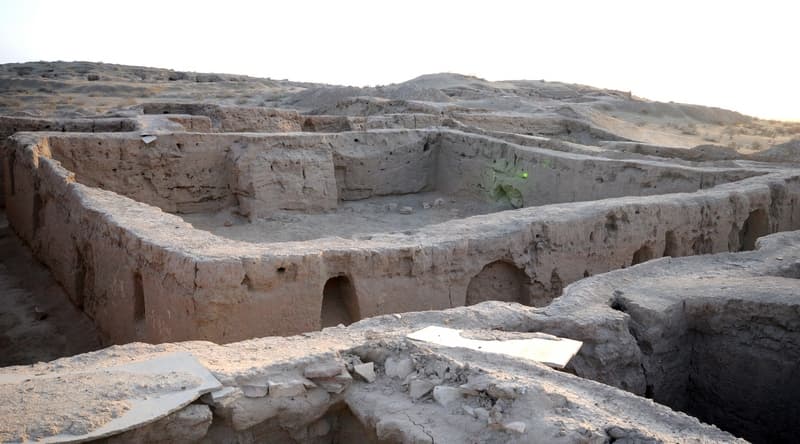
The ruins of a Kushan-era Buddhist monastery near old Termez, founded in the 1st century CE, at its height in the 3rd and 4th centuries and in decline by the 5th. An alabaster statue found by chance in the dunes in 1968 led to excavations that ran until 1976. The site has three parts: a temple in the centre, a monastery to the northwest with the cells of monks and their students, and service buildings to the southeast. Outside stands a stupa, a solid domed mound once walked around in devotion, reached by a path of brick and stone. The temple walls were covered in coloured paintings, of which only the lower parts survive, and in the monastery courtyard a small drinking-water pool drains through a spout carved as a lion's mouth, a piece of Kushan art. The site was conserved in a UNESCO project funded by Japan, and a modern shell now protects the stupa. Tickets are about 40,000 som, per visitor guides. There is no shade, so go in the morning with water and sun protection, and combine it with nearby Kara Tepe.
In its modern shell.
Around the courtyard.
Of the water pool.
Northwest of Termez, by the ruins of old Termez
In the morning, as there is no shade; tickets are about 40,000 som per visitor guides, and nearby Kara Tepe fits in the same trip.