The ramparts
Black cannon over the sea.
Stig Nygaard from Copenhagen, Denmark — CC BY 2.0 · Stig Nygaard from Copenhagen, Denmark — CC BY 2.0 · Jcornelius — CC BY-SA 4.0 · Leonardo de Ferrari — Public domain
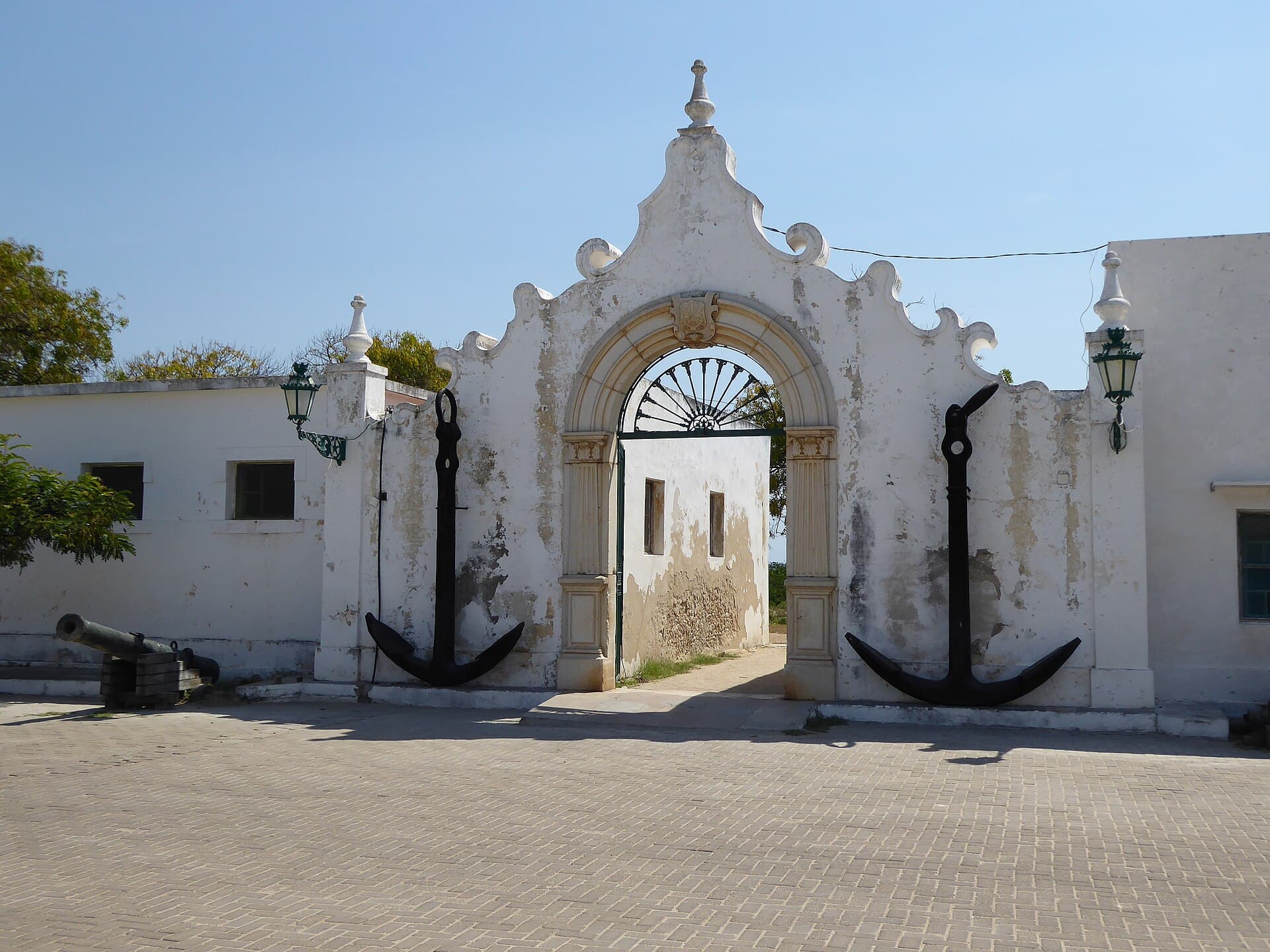
Fort São Sebastião stands at the northern end of Stone Town on the Island of Mozambique, and it is the oldest complete fort still standing in sub-Saharan Africa. The ocean surrounds it on several sides, and from afar its broad stone walls look like part of the rock. It is the largest sight on the island and the one that most stirs the imagination. The Portuguese began it in 1558, and it took about fifty years to finish. It held out against Dutch attacks in 1607 and 1608, with Dom Estêvão de Ataíde in command. Thanks to the fort, the island remained an important stop on the Portuguese route to India. In 2013 the Zamani Project of the University of Cape Town recorded it with 3D laser scanning. You enter by a narrow stone passage into a wide, almost empty inner yard, with long white buildings and the old church of São Sebastião, its walls flaking, which you see from outside. On the ramparts black cannon point out to sea beside small watchtowers. Beyond the fort stands the little Chapel of Nossa Senhora de Baluarte, built in 1522 and considered the oldest European building in the southern hemisphere. It is about 1.5 km from the middle of the island in a straight line, so it is an easy walk. Climb the ramparts late in the day, when the heat eases and the light softens. There is almost no shade up there, so bring water and a hat. Ask for a ticket when you pay, as guides warn of paying twice. The ground is uneven, so take care near the edges.
Black cannon over the sea.
Wide, with an old church.
A small building from 1522.
Northern end of Stone Town, Island of Mozambique
One to two hours, including the ramparts and the walk to the small chapel.
It is not required, but a guide explains the history, so agree a price first.