Stone Town
Old streets and arcades.
Jcornelius — CC BY-SA 4.0 · Jcornelius — CC BY-SA 4.0 · Jcornelius — CC BY-SA 4.0 · Jcornelius — CC BY-SA 4.0 · Jcornelius — CC BY-SA 4.0
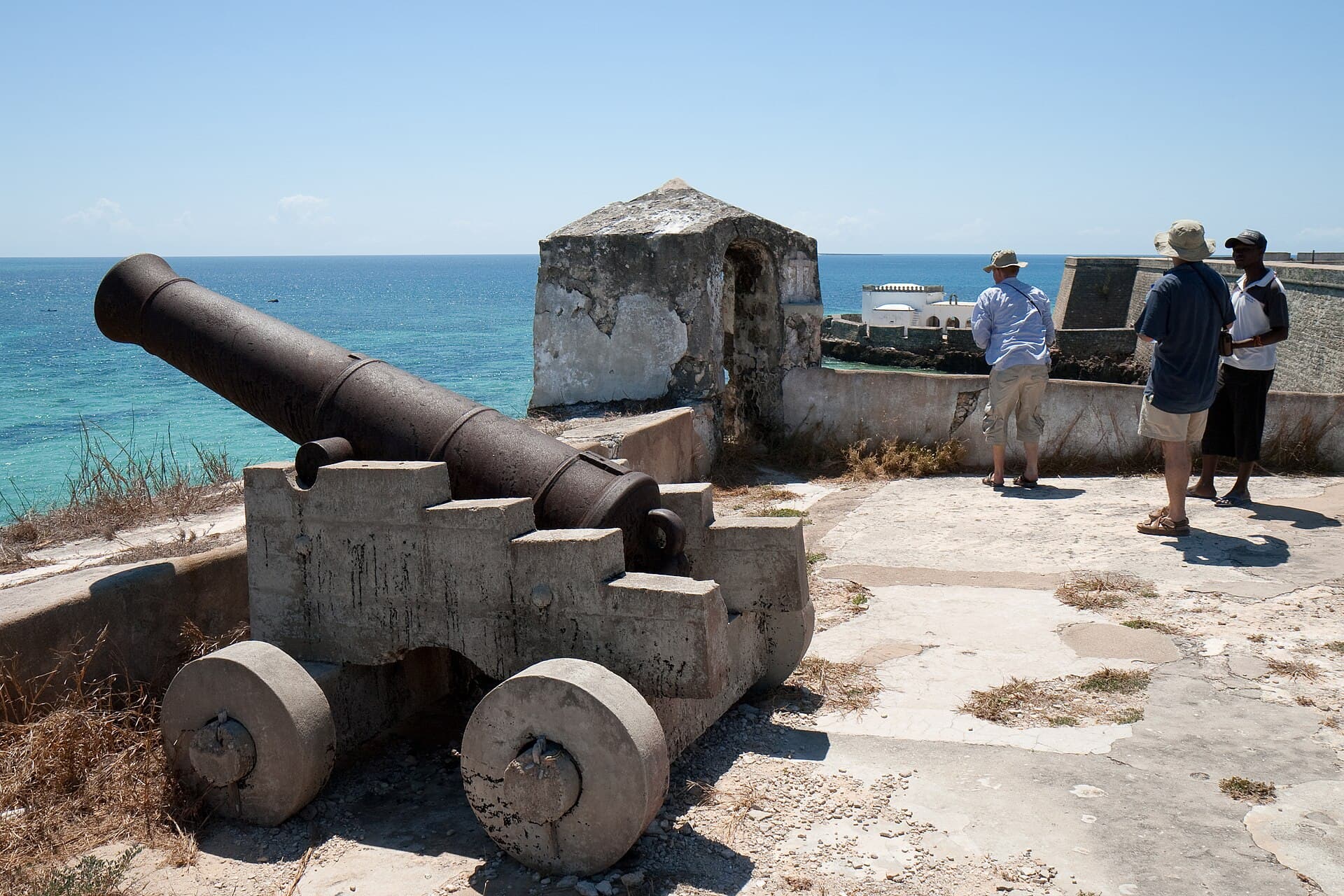
The Island of Mozambique is a small island off the north of the country, between the Mozambique Channel and Mossuril Bay, and it gave the whole nation its name. It is a UNESCO World Heritage Site and was the capital of Portuguese East Africa until 1898. About 14,000 people live here, among old stone houses, lively neighbourhoods and sandy beaches. Pottery found on the island shows the town existed by the 14th century at the latest, and tradition says its first Swahili people came from Kilwa. The name goes back to Ali Musa Mbiki, sultan of the island in Vasco da Gama's day. Duarte Barbosa noted a Muslim population in 1514. The Portuguese set up a port and naval base in 1507, and spices, gold and enslaved people all passed through here. The northern part, known as Stone Town, has narrow streets with faded yellow and blue fronts and long arcades that shade walkers from the sun. Before the old captaincy stands a white gate guarded by two black anchors. You will also see the white Nossa Senhora da Saúde church from outside, the old Cine-Teatro Nina, the big trees of the Campo São Gabriel garden and a hospital from 1877. It is about 158 km from Nampula city in a straight line, with the nearest airport at Lumbo on the mainland. Visitors arrive over a long bridge. Stone Town is easy on foot, so you need no car. There are many mosques, so dress modestly. The best months are May to October, when it is cooler and drier.
Old streets and arcades.
Two black anchors.
An old town landmark.
Off the Nampula coast, northern Mozambique
Two days suit Stone Town and the fort, with another if you want a boat trip.
From Ali Musa Mbiki, sultan of the island in Vasco da Gama's day, and the name then passed to the mainland.