The Roman theatre
Seating for around twelve thousand with its stage facade and reliefs re-erected by the Italian mission, the most complete thing on the site and its best viewpoint.
Carole Raddato — CC BY-SA 2.0 · Giorgio Galeotti — CC BY-SA 4.0 · Giorgio Galeotti — CC BY-SA 4.0 · Interfase — CC BY-SA 4.0
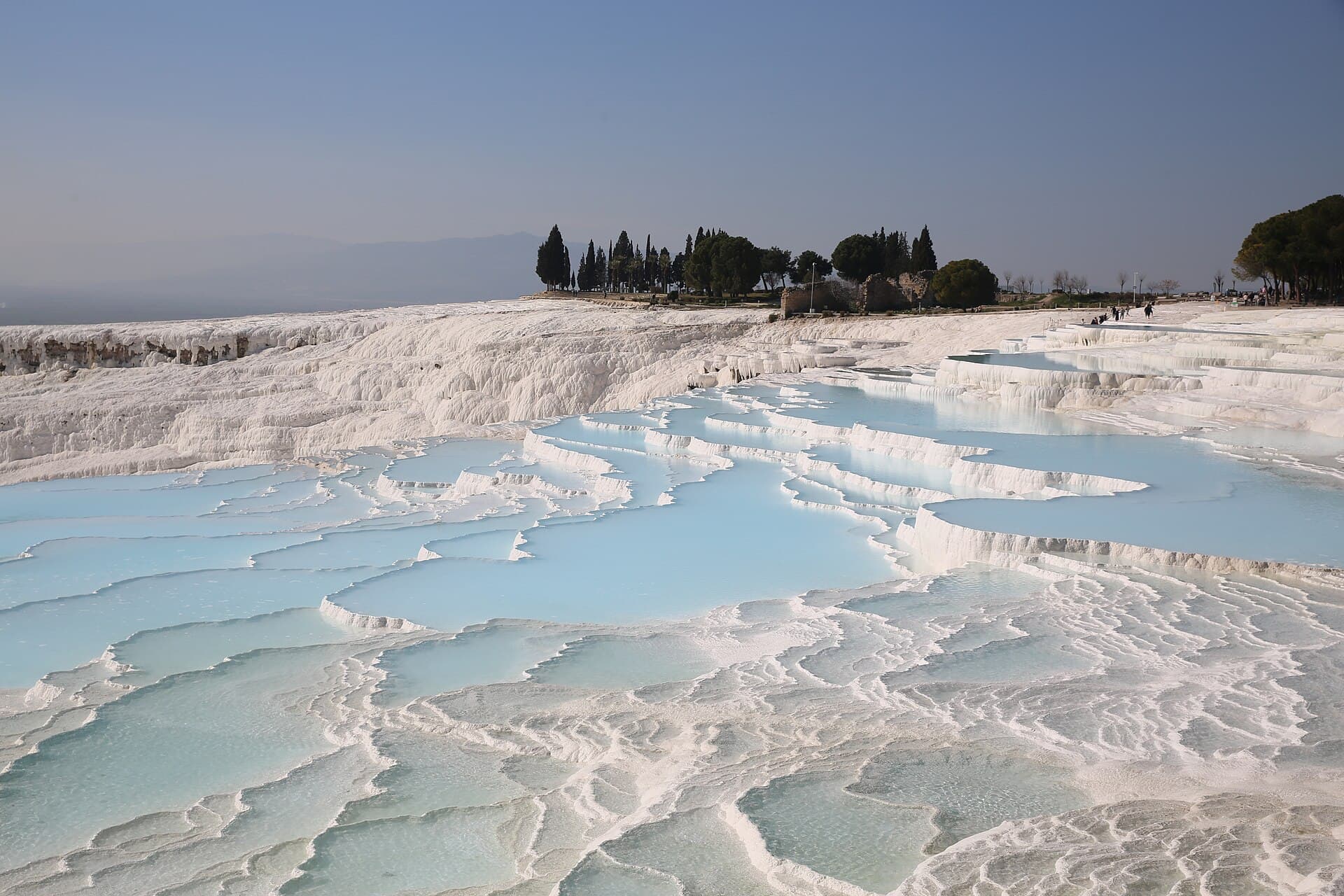
On the plateau that feeds the white cascades of Pamukkale, Greeks and then Romans built an entire city for what amounts to one purpose: to bathe in warm water, and to be buried near it. Hierapolis was a spa town founded in the 2nd century BC and enlarged under Rome, and what survives is a sprawling ruin that shares the travertines' UNESCO listing (1988) and their entry ticket. The surprise for most visitors is that the famous terraces are only the rim. The bulk of the site is this city, and most people who climb the travertines barefoot never wander more than two hundred metres past them. The Roman theatre is the reason to keep climbing: seating for around twelve thousand, built under Hadrian and enlarged under Septimius Severus, its stage facade and reliefs re-erected by the Italian mission that has dug here since 1957, which makes it one of the most complete theatres in Anatolia. Close by stands the Temple of Apollo and, beside it, the Ploutonion or 'Gate of Hell': a small cave breathing carbon dioxide at lethal concentration, into which priests walked and walked out alive while birds and bulls dropped dead. Its location was only pinned down for certain in 2013. The hole itself is unremarkable to look at, yet it is one of those places that stays in the memory far longer than its size deserves. Head north along colonnaded Frontinus Street and through its triple gate, past the Roman public latrine that impresses children more than any temple, and you reach the necropolis: two kilometres of sarcophagi and tomb houses lining the road, more than 1,200 graves, one of the largest ancient cemeteries in Anatolia. The sick came to be cured, and many never left. The Antique Pool, better known as Cleopatra's Pool, is a thermal basin at 36°C with marble columns lying on its floor where a 7th-century earthquake dropped them. It reopened in May 2026 after sixteen months of renovation; swimming needs a separate ticket (600 TRY for adults), the pool is mixed with no women-only sessions, and you can watch from the cafe for nothing. Practically: the site is huge and almost shadeless. From the South Gate (car park, museum, pool) to the theatre is 1.5 km, and from there through the necropolis to the North Gate another 2 km. Allow three to four hours, a hat and water; in August start at the 08:00 opening or come after seven in the evening, when the site reopens under lights until 23:00 (1 June to 1 October). Paid golf carts link the main points and rescue older relatives; a pushchair works only on the paved stretch around the pool and museum. April, May, September and October are the months to aim for; winter is cold and the ruins can occasionally sit under snow, though the warm pool runs all year. Denizli is 20 km away by frequent minibus, and most of our readers drive in from Antalya (about three and a half hours) or İzmir (about three).
Seating for around twelve thousand with its stage facade and reliefs re-erected by the Italian mission, the most complete thing on the site and its best viewpoint.
A cave breathing lethal gas that priests entered and left alive, pinned down only in 2013, and smaller to look at than its story.
Two kilometres of sarcophagi and tomb houses lining the road, more than 1,200 graves, for those with the time and water to walk to the North Gate.
Pamukkale plateau, Pamukkale district, Denizli
The same ticket covers both, so the real question is time. The theatre alone is worth 45 minutes and is a 15-minute walk from the top of the terraces. With small children in August heat, do the theatre, the Antique Pool and the museum and head back down; the northern necropolis is for people who like ruins and have a spare hour and a bottle of water.
There is no women-only session and no family rooms; the pool is mixed and swimwear is compulsory, so if that rules it out, watching from the cafe is free and the view from the edge is lovely. If you will swim, 36°C water with Roman columns under your feet is a one-off, and the pool was renovated and reopened in May 2026 with changing rooms and lockers. Busiest between 11:00 and 16:00.
Sign in to write your review of this place.
No reviews yet — be the first.