The Noon Gate
Crowned by the Five Phoenix pavilion.
User: (WT-shared) Shoestring at wts wikivoyage — Public domain · Christophe95 — CC BY-SA 4.0 · This Photo was taken by Supanut Arunoprayote. Feel free to use any of my images, but please mention me as the author and may send me a message. (สามารถใช้ภาพได้อิสระ แต่กรุณาใส่เครดิตผู้ถ่ายและอาจส่งข — CC BY 4.0 · https://www.flickr.com/photos/sixty4coupe/ — CC BY-SA 2.0
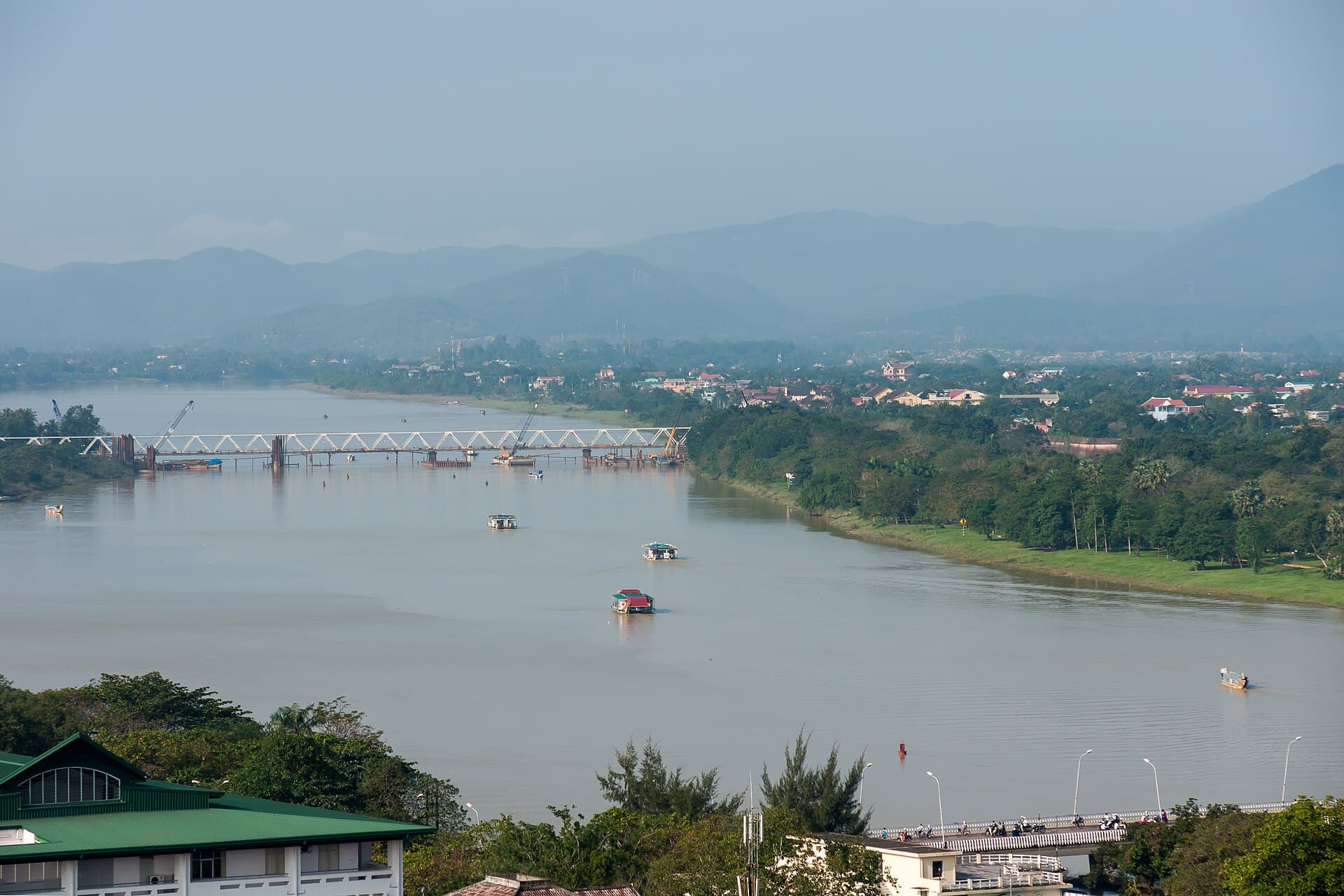
The palace complex of the Nguyen dynasty, Vietnam's last ruling house, set inside the walled citadel of Hue on the north bank of the Perfume River. Emperor Gia Long began it in 1804, modelled on Beijing's Forbidden City, and it reached its present scale by 1833; it remained the seat of the court until the last emperor, Bao Dai, abdicated here on 30 August 1945. Visitors enter through the Noon Gate, Ngo Mon, a fortified gatehouse crowned by the Five Phoenix pavilion, and walk past lotus ponds to the Thai Hoa throne hall with its lacquered red-and-gold columns. Beyond it lay the Purple Forbidden City, the emperor's private quarters, open only to the royal family and their servants; most of it was destroyed in the fighting of 1968, and rebuilt halls now stand among the foundations. Also inside are the temple of the Nguyen emperors with nine great bronze urns cast in the 1830s in front of it, the residences of the queen mothers and long covered galleries. UNESCO listed it in 1993 as part of the Complex of Hue Monuments. The grounds are large and shade is patchy, so allow at least two to three hours and come early or late in the day.
Crowned by the Five Phoenix pavilion.
Red-and-gold lacquered columns.
Cast in the 1830s.
Inside the walls of the Hue citadel, on the north bank of the Perfume River
At least two to three hours, as the complex is large; come early or late in the day to avoid the heat.
Yes: 420,000 dong for the Imperial City and two tombs, and 530,000 with all three tombs of Minh Mang, Tu Duc and Khai Dinh.