River confluence
Views over Mtskheta.
This Photo was taken by Supanut Arunoprayote. Feel free to use any of my images, but please mention me as the author and may send me a message. (สามารถใช้ภาพได้อิสระ แต่กรุณาใส่เครดิตผู้ถ่ายและอาจส่ — CC BY 4.0 · Moreau.henri — CC BY-SA 3.0 · Paata Vardanashvili — CC BY 2.0 · Jaba1977 — CC BY-SA 4.0 · Gerd Eichmann — CC BY-SA 4.0 · Gerd Eichmann — CC BY-SA 4.0 · Soghomon Matevosyan — CC BY-SA 4.0 · Millodarka — CC BY-SA 4.0
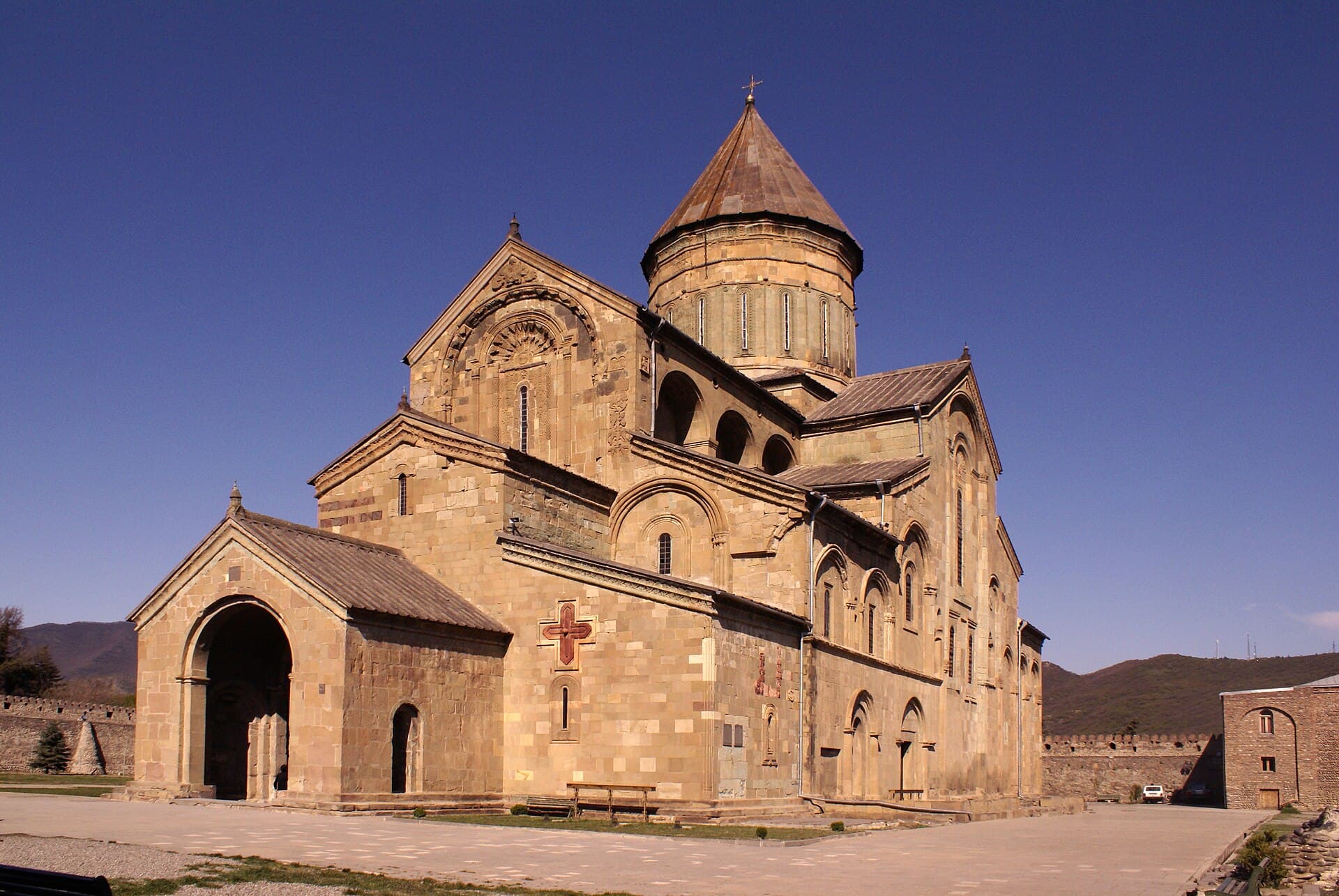
A sixth-century Georgian Orthodox monastery crowning a rocky summit about 656 metres high above the confluence of the Mtkvari and Aragvi rivers, overlooking Mtskheta, the ancient capital of the Kingdom of Iberia. Its terrace offers one of Georgia's finest views, where the two rivers meet in different colours below the historic town. Tradition holds that St Nino, who brought Christianity to Georgia, raised a great wooden cross here in the early fourth century on the site of a pagan temple, and the cross drew pilgrims from across the Caucasus. A small church was built over its remains around 545, and the present great church between about 590 and 605. It is a rare case of an early medieval Georgian church surviving almost unchanged, and it became the model for an architectural style found across Georgia and Armenia, known as the Jvari type. Together with Mtskheta's other historic monuments it was inscribed as a UNESCO World Heritage Site in 1994. Entry is free and it is an active monastery, so dress modestly. A paved road climbs to the summit; the easiest way is by car or on a tour from Tbilisi, about half an hour away, combined with Svetitskhoveli Cathedral in Mtskheta. The summit is often windy, so bring a jacket.
Views over Mtskheta.
Almost unchanged.
The site of the old cross.
Summit of Jvari Mount above Mtskheta, about twenty kilometres north of Tbilisi
By car or on a tour from Tbilisi, about half an hour away; most visitors combine the monastery with Svetitskhoveli Cathedral in half a day.