The eruption, in a dark room
The closing Vesuvius film is a quarter-hour 3D projection on a wrap-around screen with a seismic simulator, and it is the part of the visit children actually remember.
Mentnafunangann — CC BY-SA 3.0 · OrCer — CC BY-SA 4.0 · OrCer — CC BY-SA 4.0 · OrCer — CC BY-SA 4.0
A whole museum about Herculaneum and Pompeii that owns not one ancient object. Everything at MAV is light: projections stretched across walls, screens rebuilding the towns as they stood before the morning of AD 79, floors that turn to mosaic as you walk over them. The premise is simple and a little cheeky — the originals are five minutes downhill, so why duplicate them? Three floors cover some five thousand square metres and more than seventy multimedia installations, ranging over Pompeii, Herculaneum, Baiae, Stabiae and Capri: the Herculaneum central baths filling with steam, the Villa of the Papyri with its library, the town's theatre still buried under solidified volcanic rock, Villa Jovis on Capri, the bay of Baiae before the sea swallowed it. The circuit ends with a quarter-hour 3D film of the eruption, thrown onto a twenty-six-metre screen that wraps around you, with a seismic simulator that kicks in as the mountain goes — and that is the part children come out talking about. Let us be honest, though: the technology is not new. MAV opened in July 2008 and some sequences now look like the games of that decade — graphics that have aged, projectors not always perfectly aligned. Do not come here instead of the excavations. Come an hour before them, so you walk into the real town already knowing how those walls were coloured and where people sat. With children in particular, that order changes the whole day. Practically: the building is on Via IV Novembre, halfway down the walk from Ercolano Scavi station to the gate of the excavations, so you pass it whether you intend to or not. Entry is by timed slot and the museum asks you to book online at least 24 hours ahead; it is also covered by the Campania Artecard. The halls are air-conditioned and the route is set up for wheelchairs and pushchairs — a genuine advantage on a summer afternoon, when the open excavations offer almost no shade at all.
The closing Vesuvius film is a quarter-hour 3D projection on a wrap-around screen with a seismic simulator, and it is the part of the visit children actually remember.
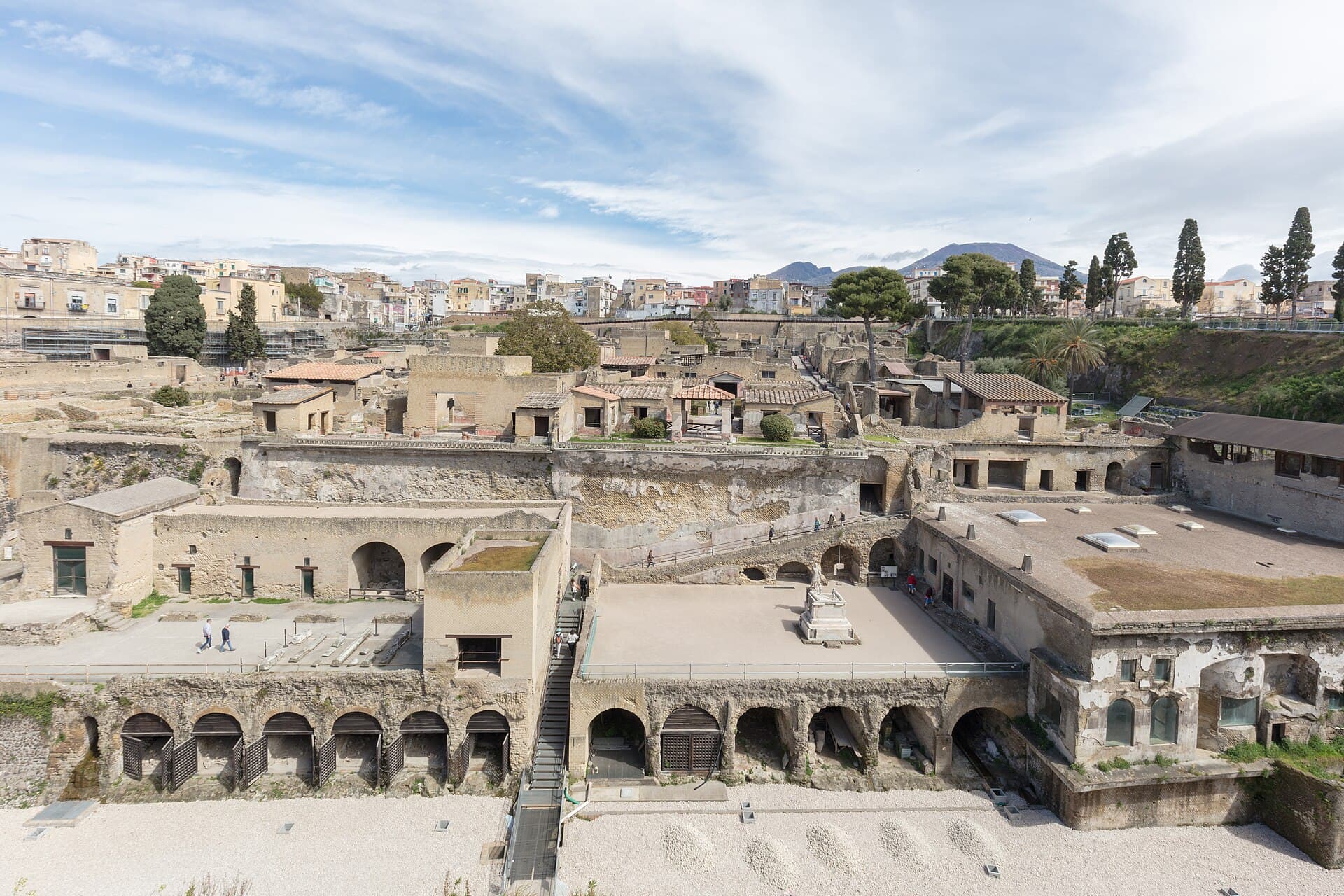
Sunken Baiae, the Villa of the Papyri and Herculaneum's buried theatre are rebuilt here precisely because you cannot enter them.
Do MAV first and Herculaneum second — the other way round it feels flat and repetitive.
Via IV Novembre 44, 80056 Ercolano (Naples)
No, and it does not pretend otherwise — there is not a single original artefact in the building. Treat it as a one-hour visual briefing before the real town, which is a five-minute walk downhill.
Yes — for under-tens it usually lands better than the ruins do: dark rooms, things to touch, no long walk in full sun. The one caveat is the eruption sequence, which is loud, very dark and physically shaky for a sensitive child.