The historic library
The 1814 school's library, its old books still in place.
Konstantinos Stampoulis (Geraki — CC BY-SA 3.0 gr · rob Stoeltje from loenen, netherlands — CC BY 2.0 · rob Stoeltje from loenen, netherlands — CC BY 2.0 · rob Stoeltje from loenen, netherlands — CC BY 2.0
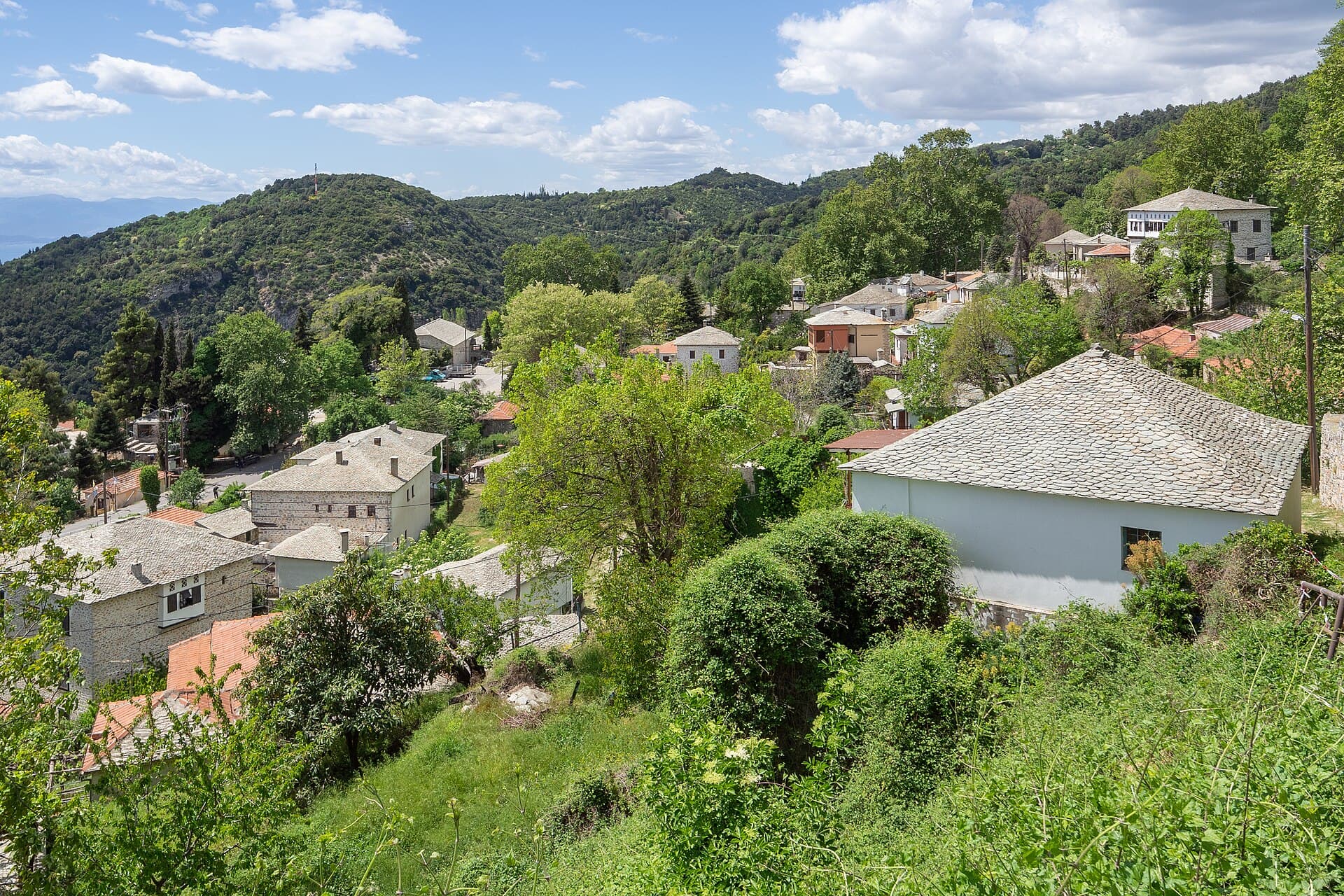
**A mountain village that was an intellectual centre before Greek independence** — in southern Pelion, and the terminus of the historic **Pelion railway**. Its historical importance exceeds its size: a **school and library** were founded here in **1814** (the *Scholi Milion*) that became **one of the most important centres of the Greek Enlightenment** before the revolution — teaching modern science and philosophy, **and producing men who took part in the 1821 rising**. The **library still stands** with its old books. On its square is the 18th-century church of **Taxiarches**: a low building, deliberately modest outside — because the Ottomans did not permit conspicuous churches — **and inside, frescoes covering every surface**. ✅ The railway station is at its edge, reached by an **iron bridge** designed by an Italian engineer. ⚠ And the village **climbs steeply with many steps**.
The 1814 school's library, its old books still in place.
Paintings over every surface inside a plain-looking church.
The end of the historic Pelion line, and its iron bridge.
Milies, 37010 Magnesia, Greece
**A 19th-century narrow-gauge train still running seasonally — a lovely experience that needs planning.** ✅ **What it is**: a **narrow-gauge** line (60 cm) built in the 1890s to link Volos with the Pelion villages, **its bridges designed by the Italian engineer Evaristo de Chirico** — father of the painter Giorgio de Chirico. The line climbs the mountain over **bridges, through tunnels and around tight curves** among olives and forest. ✅ **What survives today**: a tourist section between **Ano Lechonia** and **Milies** — about **90 minutes** one way behind a historic locomotive. ⚠ **⚠ What you must know**: it is **seasonal** (usually spring to autumn), **runs very few services** (mostly at weekends), **and requires booking**, which can sell out. **Check the official timetable before building your day around it.** ⚠ **And plan the return**: it is often one-way — you need a car or a taxi from Milies, or must wait for the return working.
**An intellectual movement that preceded and prepared the revolution — and it grew in the villages because the cities were watched.** ✅ **What it was**: in the **18th and early 19th centuries** a movement of **intellectual and linguistic revival** arose among Greeks under Ottoman rule: translating European books, teaching **modern science, mathematics and philosophy** rather than religious instruction alone, and reviving pride in the Greek language and the classical inheritance. **This is the intellectual soil that produced the 1821 revolution.** ✅ **Why mountain villages**: because places like **Milies**, **Zagori** and **Ambelakia** had **privileges, partial self-government** and trading wealth — **so they were less closely watched and better able to fund it** than the large cities. **And their emigrant merchants** in Vienna, Odessa and Trieste saw Europe **and sent books, money and ideas home**. ✅ **At Milies** the school and library were founded in **1814** — **only seven years before the revolution** — and produced men who fought in it. **So the small library you see is not decoration but a cause.**