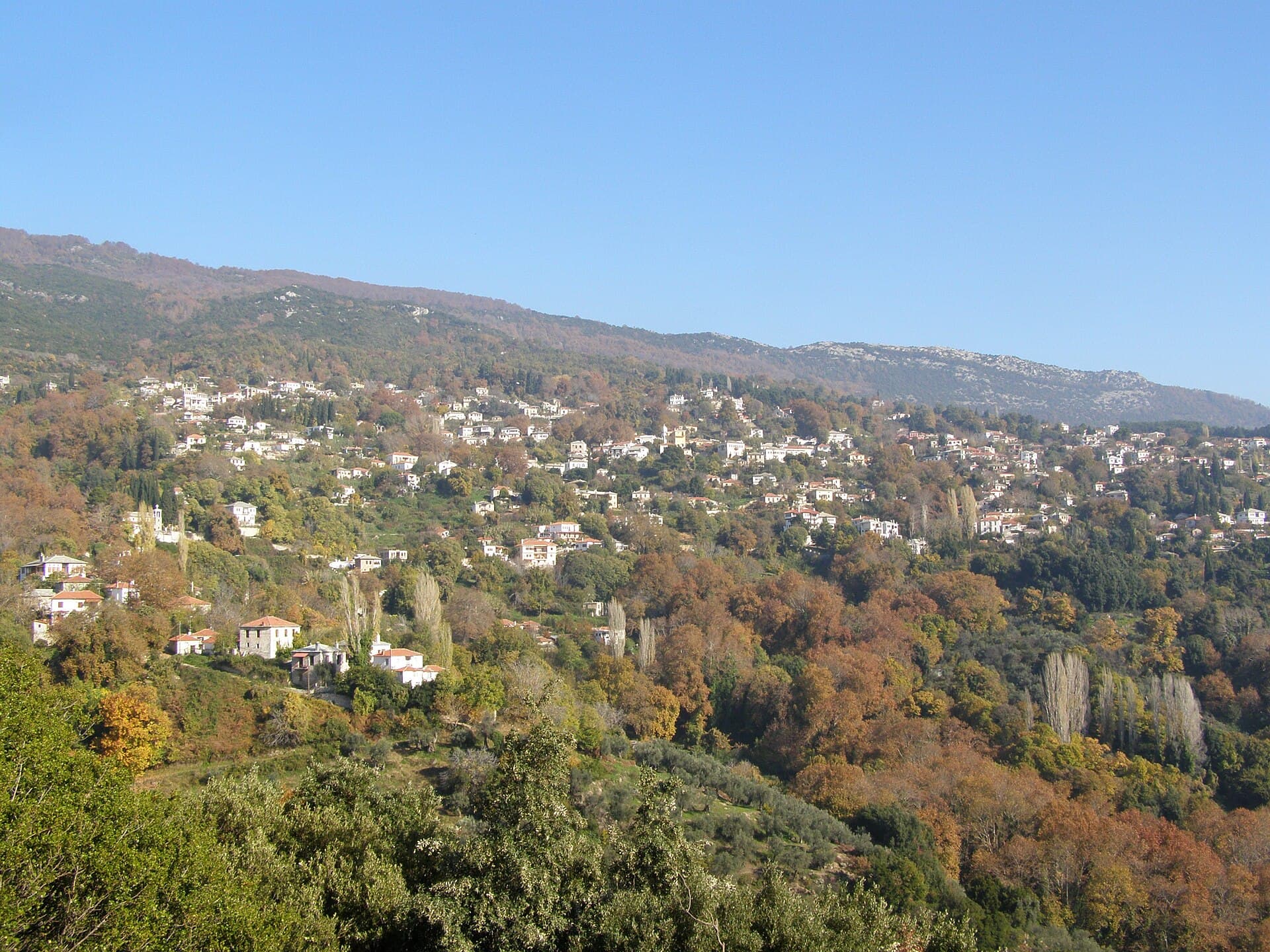
The restored mansions
Three-storey stone houses, many turned into guesthouses.
C messier — CC BY-SA 4.0 · Cosa2244 — CC BY-SA 4.0 · C messier — CC BY-SA 4.0 · C messier — CC BY-SA 4.0
**The quietest of the beautiful Pelion villages, and the one that kept most of its mansions** — on a wooded slope in the south of the mountain, and the calm alternative to crowded Makrinitsa. What distinguishes it is the **density of preserved Pelion mansions**: three-storey stone houses with wooden balconies and slab roofs, many of them **restored into guesthouses** — so you can genuinely sleep inside one, which is possible here more than in any other village. Its lanes are **stone-paved**, passing under arches and between gardens, and you barely hear a car. ✅ It is **surrounded by forest** — chestnut, oak and plane — so the air is humid, green and cool, the opposite of what you expect in Greece. ⚠ And it is **very small**: an hour or two covers it — its value is in staying rather than in a quick visit.
Three-storey stone houses, many turned into guesthouses.
Stone paths under arches and between gardens, free of cars.
Chestnut, oak and plane — a green you do not expect in Greece.
Vyzitsa, 37010 Magnesia, Greece
**Rainfall and orientation — the mountain works as a barrier that collects moisture.** ✅ **The geography**: **Pelion is a mountain range** running along a peninsula between the enclosed **Pagasetic Gulf** and the open **Aegean** — that is, **surrounded by water on two sides**. ✅ **The mechanism**: moist winds off the sea **hit the mountain and are forced up**, and rising air **cools and condenses** — **so rain falls on the slopes**. This is orographic rainfall, and it makes Pelion **one of the wettest regions in Greece**. ✅ **The botanical result**: **deciduous** forests — chestnut, oak, beech and plane — trees that need water and do not grow in the usual dry Greece; **so Pelion looks more like northern Europe than the Mediterranean**. ✅ **Snow falls in winter** and there is a ski centre. ⚠ **What that means for you**: **always carry an extra layer**, even in summer; **expect rain** in spring and autumn; and **the stone turns slippery** — these are not details but a change to what you pack.
**Yes if you want the region's real experience — and Vyzitsa is the best place for it.** ✅ **What it is**: many of the stone **Pelion mansions** in Vyzitsa, Milies and around them **have been restored into small guesthouses** — so you sleep in a two-hundred-year-old house with thick stone walls, a slab roof and a wooden balcony over the valley, **often with a wood fire** and a local breakfast. ✅ **Why Vyzitsa specifically**: because it **kept the largest number of these houses** and has the most restored, and it is **quiet**, unlike Makrinitsa. ⚠ **What to know before booking**: **the internal stairs are steep and narrow** (they are old houses) — ask if your knees are a problem; **rooms vary widely**, so read the description; **air conditioning may not exist** (though it is cool anyway); **luggage is sometimes carried up steps**; and **there is no cash machine in the village**. ⚠ **And book early**: there are very few, **and they fill at weekends, on holidays and in winter too**.