The bent gate
A narrow vaulted entrance designed to stop a cart or horse charging in.
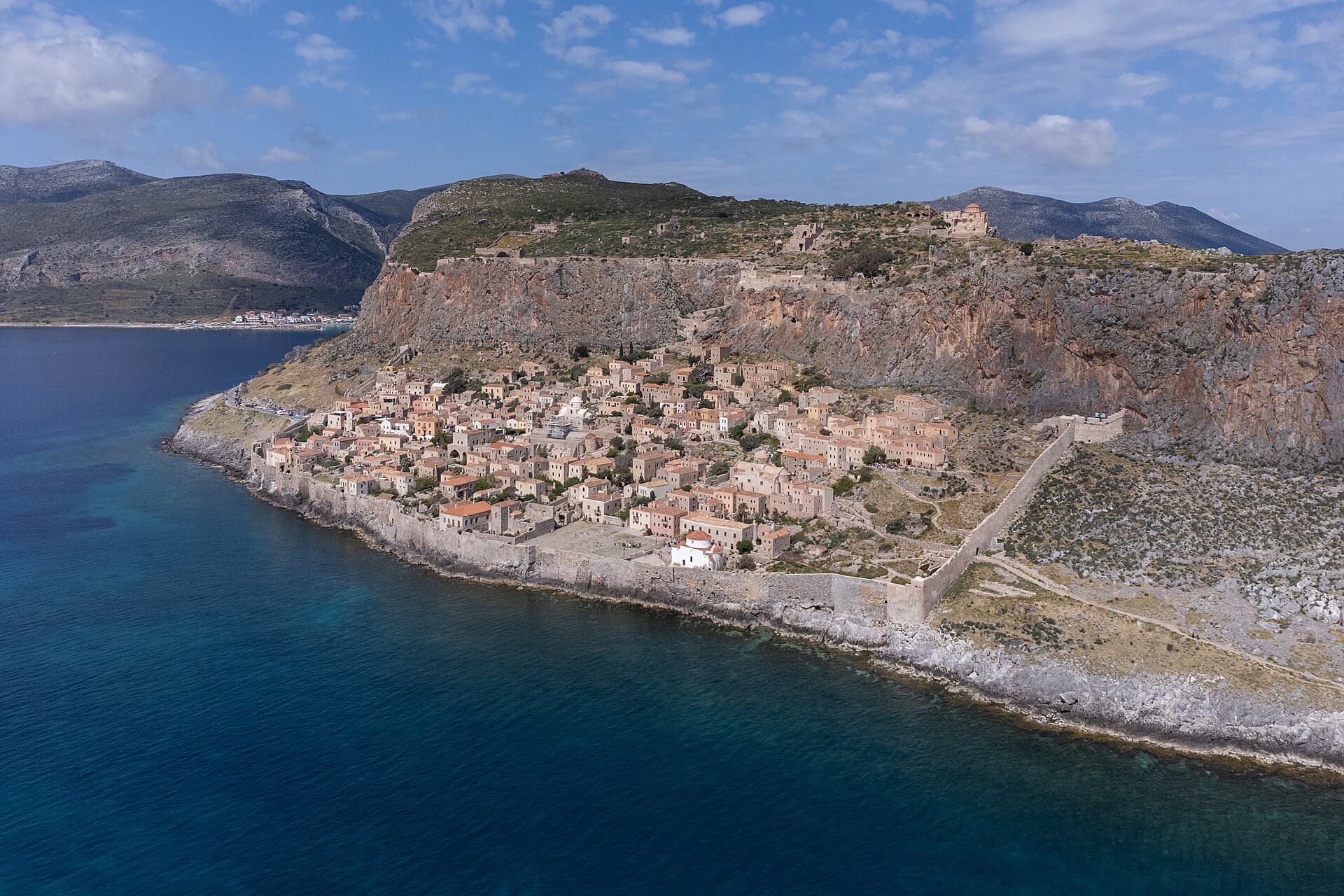
**A whole town hidden behind a rock, invisible until you walk round it** — and that is not a poetic description but an odd geographical fact. The rock is an enormous mass separated from the coast, joined to it by **a single causeway** — and the name comes from that crossing: **moni emvasis**, **"the only entrance"**. Cross the causeway and reach the rock and **you see no town**: only a stone wall and a small gate. The town is entirely **on the far side**, built on a slope facing the sea and completely screened from the land — which is what made it resistant to siege for centuries. You go in through a **bent vaulted gateway** too narrow for a cart, and a **complete Byzantine-Venetian town** opens in front of you: narrow stone lanes, tiled houses, churches, arches and bougainvillea — **and not a single car**. ✅ And it is **inhabited and carefully restored**, not a ruin.
A narrow vaulted entrance designed to stop a cart or horse charging in.
Car-free stone alleys between restored houses and bougainvillea.
Terraces directly above the water on the rock's far side.
Monemvasia, 23070 Lakonia, Greece
**Because it was deliberately built on the wrong face of the rock — a defensive decision, not an accident.** ✅ **The geography**: the rock is a mass roughly a kilometre and a half long rising some 300 metres, **separated from the coast** by a narrow channel a causeway crosses. The face towards land is a **near-vertical cliff**, unbuildable and unassailable. ✅ **So the town was built on the southeastern face** — the one looking at open sea — on a slope running down to the water. ✅ **The defensive result is twofold**: first, **an attacker coming from land sees nothing** to bombard or plan an assault against; second, **the only access is the causeway and then a single bent gate** too narrow for a cart — making a mass assault practically impossible. ✅ **And third**: the town stayed **connected to the sea**, so it could be supplied by ship during a land siege. ⚠ **Which is why it held out for centuries**, changing hands between Byzantines, Venetians and Ottomans **by long siege or negotiation rather than storm**.
**Inside the rock if you can bear the price and the steps — it is one of the finest nights in Greece.** ✅ **Inside the town** you get something rare: **the town after the day visitors leave**. The lanes empty completely after seven, dim lamps come on, and there is no sound but the sea. The hotels are **restored stone houses** with terraces above the water, and many are genuinely lovely. ⚠ **The price**: **clearly dearer**, **luggage carried by hand** up stone steps (ask the hotel about help before booking), **no car reaches your door**, and rooms are sometimes old and small. ✅ **Gefyra** — the mainland town at the causeway's end — is clearly cheaper, with parking, supermarkets, cash machines and a beach, **and you cross to the rock in a 15-minute walk**. ✅ **The rule**: one or two nights with a small bag → **inside the rock**. A family, heavy luggage, or a budget → **Gefyra**.