Agia Sofia
A domed church on the edge above a 300-metre drop to the sea.
C messier — CC BY-SA 4.0 · Jean Housen — CC BY-SA 4.0 · Jean Housen — CC BY-SA 4.0 · Jean Housen — CC BY-SA 4.0
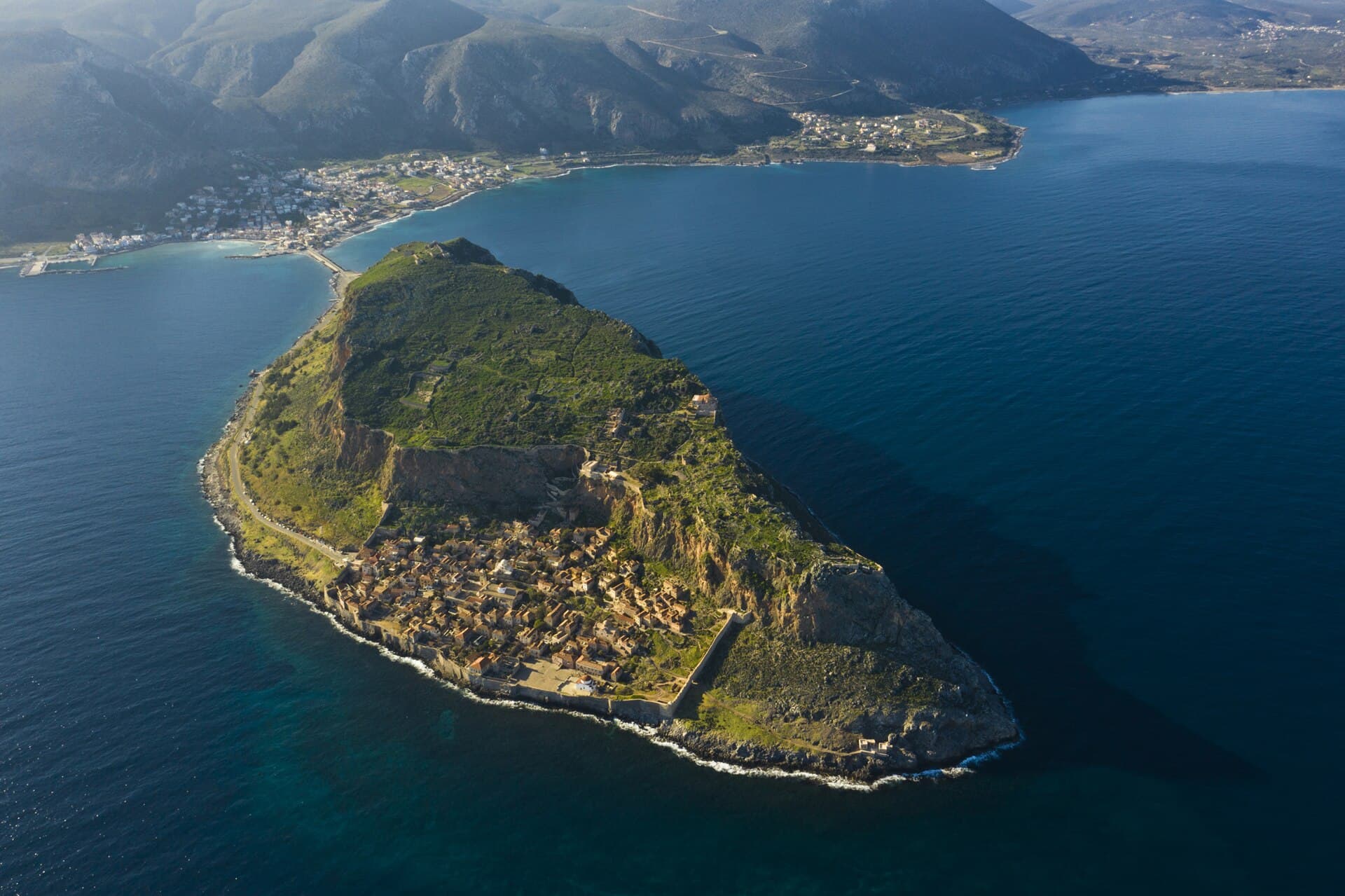
**A second complete town on top of the rock — but ruined this time** — and most visitors climb to it and then wish they had gone earlier. Monemvasia was **two towns**: the **lower**, which lives and is being restored today, and the **upper**, on the flat summit, where the ruling class and the garrisons were. The upper town was **completely abandoned** in the 19th century, so what remains is **foundations, cisterns and walls** on a wind-exposed plateau. What survives standing is the church of **Agia Sofia**: a domed Byzantine building of the **12th century**, **directly on the cliff edge** above a 300-metre drop to the sea. It served as a mosque under the Ottomans and was later returned to use as a church. ⚠ The climb is a **steep, exposed stone stair** of 20–30 minutes. ✅ And the view from the top: the entire lower town beneath you, and sea on three sides.
A domed church on the edge above a 300-metre drop to the sea.
The whole lower town beneath you and sea on three sides.
Cut water tanks that kept the upper town alive under siege.
Ano Poli, Monemvasia, 23070 Lakonia, Greece
**Yes — it is the best ninety minutes in Monemvasia, but not because of the ruins.** ⚠ **What you find up there**: **foundations, walls and cisterns** on an exposed plateau, with no explanation and no route — anyone climbing to see "a town" will find a field of stone. ✅ **What earns it**: **first the view** — the entire lower town beneath you with its tiled roofs and lanes, sea on three sides, and the coast running to the horizon; you cannot see that from anywhere else. **Second Agia Sofia** — a complete standing 12th-century church on a cliff edge, whose position alone is astonishing. **And third, understanding**: from the top you grasp at once **how this town worked** — why it never fell, and why it was built where it was. ⚠ **Who should not climb**: anyone with knee or breathing problems, anyone afraid of heights, anyone with very small children, and anyone arriving at midday in August.
**Because the reason for its existence disappeared — and living up there was hard work for nothing.** ✅ **Why it was inhabited at all**: the upper town was the **last refuge** — where the governor, the garrison and the notables would withdraw if the lower town were stormed. It had its own walls, cisterns and churches, and was lived in by those who needed the highest degree of safety. ✅ **What changed**: in the **19th century** the region settled under the modern Greek state and **the age of siege and piracy ended**. Nobody had a reason to endure life on an exposed summit any longer. ⚠ **And life there was genuinely hard**: **no running water** (everything came from rainwater in cisterns), **constant wind**, **no farmland**, and **everything carried up that stair**. ✅ **So people moved down, and then to the mainland**, and the upper town was left to the wind — ruins ever since.