The Lion Gate
A colossal lintel crowned by two facing lions for 3,300 years.
Andreas Trepte — CC BY-SA 2.5 · David Monniaux — CC BY-SA 3.0 · Gsimonov — Public domain · Gsimonov — Public domain
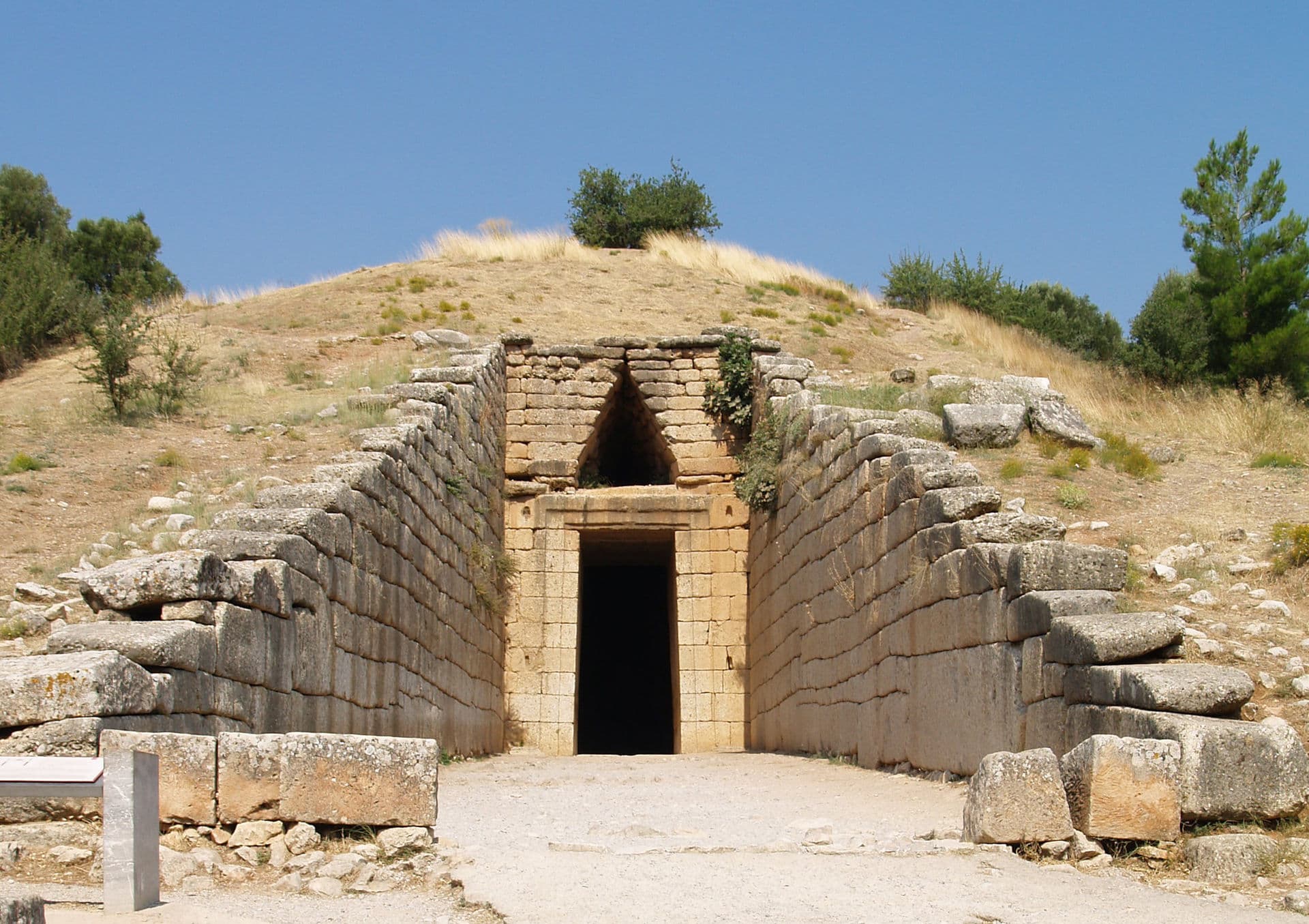
**The capital of the civilisation that preceded classical Greece by a thousand years** — a UNESCO World Heritage Site, 18 km from Nafplio. In the **13th century BC** Mycenae was a centre of power that dominated southern Greece and gave its name to a whole era: the **Mycenaean** civilisation. Homer made it the kingdom of **Agamemnon**, who led the Greeks to Troy. You enter through the **Lion Gate** — an enormous stone lintel surmounted by a carving of two facing lions, **the oldest monumental sculpture surviving in Europe**, still in its original place after 3,300 years. Behind it is **Grave Circle A**, where the gold **Mask of Agamemnon** was found (now in the Athens museum), and the path climbs to the **palace** on the summit and to the **secret cistern**, cut into the rock with a stair descending into total darkness. ⚠ The walls themselves are what the Greeks called **"Cyclopean"**: blocks so large they assumed only giants could have lifted them.
A colossal lintel crowned by two facing lions for 3,300 years.
Where the gold Mask of Agamemnon and the royal grave treasures were found.
A stair down through rock into total darkness to a protected water source.
Mykines, 21200 Argolida, Greece
**We do not know — the precise answer is that the city is real and the king unverified.** ✅ **What is established**: Mycenae **genuinely existed** and was a real centre of power in the 13th century BC, and its walls, palace and rich royal graves are in front of you. **Troy is also a real site** in Turkey, with destruction layers. ✅ **What is not established**: that a man called Agamemnon ruled from here and led an expedition against Troy. The **Iliad** was written down in the 8th century BC — **five centuries after** the period it describes — and it is poetry, not record. ⚠ **As for the "Mask of Agamemnon"**: it was named by **Heinrich Schliemann**, who excavated here in 1876 and announced that he had "gazed on the face of Agamemnon". The mask is **genuine and extraordinary**, but it dates to about **1550 BC** — three centuries **before** the supposed date of the Trojan War. The name is **Schliemann's label**, not an identification.
**Mycenae if you love history; Epidaurus if you love an experience.** ✅ **Mycenae** is the heavier and richer: the Lion Gate, the grave circle, the palace, the cistern, the Treasury of Atreus a minute away, and a museum that explains it all — **a full three hours**, and with it the sense of standing at the beginning of Greek history. ⚠ But it is **physically hard**: an exposed, shadeless slope. ✅ **Epidaurus** is one site with **one unforgettable moment**: you sit at the top of the theatre and hear an ordinary voice from the centre perfectly clearly — and people remember that longer than they remember any stone. **It is also easier physically**, with pine shade and a small museum. ✅ **The rule**: with children or in severe heat → Epidaurus. With an interest in history → Mycenae. ✅ And anyone with **two days** should take both, because they resemble each other in nothing.