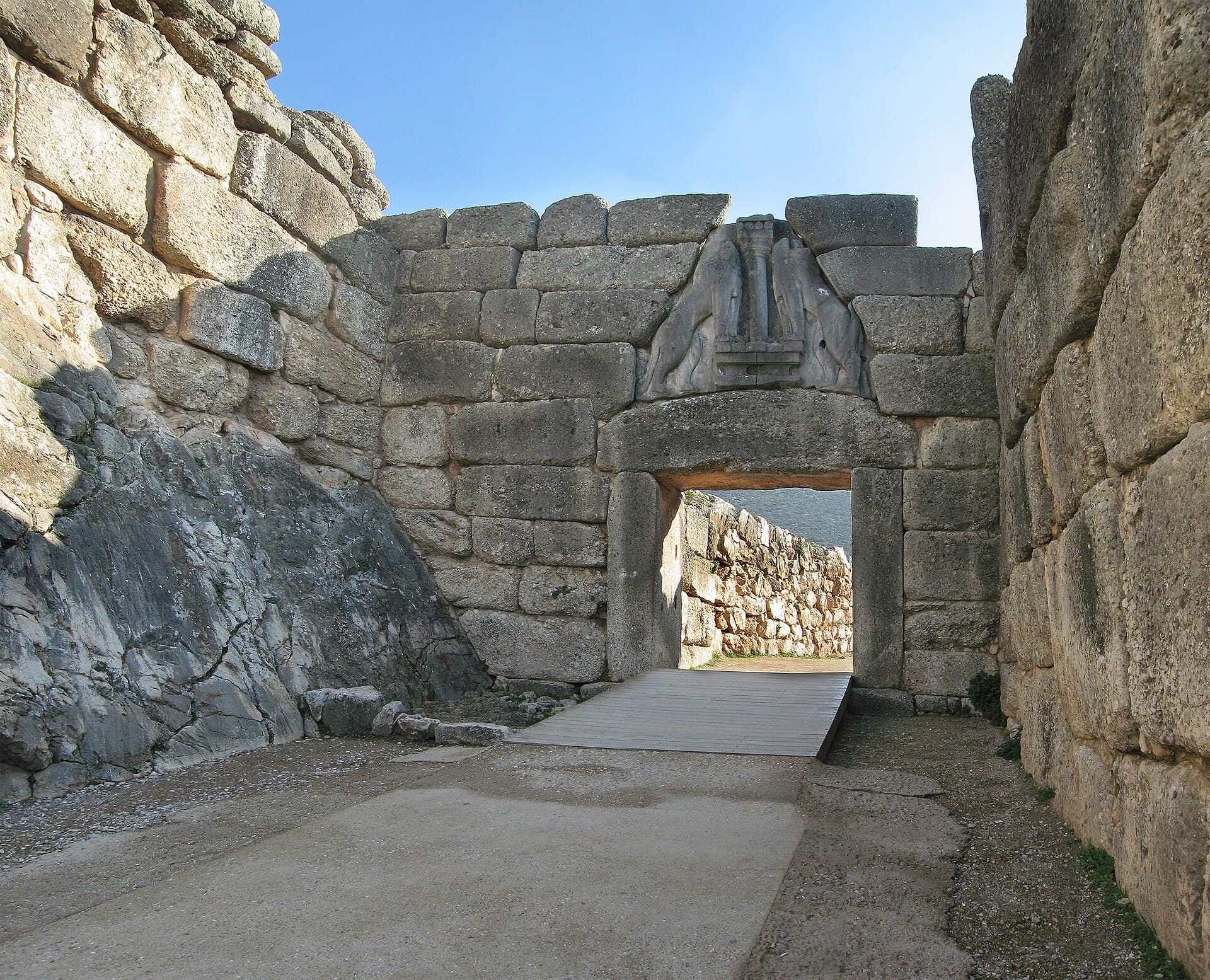
The giant lintel
A block of over a hundred tonnes above the door — an open engineering puzzle.
Ken Russell Salvador — CC BY 2.0 · Rijksmuseum — CC0 · Rijksmuseum — CC0 · Jean Housen — CC BY-SA 4.0
**A stone dome 3,300 years old that remained the largest in the world for over a thousand years** — a few hundred metres from the Lion Gate. Also called the **Tomb of Agamemnon**, it is a **tholos tomb**: you approach along an open **passage** (dromos) between two stone walls to a doorway crowned by **a single lintel weighing more than a hundred tonnes** — a block moved and raised without machinery, and how it was done remains an open question. Inside is a **circular chamber with a conical dome** about **13.5 m** high, built in corbelled courses, each ring stepping in over the one below until it closes at the top. It has stood **without structural restoration** since about **1250 BC**. ✅ And the impression it leaves is not only visual but **acoustic**: the chamber has a strange deep resonance — speak in it quietly and you will understand why. ⚠ It is **completely empty**: it was robbed in antiquity, so there is nothing inside but space and stone.
A block of over a hundred tonnes above the door — an open engineering puzzle.
Corbelled courses stepping in to close 13.5 m above you.
A strange deep echo — speak quietly at the centre and you hear it.
Mykines, 21200 Argolida, Greece
**There is no confirmed answer — it is one of the best-known open questions in ancient engineering.** ✅ **What we know**: the block is **real and in front of you**, estimated at more than **a hundred tonnes**, cut in a quarry, moved a distance and then **lifted into place** above the doorway. There were no compound pulleys and no cranes. ✅ **The hypotheses** include: **a massive earth ramp** built up to door height, the block dragged over it and the ramp then removed; **wooden sledges and rolling logs** with large numbers of workers and oxen; and **timber levers** raising the block incrementally with packing slid underneath. ⚠ **None of them is proven** — no inscription or drawing describes the operation, and the reconstructions rest on modern experiment. ✅ **What is worth pausing on**: this is not a civilisation that left us books — it left us **problems**, and this is one it has not let us solve.
**Because its entrance is separate and nothing at the roadside tells you what it is.** ⚠ **How it happens**: you drive from Nafplio towards Mycenae and pass a gate and small car park on your right about **500 m** before the main site — a small sign and nothing more. You carry on to the main site, spend two hours on the slope in the sun, come out tired, and drive back to Nafplio **without having entered the greatest standing structure of the Mycenaean world**. ✅ **The fix**: stop there **first, before the site** — your ticket covers it (ask), the visit is **20 minutes**, and it is **level with no steps**, so it costs you none of your energy. ✅ **A further reason for that order**: the coaches go to the main site first, so the Treasury is **empty early in the morning** — and it is a place whose value is only felt in silence.