The baptistery
A cross-shaped font among the earliest built in eastern Christianity.
rene boulay — CC BY-SA 3.0 · Olaf Tausch — CC BY 3.0 · Holger Uwe Schmitt — CC BY-SA 4.0 · Holger Uwe Schmitt — CC BY-SA 4.0
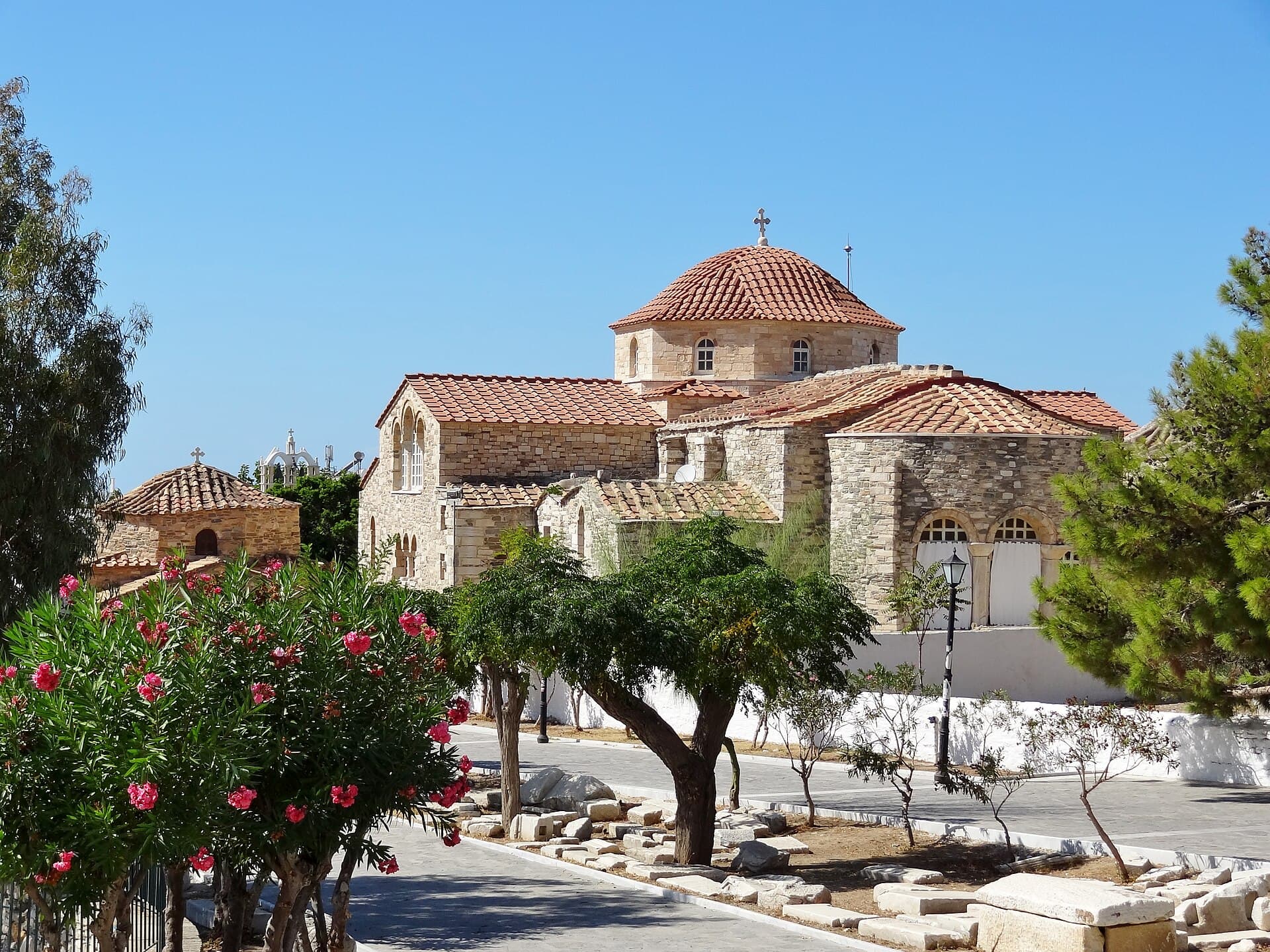
**The most important early Byzantine church in the Cyclades, and close to the oldest working church in Greece** — in the middle of Parikia, minutes from the ferry. Its name means **"of the hundred doors"**, ⚠ **a popular name rather than a count**: the story goes that it has 99 visible doors and a hundredth that **will appear when Constantinople is restored** — a tale born after 1453 and still told. Its foundation dates from the **4th century AD**, and tradition attributes it to **Helena**, mother of Constantine, on her way to the Holy Land. It was rebuilt in the **6th century** under **Justinian**. What distinguishes it architecturally is that it is **not one church but a complex**: the domed main church, a very early **baptistery** with a cross-shaped font — among the best surviving in the eastern Christian world — two small attached chapels, a courtyard and arcades. ✅ And it is built from the famous white **marble of Paros**.
A cross-shaped font among the earliest built in eastern Christianity.
The whole building in the island's famous white marble.
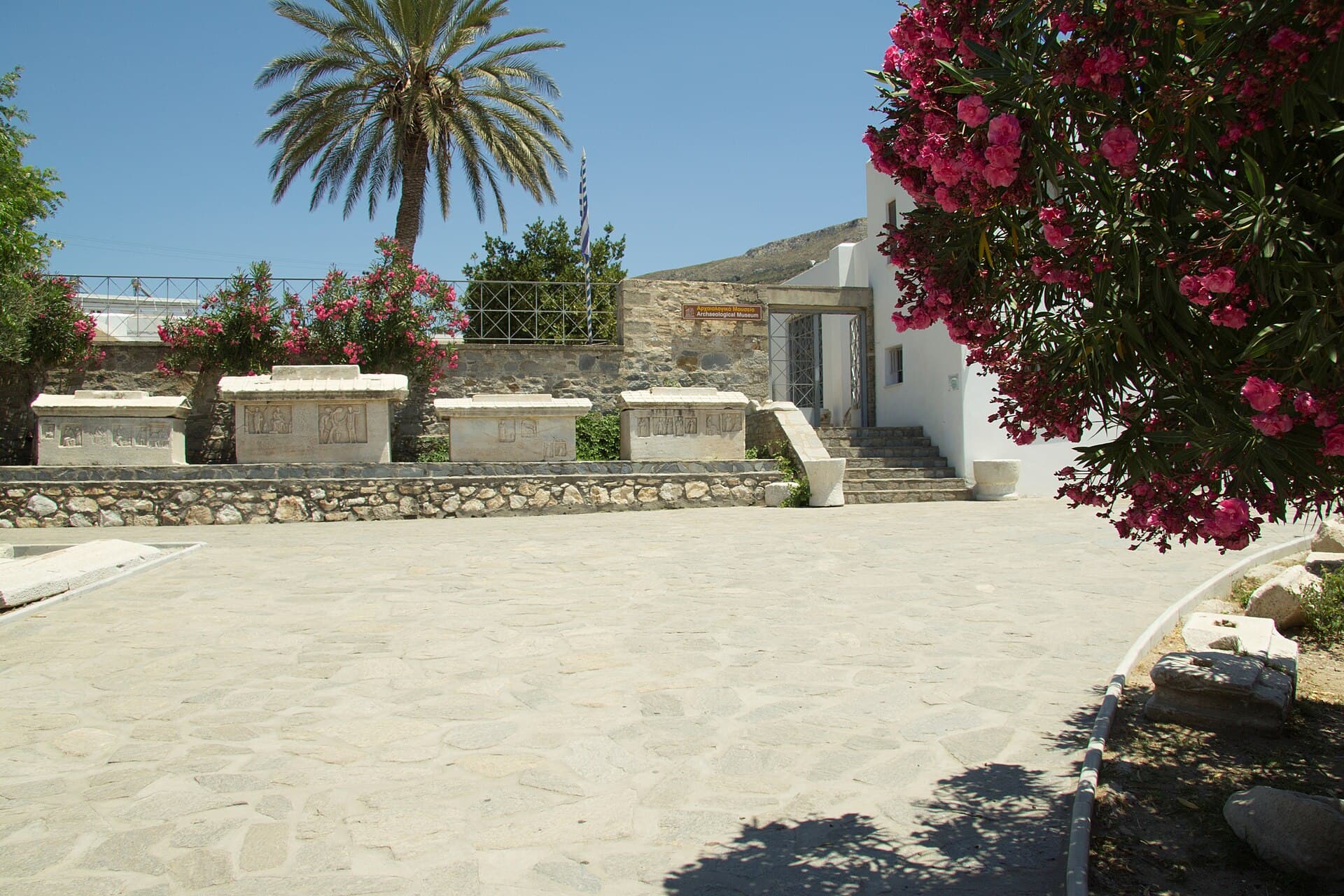
A quiet enclosure separating the church from the town's noise.
Parikia, 84400 Paros, Greece
**A popular name and a national legend — not an architectural count.** ✅ **The story told**: the church has **ninety-nine visible doors** and **a hidden hundredth** that will not be revealed **until Constantinople returns to the Greeks**. It arose after **the fall of Constantinople in 1453** and belongs to a whole family of Greek legends promising the city's recovery. ⚠ **It is not an architectural fact**: nobody has counted a hundred doors, and the name is most likely a **linguistic corruption** — the original is thought to be **Katapoliani**, «the one below the town» or something close, which was misheard and reshaped into *Ekatontapiliani*, «hundred-doored», because that sounded right and carried a meaning. ✅ **What is worth noticing**: the legend has **outlived the original name** — the church is known everywhere today by the popular one, and even the official signs use it. **Stories sometimes rename buildings.**
**Because it was the most valuable marble of the ancient world — and pieces you know were carved from it.** ✅ **What distinguishes it**: Parian marble — called **lychnites** — is **intensely white, fine-grained and semi-translucent**: light penetrates a few millimetres before reflecting, so **a figure carved from it seems lit from within**. No other marble gives that effect to the same degree, which is why it was preferred for faces and bodies. ✅ **What was carved from it**: some of the most famous survivals of antiquity — the **Winged Victory of Samothrace** and the **Venus de Milo** are both attributed to Parian marble — along with much Cycladic sculpture and the temples of Athens. ✅ **How it was quarried**: from **underground tunnels** at **Marathi** in the island's centre rather than open quarries, because the finest beds lay deep; the workers cut by lamplight, which is where the name *lychnites* comes from — **«quarried by lamp»**. ⚠ **The tunnels still exist near Marathi** but are **unmanaged and dangerous** — do not go in.